MCQ
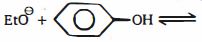
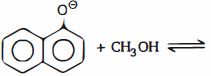
In the following acid-base reaction, in which can backward reaction if favoured?
  • A

  • B
    $KH + EtOH \rightleftharpoons$
  • C
    $Me_3 CO^{\circleddash} + H_2O \rightleftharpoons$
  • D

Answer

$(d)$ Acid base reaction favours weak acid & weak base.

Need a full question paper?

Generate a complete, print-ready paper with questions like this in minutes — across 16+ boards, with answer keys.

Start Generating Free

Similar questions

Octet rule is not valid for the molecule
Assertion : Energy of resonance hybrid is equal to the average of energies of all canonical forms.

Reason : Resonance hybrid cannot be presented by a single structure.

The ratio of $\sigma$- bond and $\pi$- bond in tetracyano ethylene is
The equilibrium constant for the reaction

$SO_3(g) \rightleftharpoons  SO_2(g)+ \frac{1}{2} O_2(g)$

is $K_c= 4.9 \times 10^{-2}.$ The value of $K_c$ for the reaction

$2SO_2(g) + O_2(g) \rightleftharpoons  2SO_3(g)$

will be

Reaction, ${H_2}(g) + {I_2}(g) \to 2HI(g)$ $\Delta H = - 12.40\,kcal$. According to this, the heat of formation of $ HI $ will be......$kcal$
Ammonia under a pressure of $15$ atm at $27\,^oC$ is heated to $347\,^oC$ in a closed vessel in the presence of a catalyst. Under the conditions, $N{H_3}$ is partially decomposed according to the equation, $2N{H_3}$ $\rightleftharpoons$ ${N_2} + 3{H_2}$.The vessel is such that the volume remains effectively constant where as pressure increases to $50$ $atm.$ Calculate the percentage of $N{H_3}$ actually decomposed........$\%$
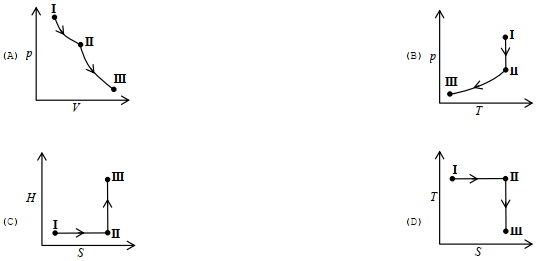
An ideal gas undergoes a reversible isothermal expansion from state $I$ to state $II$ followed by a reversible adiabatic expansion from state $II$ to state $III$. The correct plot($s$) representing the changes from state $I$ to state $III$ is(are)

( $p$ : pressure, $V$ : volume, $T$ : temperature, $H$ : enthalpy, $S$ : entropy)
The expression for the solubility product of $A{l_2}\,{(S{O_4})_3}$ is
Assign $A, B, C, D$ from given type of reaction. $N{a_2}{C_2}{O_4} + {H_2}S{O_4}\left( {conc.} \right) \longrightarrow N{a_2}S{O_4} + CO + C{O_2}$
"The properties of the elements are periodic function of their atomic numbers." The  statement was given by :-