MCQ
For the following gaseous reaction ${H_2} + {I_2}$ $\rightleftharpoons$ $2HI$, the equilibrium constant
  • A
    ${K_p} > {K_c}$
  • B
    ${K_p} < {K_c}$
  • ${K_p} = {K_c}$
  • D
    ${K_p} = 1/{K_c}$

Answer

Correct option: C.
${K_p} = {K_c}$
(c) If $\Delta n$$=0$ then ${K_p} = {K_c}$

Need a full question paper?

Generate a complete, print-ready paper with questions like this in minutes — across 16+ boards, with answer keys.

Start Generating Free

Similar questions

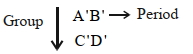
Consider the following elements.

Which of the following is/are true about $\mathrm{A}^{\prime}, \mathrm{B}^{\prime}, \mathrm{C}^{\prime}$ and $\mathrm{D}^{\prime}$ ?

$A$. Order of atomic radii: $\mathrm{B}^{\prime}<\mathrm{A}^{\prime}<\mathrm{D}^{\prime}<\mathrm{C}^{\prime}$

$B$. Order of metallic character: $\mathrm{B}^{\prime}<\mathrm{A}^{\prime}<\mathrm{D}^{\prime}<\mathrm{C}^{\prime}$

$C$. Size of the element : $\mathrm{D}^{\prime}<\mathrm{C}^{\prime}<\mathrm{B}^{\prime}<\mathrm{A}^{\prime}$

$D$. Order of ionic radii : $\mathrm{B}^{\prime+}<\mathrm{A}^{\prime+}<\mathrm{D}^{\prime+}<\mathrm{C}^{\prime+}$

Choose the correct answer from the options given below :
Last molecule of $\ce{H_2O}$ is evolved from $\ce{H_2​O_2}$​ by :
Determine the element if its ground state has $13$ electrons in its "$M-$ shell".
Which techniques is based on the difference in the solubilities of the compound and the impurities in a suitable solvent?
$56 \,g$ of nitrogen and $8 \,g$ hydrogen gas are heated in a closed vessel. At equilibrium $34\, g$ of ammonia are present. The equilibrium number of moles of nitrogen, hydrogen and ammonia are respectively
The radius of an atom is of the order of
Which of the following does not exist in free form
Which one of the following arrangements represents the correct order of electron gain enthalpy (with negative sign) of the given atomic species.
For which of the following processes, $\Delta S$  is negative?
If first orbit energy of $H{e^ + }$ is $-54.4 \,eV$, then the second orbit energy will be ............. $\mathrm{eV}$