MCQ
For the function

$f(x)=\sin x+3 x-\frac{2}{\pi}\left(x^2+x\right) \text {, where } x \in\left[0, \frac{\pi}{2}\right] \text {, }$

consider the following two statements :

($I$) $\mathrm{f}$ is increasing in $\left(0, \frac{\pi}{2}\right)$.

($II$) $\mathrm{f}^{\prime}$ is decreasing in $\left(0, \frac{\pi}{2}\right)$.

Between the above two statements,

  • A
    only ($I$) is true.
  • B
    only ($II$) is true.
  • C
    neither ($I$) nor ($II$) is true .
  • both ($I$) and ($II$) are true.

Answer

Correct option: D.
both ($I$) and ($II$) are true.
d
$ f(x)=\sin x+3 x-\frac{2}{\pi}\left(x^2+x\right) \quad x \in\left[0, \frac{\pi}{2}\right] $

$ \mathrm{f}^{\prime}(\mathrm{x})=\cos \mathrm{x}+3-\frac{2}{\pi}(2 \mathrm{x}+1)>0 \mathrm{f}(\mathrm{x}) \uparrow $

$ f^{\prime}(x)=-\sin x+0-\frac{\pi}{2}(2) $

$ =-\sin x-\frac{4}{\pi}<0 \quad f^{\prime}(x) \downarrow $

$ 0<\mathrm{x}<\frac{\pi}{2} $

$ \Rightarrow-\frac{2}{\pi}(\underset{+1}{0} \underset{+1}{0} \underset{+1}{2 x}<\pi) $

$ -\frac{2}{\pi}>\frac{-2}{\pi}(2 \mathrm{x}+1)>-\frac{2}{\pi}(\pi+1) $

$ 3-\frac{2}{\pi}>3-\frac{2}{\pi}(2 x+1)>3-\frac{2}{\pi}(\pi+1) $

Need a full question paper?

Generate a complete, print-ready paper with questions like this in minutes — across 16+ boards, with answer keys.

Start Generating Free

Similar questions

If $z = i\,\log \,(2 - \sqrt 3 ),$ then $\cos z = $
Let $X$ be the set consisting of the first $2018$ terms of the arithmetic progression $1,6,11$,

. . . .and $Y$ be set consisting of the first $2018$ terms of the arithmetic progression $9, 16, 23$,. . . . . Then, the number of elements in the set $X \cup Y$ is. . . . 

The system of equations $\lambda x + y + z = 0,$ $ - x + \lambda y + z = 0,$ $ - x - y + \lambda z = 0$, will have a non zero solution if real values of $\lambda $ are given by
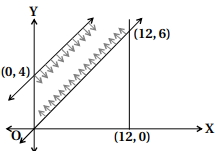
The feasible region for an $LPP$ is shown in the Figure. Let $z=3 x-4 y$ be the objective function.Minimum value of $Z$ is $....$
Let $f(x) = \frac{{x\,\,.\,\,{2^x}\,\, - \,\,x}}{{1\,\, - \,\,\cos \,x}} \& g(x) = 2^x sin \left( {\frac{{\ell n\,2}}{{{2^x}}}} \right)$ then :
${1 \over {x({x^2} + 1)}} = {A \over x} + {{Bx + C} \over {({x^2} + 1)}}$, then $(A,\,B,\,C) = $
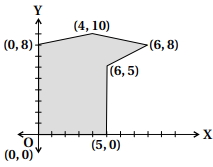
The feasible solution for a $LPP$ is shown in Figure Let $z=3 x-4 y$ be the objective function. Maximum of $Z$ occurs at $......$
Twelve tickets are numbered $1$ to $12$. One ticket is drawn at random, then the probability of the number to be divisible by $2$ or $3$, is
The $4^{\text {tht }}$ term of $GP$ is $500$ and its common ratio is $\frac{1}{m}, m \in N$. Let $S_n$ denote the sum of the first $n$ terms of this GP. If $S_6 > S_5+1$ and $S_7 < S_6+\frac{1}{2}$, then the number of possible values of $m$ is $..........$
The least value of the product $xyz$ for which the determinant $\left| {\begin{array}{*{20}{c}}
  x&1&1 \\ 
  1&y&1 \\ 
  1&1&z 
\end{array}} \right|$ is non-negative, is