MCQ
Two vectors $\vec A\,{\rm{ and }}\vec B$ are such that $\vec A + \vec B = \vec A - \vec B$. Then
  • A
    $\vec A\,.\,\vec B = 0$
  • B
    $\vec A \times \vec B = 0$
  • C
    $\vec A = 0$
  • $\overrightarrow B = 0$

Answer

Correct option: D.
$\overrightarrow B = 0$
d
$\vec{A}+\vec{B}=\vec{A}-\vec{B}$

$(\vec{A}-\vec{A})+\vec{B}+\vec{B}=0$

$0+2\vec{B}=0$

$\vec{B}=0$

Need a full question paper?

Generate a complete, print-ready paper with questions like this in minutes — across 16+ boards, with answer keys.
Start Generating Free

Similar questions

Two coherent sources of different intensities send waves which interfere. The ratio of maximum intensity to the minimum intensity is 25. The intensities of the sources are in the ratio:
  1. 25 : 1
  2. 5 : 1
  3. 9 : 4
  4. 625 : 1
The equation of state of a real gas is given by $\left(\mathrm{P}+\frac{\mathrm{a}}{\mathrm{V}^2}\right)(\mathrm{V}-\mathrm{b})=\mathrm{RT}$, where $\mathrm{P}, \mathrm{V}$ and $\mathrm{T}$ are pressure. volume and temperature respectively and $R$ is the universal gas constant. The dimensions of $\frac{a}{b^2}$ is similar to that of :
 Molecules of a ideal gas behave like:
The radiation emitted by a star $A$ is $10,000$ times that of the sun. If the surface temperatures of the sun and the star $A$ are $6000 K$ and $2000 K$ respectively, the ratio of the radii of the star $A$ and the sun is
The particles of a medium vibrate about their mean positions whenever a wave travels through that medium. The phase difference between the vibrations of two such particles
The temperature of $100 \,gm$ of water is to be raised from $24^{\circ} C$ to $90^{\circ} C$ by adding steam to it. The mass of the steam required for this purpose is ........... $g$
A body is initially at rest. It undergoes one-dimensional motion with constant acceleration. The power delivered to it at time t is proportional to:
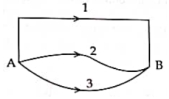
A gravitational field is present in a region and a mass is shifted from $A$ to $B$ through different paths as shown. If $W _1, W _2$ and $W _3$ represent the work done by the gravitational force along the respective paths, then
If Planck’s constant (h) and speed of light in vacuum (c) are taken as two fundamental quantities, which one of the following can, in addition, be taken to express length, mass and time in terms of the three chosen fundamental quantities?
  1. Mass of electron (me).
  2. Universal gravitational constant (G).
  3. Charge of electron (e).
  4. Mass of proton (mp).
A physical quantity $p$ is described by the relation $p\, = a^{1/2}\, b^2\, c^3\, d^{-4}$

If the relative errors in the measurement of $a, b, c$ and $d$ respectively, are $2\% , 1\%, 3\%$ and $5\%$, then the relative error in $P$ will be ........... $\%$