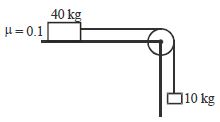
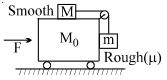
For the given figure find acceleration of $40\, kg$ block ........ $m/s^2$
Medium
Download our app for free and get started
$10\,g -40\, g \times 0.1 = 5000$

Download our appand get started for free
Experience the future of education. Simply download our apps or reach out to us for more information. Let's shape the future of learning together!No signup needed.*
Similar Questions
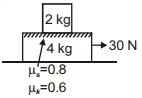
- 1Figure shows two block system, $4 \,kg$ block rests on a smooth horizontal surface, upper surface of $4 \,kg$ is rough. A block of mass $2 \,kg$ is placed on its upper surface. The acceleration of upper block with respect to earth when $4 \,kg$ mass is pulled by a force of $30 \,N$, is ......... $m / s ^2$View Solution
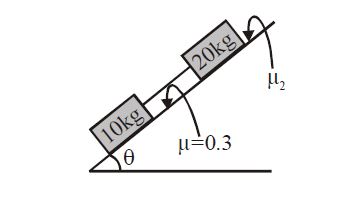
- 2Value of $\theta$ is increased gradually from $\theta = 0$ At $\theta=tan^{-1}(\frac{1}{2})$ both the block just start slipping. Then value of $\mu_2$ is : $(g = 10 m/s^2)$View Solution
- 3View SolutionA box is placed on an inclined plane and has to be pushed down. The angle of inclination is
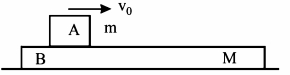
- 4A sphere of mass $m$ is set in motion with initial velocity $v_o$ on a surface on which $kx^n$ is the frictional force with $k$ and $n$ as the constants and $x$ as the distance from the point of start. Find the distance in which sphere will stopView Solution
- 5Imagine $a$ situation in which the horizontal surface of block $M_0$ is smooth and its vertical surface is rough with $a$ coefficient of friction $\mu$ Identify the correct statement $(s)$View Solution
- 6A $2 \mathrm{~kg}$ brick begins to slide over a surface which is inclined at an angle of $45^{\circ}$ with respect to horizontal axis. The co-efficient of static friction between their surfaces is:View Solution
- 7A block slides down on an inclined surface of inclination $30^o$ with the horizontal. Starting from rest it covers $8\, meter$ in the first two seconds. The coefficient of friction is $(g = 10\, ms^{-2})$View Solution
- 8$A$ block of mass $M$ is placed on $a$ horizontal surface and it is tied with an inextensible string to $a$ block of mass, as shown in figure. A block of mass $m_0$ is also placed on $M$ If friction force exists between the block $M$ and the block $m_0$ and not between the block $M$ and the horizontal surface, then the minimum value of $\mu$ for which the block m remains stationary isView Solution

- 9A rope of length $L$ and mass $M$ is being pulled on a rough horizontal floor by a constant horizontal force $F$ = $Mg$ . The force is acting at one end of the rope in the same direction as the length of the rope. The coefficient of kinetic friction between rope and floor is $1/2$ . Then, the tension at the midpoint of the rope isView Solution
- 10The masses of blocks A and B are $m$ and $M$ respectively. Between $A$ and $B$, there is a constant frictional force $F$ and $B$ can slide on a smooth horizontal surface. A is set in motion with velocity while $B$ is at rest. What is the distance moved by A relative to $B$ before they move with the same velocity?View Solution