MCQ
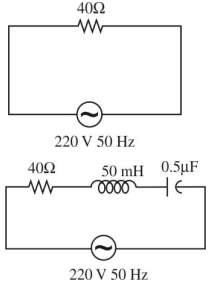
For the given figures, choose the correct options:
  • The rms current in circuit $(b)$ can never be larger than that in $(a)$
  • B
    The rms current in figure $(a)$ is always equal to that in figure $(b)$
  • C
    The rms current in circuit $(b)$ can be larger than that in $(a)$
  • D
    At resonance, current in $(b)$ is less than that in $(a)$
Answer

Correct option: A.
The rms current in circuit $(b)$ can never be larger than that in $(a)$
a
$I _{ rms }=\frac{220}{40}=5.5\,A$

$X _{ L }$ is not equal to $X _{ C }$. So rms current in $(b)$ can never be larger than $(a)$.

Need a full question paper?

Generate a complete, print-ready paper with questions like this in minutes — across 16+ boards, with answer keys.

Start Generating Free

Similar questions

A position dependent force $F = 7 - 2x + 3{x^2}\,newton$ acts on a small body of mass $2\, kg$ and displaces it from $x = 0$ to $x = 5\,m$. The work done in joules is
A cylinder of capacity $20$ litres is filled with ${H_2}$ gas. The total average kinetic energy of translatory motion of its molecules is $1.5 \times {10^5}\,J$. The pressure of hydrogen in the cylinder is
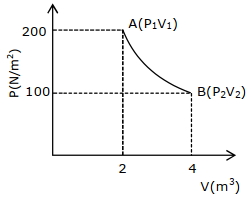
One mole of an ideal gas at $27^{\circ} {C}$ is taken from ${A}$ to ${B}$ as shown in the given ${PV}$ indicator diagram. The work done by the system will be $......\times 10^{-1} \,{J}$

[Given : $R=8.3\, {J} /\,mole\,{K}, \ln 2=0.6931$ ] (Round off to the nearest integer)

Two bulbs of $(40 \;W, 200\; V)$ and $(100\; W, 200 \;V)$. Then correct relation for their resistance
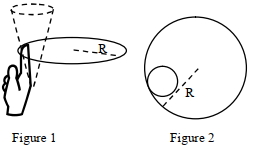
One twirls a circular ring (of mass $M$ and radius $R$ ) near the tip of one's finger as shown in Figure $1$ . In the process the finger never loses contact with the inner rim of the ring. The finger traces out the surface of a cone, shown by the dotted line. The radius of the path traced out by the point where the ring and the finger is in contact is $\mathrm{r}$. The finger rotates with an angular velocity $\omega_0$. The rotating ring rolls without slipping on the outside of a smaller circle described by the point where the ring and the finger is in contact (Figure $2$). The coefficient of friction between the ring and the finger is $\mu$ and the acceleration due to gravity is $g$.

(IMAGE)

($1$) The total kinetic energy of the ring is

$[A]$ $\mathrm{M} \omega_0^2 \mathrm{R}^2$   $[B]$ $\frac{1}{2} \mathrm{M} \omega_0^2(\mathrm{R}-\mathrm{r})^2$   $[C]$ $\mathrm{M \omega}_0^2(\mathrm{R}-\mathrm{r})^2$   $[D]$ $\frac{3}{2} \mathrm{M} \omega_0^2(\mathrm{R}-\mathrm{r})^2$

($2$) The minimum value of $\omega_0$ below which the ring will drop down is

$[A]$ $\sqrt{\frac{g}{\mu(R-r)}}$  $[B]$ $\sqrt{\frac{2 g}{\mu(R-r)}}$  $[C]$ $\sqrt{\frac{3 g}{2 \mu(R-r)}}$    $[D]$ $\sqrt{\frac{g}{2 \mu(R-r)}}$

Givin the answer quetion ($1$) and ($2$)

The dimensions of $RC$ is

($C$ and $R$ represent capacitance and resistance respectively)

A charge $q$ is located at the centre of a cube. The electric flux through any face is
A cricketer can throw a ball to maximum horizontal distance of $100\,m$ . With the same speed how much high above the ground can the cricketer throw the same ball   ......... $m$
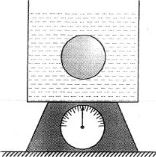
A container of mass $M$ containing liquid of mass $m_0$ is kept on weighing machine. A ball of mass $m$ is released from rest from given position. Then choose correct option just after ball is released
Considering the Bohr model of hydrogen like atoms, the ratio of the ratio of the radius $5^{\text {th }}$ orbit of the electron in $\mathrm{Li}^{2+}$ and $\mathrm{He}^{+}$is