MCQ
For the given figures, choose the correct options:
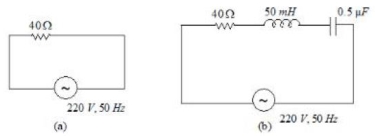
  • The rms current in circuit $(b)$ can never be larger than that in $(a)$
  • B
    The rms current in figure $(a)$ is always equal to that in figure $(b)$
  • C
    The rms current in circuit $(b)$ can be larger than that in $(a)$
  • D
    At resonance, current in $(b)$ is less than that in $(a)$
Answer

Correct option: A.
The rms current in circuit $(b)$ can never be larger than that in $(a)$
a
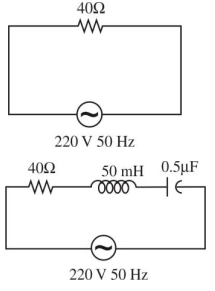
$I _{ rms }=\frac{220}{40}=5.5\,A$

$X _{ L }$ is not equal to $X _{ C }$. So rms current in $(b)$ can never be larger than $(a)$.

Need a full question paper?

Generate a complete, print-ready paper with questions like this in minutes — across 16+ boards, with answer keys.

Start Generating Free

Similar questions

A small bar magnet A oscillates in a horizontal plane with a period $T$ at a place where the angle of dip is $60^o$. When the same needle is made to oscillate in a vertical plane coinciding with the magnetic meridian, its period will be
A proton and an alpha particle of the same enter in a uniform magnetic field which is acting perpendicular to their direction of motion. The ratio of the circular paths described by the alpha particle and proton is ....
A particle of mass $m$ and charge $q$ is in an electric and magnetic field given by

$\vec E = 2\hat i + 3\hat j ;\, B = 4\hat j + 6\hat k$

The charged particle is shifted from the origin to the point $P(x = 1 ;\, y = 1)$ along a straight path. The magnitude of the total work done is

The half life of polonium is $140\, days$. After how many days, $16 \,gm$ polonium will be reduced to $1 \,gm$ .........$days$(or $15\,g$ will decay)
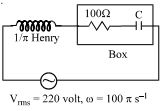
In the circuit, as shown in the figure, if the value of $R.M.S$ current is $2.2$ ampere, the power factor of the box is 
The resolving power of an astronomical telescope is $0.2$ seconds. If the central half portion of the objective lens is covered, the resolving power will be......$sec$
An electric dipole is kept in non-uniform electric field. It experiences
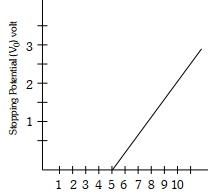
The variation of stopping potential $\left(V_0\right)$ as a function of the frequency $(\nu)$ of the incident light for a metal is shown in figure. The work function of the surface is $...........\,eV$
A horse-shoe magnet is an example of $.......$
Due to the flow of current in a circular loop of radius $R$, the magnetic field produced at the centre of the loop is $B$. The manetic moment of the loop is