MCQ
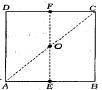
For the given uniform square lamina $ABCD$ , whose centre is $O$,
  • A
    $I_{AC}$ =$\sqrt 2 $$I_{EF}$
  • B
    $\sqrt 2 $$I_{AC}=I_{EF}$
  • C
    $I_{AO}=3I_{EF}$
  • $I_{AC}=I_{EF}$

Answer

Correct option: D.
$I_{AC}=I_{EF}$
d
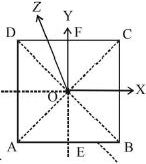
By the theorem of perpendicular axes,

${I_z} = {I_x} + {I_y}\,\,\,\,\,\,\,\,\,\,\,\,\,\,\,\,\,\,or,\,\,{I_z} = 2{I_y}$

$\begin{array}{l}
\left( {\,{I_x} = {I_y}\,by\,symmetry\,of\,the\,figure} \right)\\
\therefore \,{I_{EF}} = \frac{{{I_z}}}{2}\,\,\,\,\,\,\,\,\,\,\,\,\,\,\,\,\,\,\,\,\,\,\,\,\,\,\,\,\,\,\,\,\,\,\,\,\,...\left( i \right)
\end{array}$

Again, by the same theorem

$\begin{array}{l}
{I_z} = {I_{AC}} + {I_{BD}} = 2{I_{AC}}\\
\left( {\therefore \,{I_{AC}} = {I_{BD}}\,by\,symmetry\,of\,the\,figure} \right)\\
\,\,\,\,\,\,\,\,\,\,\,\,\,\,\,\therefore \,{I_{AC}} = \frac{{{I_z}}}{2}\,\,\,\,\,\,\,\,\,\,\,\,\,\,\,\,\,\,...\left( {ii} \right)
\end{array}$

    From $(i)$ and $(ii)$, we get ${I_{EF}} = {I_{AC}}$
Need a full question paper?

Generate a complete, print-ready paper with questions like this in minutes — across 16+ boards, with answer keys.

Start Generating Free

Similar questions

The pressure and temperature of two different gases is $P$ and $T$ having the volume $V$ for each. They are mixed keeping the same volume and temperature, the pressure of the mixture will be
An iron needle slowly placed on the surface of water floats because
The acceleration of a moving object can be determined by:
If pressure $P$, velocity $V$ and time $T$ are taken as fundamental physical quantities, the dimensional formula of force is
A gas is contained in a metallic cylinder fitted with a piston. The piston is suddenly moved in to compress the gas and is maintained at this position. As time passes the pressure of the gas in the cylinder:
A stick has its bottom end attached to a wall by a pivot and is held up by a massless string attached to its other end. Which of the following scenarios has the smallest tension in the string ? (Length of stick is same in all scenarios)
Find angle between $\vec A = 3\hat i - \hat j + 4\hat k$ and $Z-$ axis
A train is moving towards east and a car is along north, both with same speed. The observed direction of car to the passenger in the train is
A is the fundamental quantity. Here, $A$ refers to:
Two identical blocks $A$ and $B$, each of mass $'m'$  resting on smooth floor are connected by a light spring of natural length $L$ and spring constant $K$, with the spring at its natural length. $A$ third identical block $'C'$ (mass $m$) moving with a speed $v$ along the line joining $A$ and $B$ collides with $A$. the maximum compression in the spring is