MCQ
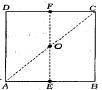
For the given uniform square lamina $ABCD$ , whose centre is $O$,
  • A
    $I_{AC}$ =$\sqrt 2 $$I_{EF}$
  • B
    $\sqrt 2 $$I_{AC}=I_{EF}$
  • C
    $I_{AO}=3I_{EF}$
  • $I_{AC}=I_{EF}$

Answer

Correct option: D.
$I_{AC}=I_{EF}$
d
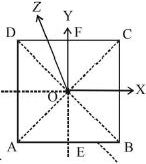
By the theorem of perpendicular axes,

${I_z} = {I_x} + {I_y}\,\,\,\,\,\,\,\,\,\,\,\,\,\,\,\,\,\,or,\,\,{I_z} = 2{I_y}$

$\begin{array}{l}
\left( {\,{I_x} = {I_y}\,by\,symmetry\,of\,the\,figure} \right)\\
\therefore \,{I_{EF}} = \frac{{{I_z}}}{2}\,\,\,\,\,\,\,\,\,\,\,\,\,\,\,\,\,\,\,\,\,\,\,\,\,\,\,\,\,\,\,\,\,\,\,\,\,...\left( i \right)
\end{array}$

Again, by the same theorem

$\begin{array}{l}
{I_z} = {I_{AC}} + {I_{BD}} = 2{I_{AC}}\\
\left( {\therefore \,{I_{AC}} = {I_{BD}}\,by\,symmetry\,of\,the\,figure} \right)\\
\,\,\,\,\,\,\,\,\,\,\,\,\,\,\,\therefore \,{I_{AC}} = \frac{{{I_z}}}{2}\,\,\,\,\,\,\,\,\,\,\,\,\,\,\,\,\,\,...\left( {ii} \right)
\end{array}$

    From $(i)$ and $(ii)$, we get ${I_{EF}} = {I_{AC}}$
Need a full question paper?

Generate a complete, print-ready paper with questions like this in minutes — across 16+ boards, with answer keys.

Start Generating Free

Similar questions

The instantaneous displacement of an oscillating spring is $y=5 \sin \left(0.2 \pi t+\frac{\pi}{2}\right) m$ its period of oscillations is :
The equation of motion of a projectile is:   $y = 12x - \frac{5}{9}{x^2}$. The horizontal component of velocity is $3\ ms^{- 1}$ . Given that $g = 10\ ms^{- 2}$ , .......... $m$ is the range of the projectile .
Consider a point $P$ on the circumference of a disc rolling along a horizontal surface. If $R$ is the radius of the disc, the distance through which $P$ moves in one full rotation of the disc  is:
Which of the following is not a dimensionless quantity?
If the temperature of the sun (black body) is doubled, the rate of energy received on earth will be increased by a factor of
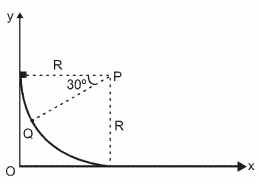
$40 \ m$. The block slides along the track without toppling and a frictional force acts on it in the direction opposite to the instantaneous velocity. The work done in overcoming the friction up to the point $Q$, as shown in the figure below, is $150 \ J$. (Take the acceleration due to gravity, $g =10 \ m s ^{-2}$ )

$1.$ The speed of the block when it reaches the point $Q$ is :

$(A)$ $5 \ ms ^{-1}$ $(B)$ $10 \ ms ^{-1}$$(C)$ $10 \sqrt{3} \ ms ^{-1}$ $(D)$ $20 \ ms ^{-1}$

$2.$ The magnitude of the normal reaction that acts on the block at the point $Q$ is :

$(A)$ $7.5 \ N$ $(B)$ $8.6 \ N$ $(C)$ $11.5 \ N$ $(D)$ $22.5 \ N$

Give the answer question $1$ and $2.$

A heavy box of $40\, kg$ is pushed along $20\, m$ by two coolies over a railway platform  whose coefficient of friction with the box is $0.4.$ The work done by two coolies is :- .................. $\mathrm{J}$
Out of the two cars $A$ and $B$, car $A$ is moving towards east with a velocity of $10 \,m / s$ whereas $B$ is moving towards north with a velocity $20 \,m / s$, then velocity of A w.r.t. $B$ is ......... $m / s$ (nearly)
In the reported figure, two bodies $A$ and $B$ of masses $200\, {g}$ and $800\, {g}$ are attached with the system of springs. Springs are kept in a stretched position with some extension when the system is released. The horizontal surface is assumed to be frictionless. The angular frequency will be $.....\,{rad} / {s}$ when ${k}=20 \,{N} / {m} .$
A uniformly thick wheel with moment of inertia $I$ and radius $R$ is free to rotate about its centre of mass (see fig). A massless string is wrapped over its rim and two blocks of masses $\mathrm{m}_{1}$ and $\mathrm{m}_{2}\left(\mathrm{m}_{1}>\mathrm{m}_{2}\right)$ are attached to the ends of the string. The system is released from rest. The angular speed of the wheel when $\mathrm{m}_{1}$ descents by a distance $h$ is