MCQ
Which of the following is not a dimensionless quantity?
  • A
    Relative magnetic permeability $\left(\mu_{{r}}\right)$
  • B
    Power factor
  • Permeability of free space $\left(\mu_{0}\right)$
  • D
    Quality factor

Answer

Correct option: C.
Permeability of free space $\left(\mu_{0}\right)$
c
$\left[\mu_{{}}\right]=1 \text { as } \mu_{{r}}=\frac{\mu}{\mu_{{m}}}$

[power factor $(\cos \phi)]=1$

$\mu_T{0}=\frac{{B}_{0}}{{H}}\left(\right.$ unit $\left.={NA}^{-2}\right)$ : Not dimensionless

$\left[\mu_{0}\right]=\left[{MLT}^{-2} {A}^{-2}\right]$

quality factor (Q) $=\frac{\text { Energystored }}{\text { Energy dissipated per cycle }}$

So $Q$ is unitless $\&$ dimensionless.

Need a full question paper?

Generate a complete, print-ready paper with questions like this in minutes — across 16+ boards, with answer keys.

Start Generating Free

Similar questions

Two objects A and B are thrown upward simultaneously with the same speed. The mass of A is greater than the mass of B. Suppose the air exerts a constant and equal force of resistance on the two bodies:
  1. The two bodies will reach the same height.
  2. A will go higher than B.
  3. B will go higher than A.
  4. Any of the above three may happen depending on the speed with which the objects are thrown.
A small sphere of mass $m$ is dropped from a great height. After it has fallen $100\; m$ , it has attained its terminal velocity and continues to fall at that speed. The work done by air friction against the sphere during the first $ 100 \;m $ of fall is
$Assertion$ : Velocity-time graph for an object in uniform motion along a straight path is a straight line parallel to the time axis.

$Reason$ : In uniform motion of an object velocity increases as the square of time elapsed.
Four identical rods of same material are joined end to end to form a square. If the temperature difference between the ends of a diagonal is ${100^o}C$, then the temperature difference between the ends of other diagonal will be ........ $^oC$
In a semiconductor:
  1. There are no free electrons at 0K.
  2. There are no free electrons at any temperature.
  3. The number of free electrons increases with temperature.
  4. The number of free electrons is less than that in a conductor.
A simple pendulum is set up in a trolley which moves to the right with an acceleration a on a horizontal plane. Then the thread of the pendulum in the mean position makes an angle $\theta $ with the vertical
The dimensions of power are
If the Earth stops rotating on its axis, then the value of g at the equator will be:
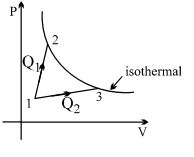
A gas takes part in two processes in which it is heated from the same initial state $1$ to the same final temperature. The processes are shown on the $P-V$ diagram by the straight line $1-2$ and $1-3$. $2$ and $3$ are the points on the same isothermal curve. $Q_1$ and $Q_2$ are the heat transfer along the two processes. Then
Water is moving with a speed of $5.0\,m/s$ through a pipe of cross sectional area $4.0\,cm^2$ . The water gradually descends $10\,m$ as the pipe increase in area to $8.0\,cm^2$ . If the pressure at the upper level is $1.5 \times 10^5\,Pa$ , the pressure at lower level will be