MCQ
For the linear programming problem $\text{(LPP),}$ the objective function is $Z= 4x+3y$ and the feasible region determined by a set of constraints is shown in the graph:
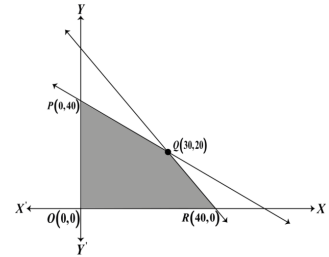
Image
Which of the following statements is true?
  • A
    Maximum value of $Z$ is at $R(40, 0)$
  • Maximum value of $Z$ is at $Q(30, 20)$
  • C
    Value of $Z$ at $R(40, 0)$ is less than the value at $P(0,40)$
  • D
    The value of $Z$ at $Q(30, 20)$ is less than the value at $R(40, 0)$

Answer

Correct option: B.
Maximum value of $Z$ is at $Q(30, 20)$
Corner point Value of the objective function $Z = 4x + 3y$
$1. O(0, 0)$ $z = 0$
$2. R(40, 0)$ $z = 160$
$3. Q(30,20)$ $z = 120 + 60 = 180$
$4. P(0,40)$ $z = 120$
Since, the feasible region is bounded so the maximum value of the objective function $z = 180$ is at $Q(30, 20)$

Need a full question paper?

Generate a complete, print-ready paper with questions like this in minutes — across 16+ boards, with answer keys.

Start Generating Free

Similar questions

If $\text{y}=\text{a}+\text{bx}^2,\text{a,b}$ arbitrary constants, then
Three concurrent edges $ OA, OB, OC$  of a parallelopiped are represented by three vectors $2i + j - k,\,\,i + 2j + 3k$ and $ - 3i - j + k,$ the volume of the solid so formed in cubic unit is
A Linear Programming Problem is as follows:
Maximize/Minimize objective function $Z = 2x - y +5$
Subject to the constraints
$3 x+4 y \leq 60$
$x+3 y \leq 30$
$x \leq 0, y \geq 0$
In the corner points of the feasible region are $A(0, 10), B(12, 6), C(20, 0)$ and $O(0,0),$ then which of the following is true?
Out of $30$ consecutive integers$, 2$ are chosen at random. The probability that their sum is odd, is
Let $A$ be a $2 \times 2$ matrix with real entries. Let $I$ be the $2 \times 2$ identity matrix. Denote by $tr(A),$ the sum of diagonal entries of $a$. Assume that ${A^2} = I$ .

Statement $-1 :$ If $A \ne I,A \ne - I$ then $\det \left( A \right) = - 1$

Statement $-2 :$ If $A \ne I,A \ne - I$ then ${\rm{tr}}\left( A \right) \ne 0$

$2\cos^{-1}\text{x}=\sin^{-1}(2\text{x}\sqrt{1-\text{x}^2})$ is true for:
If A and B are two independent events with $\text{P(A)}=\frac{1}{3}$ and $\text{P(B)}=\frac{1}{4},$ then P(B'|A) is equal to:
If $\text{A}=\begin{bmatrix}a^2 &\text{amp; ab}&\text{amp; ac} \\\text{ab}&\text{amp; }\text{b}^2&\text{amp;}\text{ bc}\\\text{ac}&\text{amp;}\text{bc}&\text{amp;}\text{c}^2 \end{bmatrix}$and $\text{a}^2+\text{b}^2+\text{c}^3=1$ then $\text{A}^2=$
The maximum volume (in $cu.m$) of the right circular cone having slant height $3\, m$ is
Let $f$ be an injective map with domain $\{x, y, z\}$ and range $\{1, 2, 3\}$, such that exactly one of the following statements is correct and the remaining are false. $\text{f(x)}=1,\ \text{f(y)}\neq1,\ \text{f(z)}\neq2.$The value of $f ^{-1}(1)$ is