For the magnetic field to be maximum due to a small element of current carrying conductor at a point, the angle between the element and the line joining the element to the given point must be.......$^o$
Easy
Download our app for free and get started
(b) The magnetic field due to small element of conductor of length is given by $dB = \frac{{{\mu _0}}}{{4\pi }}\frac{{Idl\sin \theta }}{{{r^2}}}$
This value will be maximum when
$\sin \theta = 1 = \sin 90^\circ $ or, $\theta = 90^\circ $
This value will be maximum when
$\sin \theta = 1 = \sin 90^\circ $ or, $\theta = 90^\circ $

Download our appand get started for free
Experience the future of education. Simply download our apps or reach out to us for more information. Let's shape the future of learning together!No signup needed.*
Similar Questions
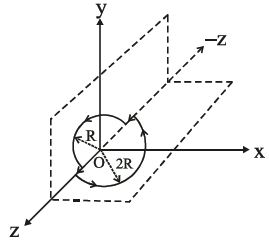
- 1In given diagram, two current carrying circular loop of radius $R$ and $2R$ are arranged in $YZ-$ plane and $XZ-$ plane respectively. Common centre of both are at origin $O$. Then what will be angle of resultant magnetic field from $X-$ axis.View Solution
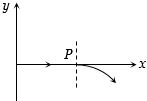
- 2For a positively charged particle moving in a $x-y$ plane initially along the $x$-axis, there is a sudden change in its path due to the presence of electric and/or magnetic fields beyond $P$. The curved path is shown in the $x-y$ plane and is found to be non-circular. Which one of the following combinations is possibleView Solution
- 3A proton of mass $m$ and charge $+e$ is moving in a circular orbit in a magnetic field with energy $1\, MeV$. What should be the energy of $\alpha - $particle (mass = $4m$ and charge = $+ 2e),$ so that it can revolve in the path of same radius.......$MeV$View Solution
- 4Biot-Savart, law indicates that the moving electrons (velocity $v$) produce a magnetic field $B$ such thatView Solution
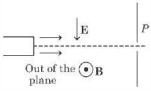
- 5A collimated beam of charged and uncharged particles is directed towards a hole marked $P$ on a screen as shown below. If the electric and magnetic fields as indicated below are turned $ON$View Solution
- 6View SolutionA charged particle enters a uniform magnetic field perpendicular to it. The magnetic field
- 7Two circular coils $1$ and $2$ are made from the same wire but the radius of the $1^{st}$ coil is twice that of the $2^{nd}$ coil. What is the ratio of potential difference in volts should be applied across them so that the magnetic field at their centres is the same?View Solution
- 8A proton and a deutron ( $\mathrm{q}=+\mathrm{e}, m=2.0 \mathrm{u})$ having same kinetic energies enter a region of uniform magnetic field $\vec{B}$, moving perpendicular to $\vec{B}$. The ratio of the radius $r_d$ of deutron path to the radius $r_p$ of the proton path is:View Solution
- 9View SolutionMark the correct statement
- 10A particle with charge $-Q$ and mass m enters a magnetic field of magnitude $B,$ existing only to the right of the boundary $YZ$. The direction of the motion of the $m$ particle is perpendicular to the direction of $B.$ Let $T = 2\pi\frac{m}{{QB}}$ . The time spent by the particle in the field will beView Solution