- With the help of a suitable ray diagram, derive the mirror formula for a concave mirror.
- The near point of a hypermetropic person is 50 cm from the eye. What is the power of the lens required to enable the person to read clearly a book held at 25 cm from the eye?
CBSE OUTSIDE DELHI - SET 1 2009
Download our app for free and get started
- Derivation
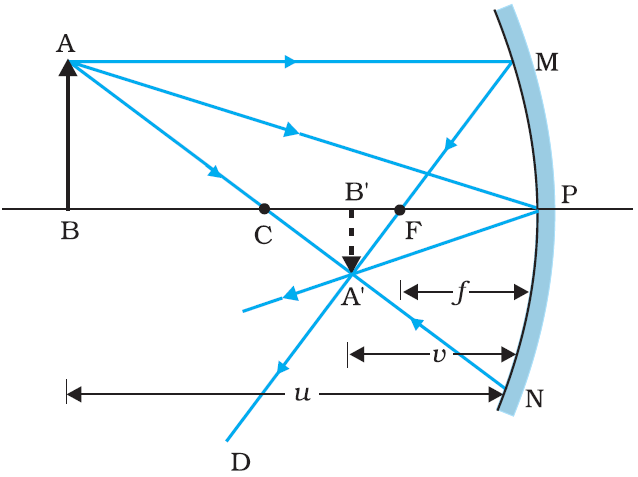
 Triangle A' B'F is similar to $\Delta$MPF.
Therefore $\frac{\text{B}'\text{A}'}{\text{PM}} =\frac{\text{B}'\text{F}}{\text{FP}}$
From Fig. PM = BA
$\text{Right angled}\Delta^\text{S}\text{A}'\text{B}'\text{P}\text{ and ABP are similar.}$
$\frac{\text{B}'\text{A}'}{\text{BA}} = \frac{\text{B}'\text{P}}{\text{BP}}$
On comparing $\frac{\text{B}'\text{F}}{\text{FP}} = \frac{\text{B}'\text{P}}{\text{BP}}$
$\frac{-\text{v} + \text{f}}{-\text{f}} =\frac{-\text{v}}{\text{-u}}\Rightarrow$
$\frac{1}{\text{f}} =\frac{1}{\text{v}} + \frac{1}{\text{u}}$
- $\frac{1}{\text{v}} - \frac{1}{\text{u}} = \frac{1}{\text{f}}$
$\therefore\text{f} = 50\text{ cm} = 0.5\text{m}$
$\text{Power =}\frac{1}{\text{f}} = \frac{1}{0.5}\text{D}$
$ = 2\text{D}.$

Download our appand get started for free
Experience the future of education. Simply download our apps or reach out to us for more information. Let's shape the future of learning together!No signup needed.*
Similar Questions
- 1View SolutionA diverging lens of focal length 20cm and a converging lens of focal length 30cm are placed 15cm apart with their principal axes coinciding. Where should an object be placed on the principal axis so that its image is formed at infinity?
- 2View SolutionA particle executes a simple harmonic motion of amplitude 1.0cm along the principal axis of a convex lens of focal length 12cm. The mean position of oscillation is at 20cm from the lens. Find the amplitude of oscillation of the image of the particle.
- 3View SolutionA convex lens of focal length 20cm and a concave lens of focal length 10cm are placed 10cm apart with their principal axes coinciding. A beam of light travelling parallel to the principal axis and having a beam diameter 5.0mm, is incident on the combination. Show that the emergent beam is parallel to the incident one. Find the beam diameter of the emergent beam.
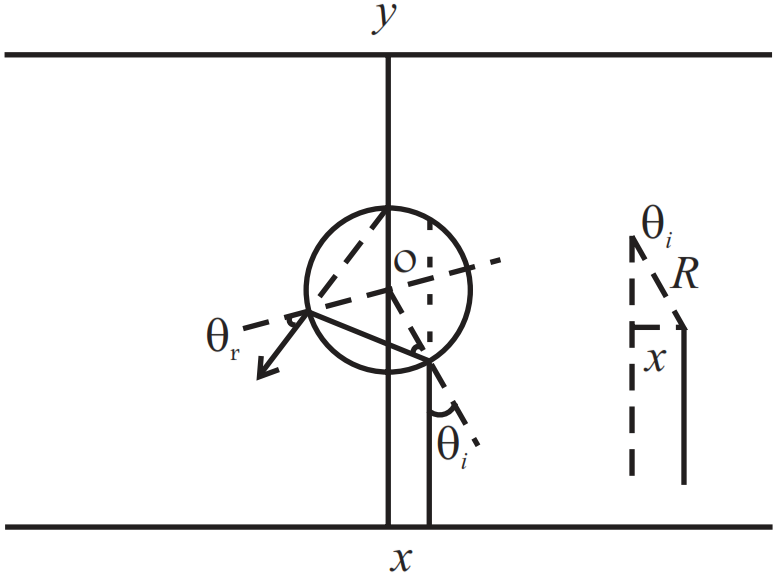
- 4View SolutionAn infinitely long cylinder of radius R is made of an unusual exotic material with refractive index -1 (Fig). The cylinder is placed between two planes whose normals are along the y direction. The center of the cylinder O lies along the y-axis. A narrow laser beam is directed along the y direction from the lower plate. The laser source is at a horizontal distance x from the diameter in the y direction. Find the range of x such that light emitted from the lower plane does not reach the upper plane.
- 5View SolutionHow is the working of a telescope different from that of a microscope?
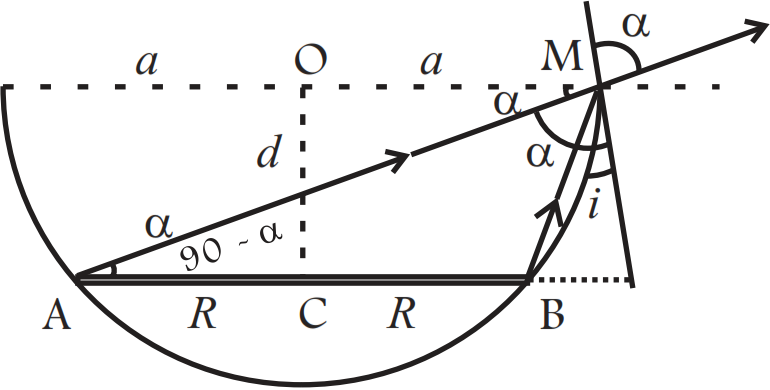
The focal lengths of the objective and eyepiece of a microscope are 1.25 cm and 5 cm respectively. Find the position of the object relative to the objective in order to obtain an angular magnification of 30 in normal adjustment. - 6View SolutionA circular disc of radius 'R' is placed co-axially and horizontally inside an opaque hemispherical bowl of radius 'a' (Fig). The far edge of the disc is just visible when viewed from the edge of the bowl. The bowl is filled with transparent liquid of refractive index μ and the near edge of the disc becomes just visible. How far below the top of the bowl is the disc placed?
- 7View SolutionA pin of length 2.00cm is placed perpendicular to the principal axis of a converging lens. An inverted image of size 1.00cm is formed at a distance of 40.0cm from the pin. Find the focal length of the lens and its distance from the pin.
- 8View Solution
- An object is placed in front of a concave mirror. It is observed that a virtual image is formed. Draw the ray diagram to show the image formation and hence derive the mirror equation $\frac{1}{\text{f}}=\frac{1}{\text{u}}+\frac{1}{\text{v}}.$
- An object is placed 30cm in front of a plano-convex lens with its spherical surface of radius of curvature 20cm. If the refractive index of the material of the lens is 1.5, find the position and nature of the image formed.
- 9Derive the lens formula $\frac{1}{\text{f}}=\frac{1}{\text{v}}-\frac{1}{\text{u}}$ for a thin concave lens, using the necessary ray diagram.View Solution
- 10View SolutionA 5mm high pin is placed at a distance of 15cm from a convex lens of focal length 10cm. A second lens of focal length 5cm is placed 40cm from the first lens and 55cm from the pin. Find
- The position of the final image.
- Its nature.
- Its size.