MCQ
For the situation shown in the figure below, mark out the correct statement
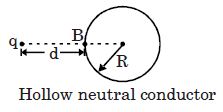
  • A
    Potential of the conductor is $\frac{{ - q}}{{4\pi {\varepsilon _0}\left( {d + R} \right)}}$
  • B
    Potential of the conductor is $\frac{q}{{4\pi {\varepsilon _0}d}}$
  • C
    Potential of the conductor can’t be determined as nature of distribution of induced charges is not known
  • Potential at point $B$ due to induced charges is $\frac{{ - qR}}{{4\pi {\varepsilon _0}\left( {d + R} \right)d}}$

Answer

Correct option: D.
Potential at point $B$ due to induced charges is $\frac{{ - qR}}{{4\pi {\varepsilon _0}\left( {d + R} \right)d}}$
d
Potential at surface $=$ Potential at centre

$\mathrm{V}_{\mathrm{+q}}+\mathrm{V}_{\mathrm{ind}}=\mathrm{V}_{\mathrm{c}}$

$\mathrm{V}_{\mathrm{ind}}=\frac{\mathrm{Kq}}{(\mathrm{R}+\mathrm{d})}-\frac{\mathrm{Kq}}{\mathrm{d}}=\frac{-\mathrm{qR}}{4 \pi \varepsilon_{0}(\mathrm{d}+\mathrm{R}) \mathrm{d}}$

Need a full question paper?

Generate a complete, print-ready paper with questions like this in minutes — across 16+ boards, with answer keys.

Start Generating Free

Similar questions

The value of angle of dip is zero at the magnetic equator because on it
To deposit one gm equivalent of an element at an electrode, the quantity of electricity needed is
In an amplitude modulation, a modulating signal having amplitude of $X$ Volt is superimposed with a carrier signal of amplitude $Y$ Volt in first case. Then, in second case, the same modulating signal is superimposed with different carrier signal of amplitude $2 Y$ Volt. The ratio of modulation index in the two case respectively will be:
If the atom $_{100}F{m^{257}}$ follows the Bohr model and the radius of $_{100}F{m^{257}}$ is $n$ times the Bohr radius, then find $n$
A plane convex lens is made of refractive index $1.6$. The radius of curvature of the curved surface is $60 cm. $ The focal length of the lens is.....$cm$
Two wires $A$ and $B$ , having identical geometrical construction, are stretched from their natural length by small but equal amount. The Young's modulus of the wires are $Y_{\mathrm{A}}$ and $Y_{\mathrm{B}}$ whereas the densities are $\rho_{\mathrm{A}}>\rho_{\mathrm{B}^{+}}$It is given that $\mathrm{Y}_{\mathrm{A}}>\mathrm{Y}_{\mathrm{B}}$ and $\rho_{\mathrm{A}}>\rho_{\mathrm{B}^{+}} . \mathrm{A}$ transverse signal started at one end takes a time $\mathrm{t}_1$ to reach the other end for $A$ and $\mathrm{t}_2$ for $B.$
Maximum kinetic energy of the positive ion in the cyclotron is
A long straight wire of resistance $R$, radius $a $ and length $ l$ carries a constant current $ I.$ The Poynting vector for the wire will be
A long straight wire with a circular crosssection having radius $R$, is carrying a steady current $I$. The current I is uniformly distributed across this cross-section. Then the variation of magnetic field due to current I with distance $r\;( r < R )$ from its centre will be
Consider a finite insulated, uncharged conductor placed near a finite positively charged conductor. The uncharged body must have a potential