MCQ
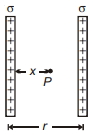
For two infinitely long charged parallel sheets, the electric field at $P$ will be
- A$\frac{\sigma}{2 x}-\frac{\sigma}{2(r-x)}$
- B$\frac{\sigma}{2 \varepsilon_0 x}+\frac{\sigma}{2 \pi(r-x) \varepsilon_0}$
- C$\frac{\sigma}{\varepsilon_0}$
- ✓$0$
$E_N=E_1-E_2=\frac{\sigma}{2 \varepsilon_0}-\frac{\sigma}{2 \varepsilon_0}=0$
Generate a complete, print-ready paper with questions like this in minutes — across 16+ boards, with answer keys.
Which of the following statement($s$) is(are) correct?
$(A)$ If $\mathrm{d}=\lambda$, the screen will contain only one maximum
$(B)$ If $\lambda<\mathrm{d} < 2 \lambda$, at least one more maximum (besides the central maximum) will be observed on the screen
$(C)$ If the intensity of light falling on slit $1$ is reduced so that it becomes equal to that of slit $2$ , the intensities of the observed dark and bright fringes will increase
$(D)$ If the intensity of light falling on slit $2$ is increased so that it becomes equal to that of slit $1$ , the intensities of the observed dark and bright fringes will increase