MCQ
In a reversible isochoric change
  • $\Delta W = 0$
  • B
    $\Delta Q = 0$
  • C
    $\Delta T = 0$
  • D
    $\Delta U = 0$

Answer

Correct option: A.
$\Delta W = 0$
a
(a) $\Delta V = 0 \Rightarrow P\Delta V = 0 \Rightarrow \Delta W = 0$

Need a full question paper?

Generate a complete, print-ready paper with questions like this in minutes — across 16+ boards, with answer keys.
Start Generating Free

Similar questions

If $10^{9}$ electrons move out of a body to another body every second. how much time is required to get a total charge of $1 \,C$ on the other body?
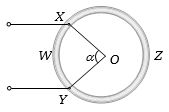
A wire of resistor $R$ is bent into a circular ring of radius $r$. Equivalent resistance between two points $X$ and $Y$ on its circumference, when angle $XOY$ is $\alpha$, can be given by
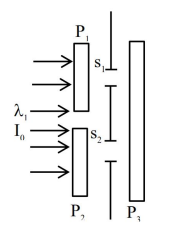
In a Young's double slit experiment, three polarizers are kept as shown in the figure. The transmission axes of $P_1$ and $P_2$ are orthogonal to each other. The polarizer $P_3$ covers both the slits with its transmission axis at $45^{\circ}$ to those of $P$ and $P_2$. An unpolarized light of wavelength $\lambda$ and intensity $I_0$ is incident on $P_1$ and $P_2$. The intensity at a point after $P_3$ where the path difference between the light waves from $s_1$ and $s_2$ is $\frac{\lambda}{3}$, is
Image
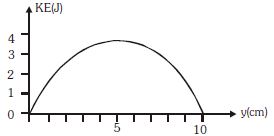
A mass on a vertical spring begins its motion at rest at $y = 0\  cm$. It reaches a maximum height of $y = 10\  cm$. The two forces acting on the mass are gravity and the spring force. The graph of its kinetic energy ($KE$) versus position is given below. Net force on the mass varies with $y$ as
The Fraunhoffer ‘diffraction’ pattern of a single slit is formed in the focal plane of a lens of focal length $1\,m$. The width of slit is $0.3\,mm$. If third minimum is formed at a distance of $5\,mm$ from central maximum, then wavelength of light will be......$\mathop A\limits^o $
The sodium nucleus $_{11}^{23}Na$ contains
The phase difference between incident wave and reflected wave is $180^o $  when light ray
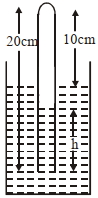
A $20 \,cm$ long tube is closed at one end. It is held vertically, and its open end is dipped in water until only half of it is outside the water surface. Consequently, water rises in it by height $h$ as shown in the figure. The value of $h$ is closest to .............. $\,m / s$ (assume that the temperature remains constant, $P _{\text {armosphere }}=10^5 \,N / m ^2$, density. of water $=10^3 \,kg / m ^3$, and acceleration due to gravity $g =10 \,m / s ^2$ )
The carrier frequency of a transmitter is provided by a tank circuit of a coil of inductance $49\,\mu H$ and a capactiance of $2.5\,nF$ . It is modulated by an audio signal of $12\,kHz$. The frequency range occupied by the side bands is
Assertion : Soft and hard $X-$ rays differ in frequency as well as velocity.
Reason : The penetrating power of hard $X-$ rays is more than the penetrating power of soft $X-$ rays.