Question
For two statements are given-one labelled Assertion (A) and the other labelled Reason (R). Select the correct answer to these questions from the codes (a), (b), (c) and (d) as given below.
  1. Both A and R are true and R is the correct explanation of A.
  2. Both A and R are true but R is not the correct explanation of A.
  3. A is true but R is false.
  4. A is false and R is also false.
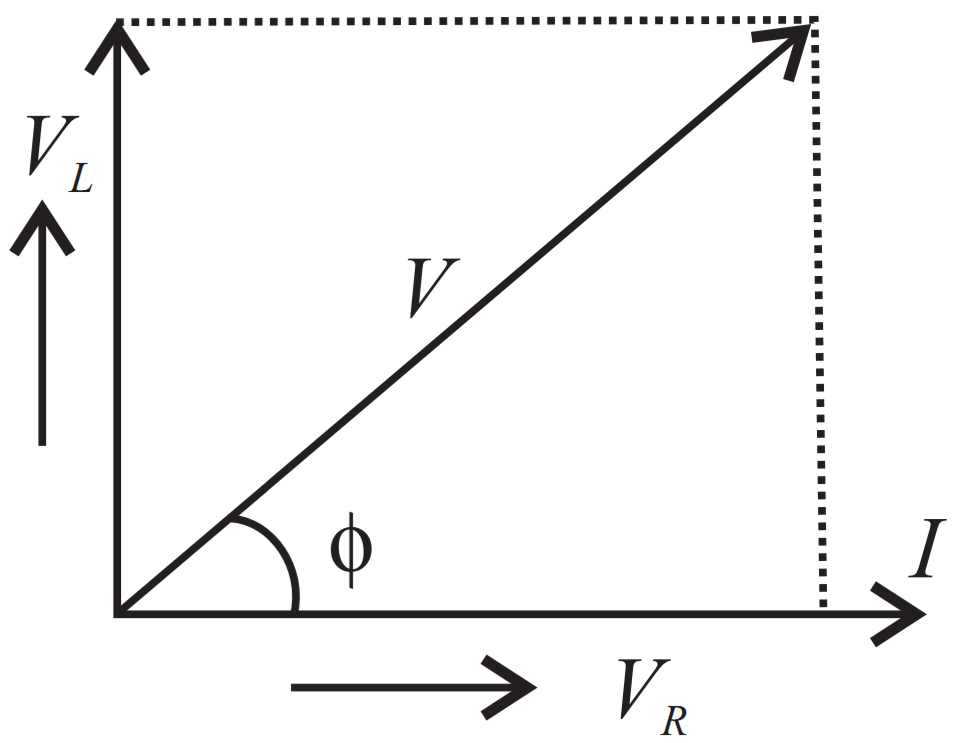
Assertion: An inductance and a resistance are connected in series with an A.C. circuit. ln this circuit the current and the potential difference across the resistance lags behind potential difference across the inductance by an angle $\frac{\pi}{2}.$
Reason: In L-R circuit voltage leads the current by phase angle which depends on the value ofinductance and resistance both.
Answer

  1. Both A and R are true but R is not the correct explanation of A.
Explanation:

As both the inductance and resistance are joined in series, hence current through both will be same. But in case of resistance, both the current and potential vary simultaneously, hence they are in same phase. While in case of an inductance when current is zero, potential difference across it is maximum and when current reaches maximum $\big($at $\omega\text{t}=\frac{\pi}{2}\big),$ potential difference across it becomes zero i.e., potential difference leads the current by $\frac{\pi}{2}$ or current lags behind the potential difference by $\frac{\pi}{2}.$ Phase angle in case of LR circuit is given as $\phi=\tan^{-1}\Big(\frac{\omega\text{L}}{\text{R}}\Big).$

Need a full question paper?

Generate a complete, print-ready paper with questions like this in minutes — across 16+ boards, with answer keys.

Start Generating Free

Similar questions

Two statements are given-one labelled Assertion (A) and the other labelled Reason (R). Select the correct answer to these questions from the codes (a), (b), (c) and (d) as given below.
  1. Both A and R are true and R is the correct explanation of A.
  2. Both A and R are true but R is not the correct explanation of A.
  3. A is true but R is false.
  4. A is false and R is also false.
Assertion: When a charged particle moves in a circular path. It produces electromagnetic wave.
Reason: Charged particle has acceleration.
For two statements are given-one labelled Assertion (A) and the other labelled Reason (R). Select the correct answer to these questions from the codes (a), (b), (c) and (d) as given below.
  1. Both A and R are true, and R is the correct explanation of A.
  2. Both A and R are true, but R is not the correct explanation of A.
  3. A is true, but R is false.
  4. A is false, and R is also false.
Assertion: A person touching a high power line gets stuck with the line.
Reason: The current carrying wire attracts the man towards it.
For two statements are given$-$one labelled Assertion $(A)$ and the other labelled Reason $(R).$ Select the correct answer to these questions from the codes $(a), (b), (c)$ and $(d)$ as given below.
Assertion: The current flowing through a conductor is directly proportional to the drift velocity.
Reason: As the drift velocity increases the current following through the conductor decreases.
For two statements are given$-$one labelled Assertion $(A)$ and the other labelled Reason $(R).$ Select the correct answer to these questions from the codes $(a), (b), (c)$ and $(d)$ as given below.
Assertion: Two bulbs of same wattage, one having a carbon filament and the other having a metallic filament are connected in series. Metallic bulbs will glow more brightly than carbon filament bulb.
Reason: Carbon is a semiconductor.
Two statements are given-one labelled Assertion (A) and the other labelled Reason (R). Select the correct answer to these questions from the codes (a), (b), (c) and (d) as given below.
  1. Both A and R are true and R is the correct explanation of A.
  2. Both A and R are true but R is not the correct explanation of A.
  3. A is true but R is false.
  4. A is false and R is also false.
Assertion: A double convex lens $(\mu = 1.5)$ has focal length 10cm. When the lens is immersed in water $\big(\mu=\frac{4}{3}\big)$ its focal length becomes 78.24cm.
Reason: $\frac{1}{\text{f}}=\frac{\mu_\text{g}-\mu_\text{m}}{\mu_\text{m}}\Big(\frac{1}{\text{R}_1}-\frac{1}{\text{R}_2}\Big).$
Two statements are given$-$one labelled Assertion $(A)$ and the other labelled Reason $(R).$ Select the correct answer to these questions from thecodes $(a), (b), (c)$ and $(d)$ as given below.
Assertion: Light Emitting Diode $\text{(LED)}$ emit spontaneous radiation.
Reason: $\text{LED}$ are forward-biased $p-n$ junction.
Directions: In the following questions, the Assertions (A) and Reason(s) (R) have been put forward. Read both the statements carefully and choose the correct alternative from the following:
Assertion: Basic difference between an electric line and magnetic line of force is that former is discontinuous and the later is continuous or endless.
Reason: No electric lines of force exist inside a charged body but magnetic lines do exist inside a magnet.
  1. Both A and R are true and R is the correct explanation of A.
  2. Both A and R are true and R is not correct explanation of A.
  3. A is true, But R is false.
  4. A is false, But R is true.
Two statements are given-one labelled Assertion (A) and the other labelled Reason (R). Select the correct answer to these questions from thecodes(a), (b), (c) and (d) as given below.
  1. Both A and R are true and R is the correct explanation of A.
  2. Both A and R are true but R is not the correct explanation of A.
  3. A is true but R is false.
  4. A is false and R is also false.
Assertion: The resistivity of a semiconductor increases with temperature.
Reason: The atoms of a semiconductor vibrate with larger amplitude at higher temperatures thereby increasing its resistivity.
For two statements are given$-$one labelled Assertion $(A)$ and the other labelled Reason $(R)$.
Select the correct answer to these questions from the codes $(a), (b), (c)$ and $(d)$ as given below.
Assertion: At resonance$, \text{LCR}$ series circuit have a maximum current.
Reason: At resonance, in $\text{LCR}$ series circuit, the current and $e.m.f$ are in phase with each other.
Assertion (A): Light from two coherent sources is reaching the screen. If the path difference at a point on the screen for yellow light is $\frac{3 \lambda}{2}$, then the fringe at that point will be coloured.
Reason (R): Two coherent source always have constant phase relationship.