Question
For two statements are given-one labelled Assertion (A) and the other labelled Reason (R). Select the correct answer to these questions from the codes (a), (b), (c) and (d) as given below.
  1. Both A and R are true, and R is the correct explanation of A.
  2. Both A and R are true, but R is not the correct explanation of A.
  3. A is true but R is false.
  4. A is false and R is also false.
Assertion (A): For charge to be in equilibrium, sum of the forces on charge due to rest of the two charges must be zero.
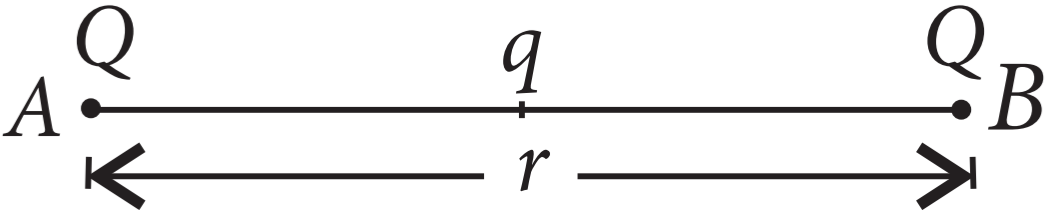
Reason (R): A charge is lying at the centre of the line joining two similar charges each which are fixed. The system will be in equilibrium if that charge is one fourth of the similar charges.
Answer

  1. A is true but R is false.
Explanation:

According to Coulomb's law, $\text{F}=\text{k}\frac{\text{Q}_1\text{Q}_2}{\text{r}^2}.$

The force on q due to A,

$\text{F}_\text{A}=\frac{1}{4\pi\in_0}\cdot\frac{\text{Qq}}{(\frac{\text{r}}{2})^2}$ to the right


Due to B,

$\text{F}_\text{B}=\frac{1}{4\pi\in_0}\cdot\frac{\text{Qq}}{(\frac{\text{r}}{2})^2}$ to the right

$\therefore$ Their sum is zero whether q is $+\frac{\text{Q}}{4}$or $-\frac{\text{Q}}{4}$ or any other value.

Therefore, it is not true that the third charge has to be $\frac{\text{Q}}{4}$ only. It can be any value.

Need a full question paper?

Generate a complete, print-ready paper with questions like this in minutes — across 16+ boards, with answer keys.

Start Generating Free

Similar questions

Assertion (A): On increasing the current sensitivity of a galvanometer by increasing the number of turns may not necessarily increase its voltage sensitivity.
Reason(R): The resistance of the coil of the galvanometer increases on increasing the number of turns.
Two statements are given$-$one labelled Assertion $(A)$ and the other labelled Reason $(R)$. Select the correct answer to these questions from the codes $(a), (b), (c)$ and $(d)$ as given below.
Assertion: The focal length of an equiconvex lens placed in air is equal to radius of curvature of either face. Lens is made up of material of refractive index of $1.5.$
Reason: For an equiconvex lens, radius of curvature of both the faces is same.
For question, statements are given-one labelled Assertion (A) and the other labelled Reason (R). Select the correct answer to these questions from the codes (a) (b) (c) and (d) as given below.
  1. Both A and R are true, and R is the correct explanation of A.
  2. Both A and R are true, but R is NOT the correct explanation of A.
  3. A is true, but R is false.
  4. A is false and R is also false.
Assertion (A): There is a chain reaction when uranium is bombarded with slow neutrons. Reason (R): When uranium is bombarded with slow neutrons, more neutrons are produced.
Two statements are given-one labelled Assertion (A) and the other labelled Reason (R). Select the correct answer to these questions from the codes (a), (b), (c) and (d) as given below.
  1. Both A and R are true and R is the correct explanation of A.
  2. Both A and R are true but R is not the correct explanation of A.
  3. A is true but R is false.
  4. A is false and R is also false.
Assertion: X-rays in vacuum travel faster than light waves in vacuum
Reason: The energy of X-rays photon is less than that of light photon.
For two statements are given$-$one labelled Assertion $(A)$ and the other labelled Reason $(R)$. Select the correct answer to these questions from the codes $(a), (b), (c)$ and $(d)$ as given below.
Assertion $(A):$ Charge is quantized.
Reason $(R):$ Charge which is less than $\text{IC}$ is not possible.
Two statements are given-one labelled Assertion (A) and the other labelled Reason (R). Select the correct answer to these questions from the codes (a), (b), (c) and (d) as given below.
  1. Both A and R are true and R is the correct explanation of A.
  2. Both A and R are true but R is not the correct explanation of A.
  3. A is true but R is false.
  4. A is false and R is also false.
Assertion: It is possible to eliminate dispersion by combining two prism of same refracting angles but of different materials.
Reason: The angular dispersion does not depend on refractive index of the material of the prism.
For question two statements are given-one labelled Assertion (A) and the other labelled Reason (R). Select the correct answer to these questions from the codes (a), (b), (c) and (d) as given below.
  1. Both A and R are true and R is the correct explanation of A.
  2. Both A and R are true but R is NOT the correct explanation of A.
  3. A is true but R is false.
  4. A is false and R is also false.
Assertion (A): Interference obeys the law of conservation of energy.
Reason (R): The energy is redistributed in case of interference.
Two statements are given-one labelled Assertion (A) and the other labelled Reason (R). Select the correct answer to these questions from the codes (a), (b), (c) and (d) as given below.
  1. Both A and R are true and R is the correct explanation of A.
  2. Both A and R are true but R is not the correct explanation of A.
  3. A is true but R is false.
  4. A is false and R is also false.
Assertion: Optical fibres are used for telecommunication.
Reason: Optical fibres are based on the phenomenon of total internal reflection.
Two statements are given-one labelled Assertion(A) and the other labelled Reason (R). Select the correct answer to these questions from the codes(a), (b), (c) and (d) as given below.
  1. Both A and R are true and R is the correct explanation of A.
  2. Both A and R are true but R is NOT the correct explanation of A.
  3. A is true but R is false.
  4. A is false and R is also false.
Assertion (A): A compass needle when placed on the magnetic north pole of the earth rotates in vertical direction.
Reason (R): The earth has only horizontal component of its magnetic field at the north poles.
For two statements are given-one labelled Assertion (A) and the other labelled Reason (R). Select the correct answer to these questions from the codes (a), (b), (c) and (d) as given below.
  1. Both A and R are true, and R is the correct explanation of A.
  2. Both A and R are true, but R is not the correct explanation of A.
  3. A is true, but R is false.
  4. A is false, and R is also false.
Assertion: The temperature coefficient of resistance is always positive only for metals.
Reason: On increasing the temperature, the resistance of metals and alloys increases.