Question
For two statements are given-one labelled Assertion (A) and the other labelled Reason (R). Select the correct answer to these questions from the codes (a), (b), (c) and (d) as given below.
  1. Both A and R are true and R is the correct explanation of A.
  2. Both A and R are true but R is not the correct explanation of A.
  3. A is true but R is false.
  4. A is false and R is also false.
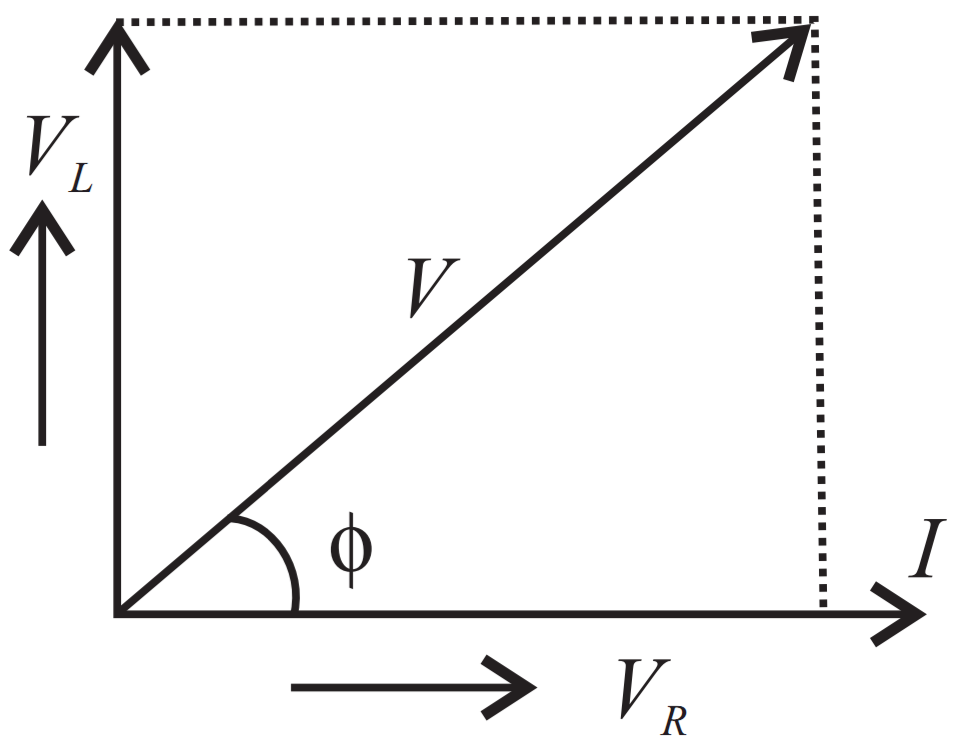
Assertion: An inductance and a resistance are connected in series with an A.C. circuit. ln this circuit the current and the potential difference across the resistance lags behind potential difference across the inductance by an angle $\frac{\pi}{2}.$
Reason: In L-R circuit voltage leads the current by phase angle which depends on the value ofinductance and resistance both.
Answer

  1. Both A and R are true but R is not the correct explanation of A.

Explanation:

As both the inductance and resistance are joined in series, hence current through both will be same. But in case of resistance, both the current and potential vary simultaneously, hence they are in same phase. While in case of an inductance when current is zero, potential difference across it is maximum and when current reaches maximum $\big($at $\omega\text{t}=\frac{\pi}{2}\big),$ potential difference across it becomes zero i.e., potential difference leads the current by $\frac{\pi}{2}$ or current lags behind the potential difference by $\frac{\pi}{2}.$ Phase angle in case of LR circuit is given as $\phi=\tan^{-1}\Big(\frac{\omega\text{L}}{\text{R}}\Big).$

Need a full question paper?

Generate a complete, print-ready paper with questions like this in minutes — across 16+ boards, with answer keys.

Start Generating Free

Similar questions

For two statements are given-one labelled Assertion (A) and the other labelled Reason (R). Select the correct answer to these questions from the codes (a), (b), (c) and (d) as given below.
  1. Both A and R are true, and R is the correct explanation of A.
  2. Both A and R are true, but R is not the correct explanation of A.
  3. A is true but R is false.
  4. A is false and R is also false.
Assertion (A): The surface densities of two spherical conductors of different radii are equal. Then the electric field intensities near their surface are also equal.
Reason (R): Surface density is equal to charge per unit area.
For two statements are given-one labelled Assertion (A) and the other labelled Reason (R). Select the correct answer to these questions from the codes (a), (b), (c) and (d) as given below.
  1. Both A and R are true and R is the correct explanation of A.
  2. Both A and R are true but R is not the correct explanation of A.
  3. A is true but R is false.
  4. A is false and R is also false.
Assertion: When capacitive reactance is smaller than the inductive reactance in LCR series circuit, e.m.f. leads the current.
Reason: The phase angle is the angle between the alternating e.m.f. and alternating current of the circuit.
For question, statements are given-one labelled Assertion (A) and the other labelled Reason (R). Select the correct answer to these questions from the codes (a) (b) (c) and (d) as given below.
  1. Both A and R are true, and R is the correct explanation of A.
  2. Both A and R are true, but R is NOT the correct explanation of A.
  3. A is true, but R is false.
  4. A is false and R is also false.
Assertion (A): Rydberg's constant varies with the mass number of a given element.
Reason (R): The reduced mass of the electron depends on the mass of the nucleus only.
For question two statements are given-one labelled Assertion (A) and the other labelled Reason (R). Select the correct answer to these questions from the codes (a), (b), (c) and (d) as given below.

  1. Both A and R are true, and R is the correct explanation of A.
  2. Both A and R are true, but R is NOT the correct explanation of A.
  3. A is true, but R is false.
  4. A is false and R is also false.

Assertion (A): A tube light emits white light

Reason (R): Emission of light in a tube takes place at a very high temperature.

Two statements are given-one labelled Assertion (A) and the other labelled Reason (R). Select the correct answer to these questions from the codes (a), (b), (c) and (d) as given below.
  1. Both A and R are true and R is the correct explanation of A.
  2. Both A and R are true but R is not the correct explanation of A.
  3. A is true but R is false.
  4. A is false and R is also false.
Assertion: Optical fibres are used for telecommunication.
Reason: Optical fibres are based on the phenomenon of total internal reflection.
Two statements are given-one labelled Assertion (A) and the other labelled Reason (R). Select the correct answer to these questions from the codes (a), (b), (c) and (d) as given below.
  1. Both A and R are true and R is the correct explanation of A.
  2. Both A and R are true but R is not the correct explanation of A.
  3. A is true but R is false.
  4. A is false and R is also false.
Assertion: Electromagnetic waves exert pressure called radiation pressure.
Reason: Electromagnetic waves carries energy.
Assertion (A): Light from two coherent sources is reaching the screen. If the path difference at a point on the screen for yellow light is $\frac{3 \lambda}{2}$, then the fringe at that point will be coloured.
Reason (R): Two coherent source always have constant phase relationship.
Two statements are given-one labelled Assertion (A) and the other labelled Reason (R). Select the correct answer to these questions from the codes (a), (b), (c) and (d) as given below.
  1. Both A and R are true and R is the correct explanation of A.
  2. Both A and R are true but R is NOT the correct explanation of A.
  3. A is true but R is false.
  4. A is false and R is also false.
Assertion (A): When force is zero, the charged particle follows linear path.
Reason (R): A charged particle enters in a uniform magnetic field, whose velocity makes an angle 8 with magnetic field will cover a linear path.
For two statements are given-one labelled Assertion (A) and the other labelled Reason (R). Select the correct answer to these questions from the codes (a), (b), (c) and (d) as given below.
  1. Both A and R are true and R is the correct explanation of A.
  2. Both A and R are true but R is not the correct explanation of A.
  3. A is true but R is false.
  4. A is false and R is also false.
Assertion: A bulb connected in series with a solenoid is connected to A.C. source. If a soft iron core is introduced in the solenoid, the bulb will glow brighter.
Reason: On introducing soft iron core in the solenoid, the inductance decreases.
Two statements are given-one labelled Assertion (A) and the other labelled Reason (R). Select the correct answer to these questions from the codes (a), (b ), (c) and (d) as given below.
  1. Both A and R are true and R is the correct explanation of A.
  2. Both A and Rare true but R is NOT the correct explanation of A.
  3. A is true but R is false.
  4. A is false and R is also false.
Assertion (A): When number of turns in a coil doubled, coefficient of self inductance of the coil becomes four times.
Reason (R): Coefficient of self inductance is proportional to the square of number of turns.