Question
For what value of $\alpha,$ the system of equations will have no solution
$\alpha\text{x}+3\text{y}=\alpha-3$
$12\text{x}+\alpha\text{y}=\alpha$
 

Answer

The given system of equations may be written as,
$\alpha\text{x}+3\text{y}-(\alpha-3)=0$
$12\text{x}+\alpha\text{y}-\alpha=0$
The given system of equations is of the form
$a_1x + b_1y + c_1 = 0$
$a_2x + b_2y + c_2 = 0$
Where, $\text{a}_1=\alpha,\text{b}_1=3,\text{c}_1=-(\alpha-3)$
and, $\text{a}_2=12,\text{b}_2=\alpha,\text{c}_2=-\alpha$
For no solution, we must have
$\frac{\text{a}_1}{\text{a}_2}=\frac{\text{b}_1}{\text{b}_2}\neq\frac{\text{c}_1}{\text{c}_2}$
$\Rightarrow\frac{\alpha}{12}=\frac{3}{\alpha}\neq\frac{-(\alpha-3)}{-\alpha}$
Now,
$\frac{3}{\alpha}\neq\frac{-(\alpha-3)}{-\alpha}$
$\Rightarrow\frac{3}{\alpha}\neq\frac{\alpha-3}{\alpha}$
$\Rightarrow3\neq\alpha-3$
$\Rightarrow3+3\neq\alpha$
$\Rightarrow6\neq\alpha$
$\Rightarrow\alpha\neq6$
and $\frac{\alpha}{12}=\frac{3}{\alpha}$
$\Rightarrow\alpha^2=36$
$\Rightarrow\alpha=\pm6$
$\Rightarrow\alpha=-6$ $\big[\therefore\alpha\neq6\big]$
Hence, the given system of equations will have no solution, if $\alpha=-6$

Need a full question paper?

Generate a complete, print-ready paper with questions like this in minutes — across 16+ boards, with answer keys.
Start Generating Free

Similar questions

If $\alpha$ and $\beta$ are zeroes of a polynomial $6 x^2-5 x +1$ then form a quadratic polynomial whose zeroes are $\alpha^2$ and $\beta^2$.
A guy wire attached to a vertical pole of height 18m is 24m long and has a stake attached to the other end. How far from the base of the pole should the stake be driven so that the wire will be taut?
Which of the following sequences are arithmetic progressions. For those which are arithmetic progressions, find out the common difference.
$a + b, (a + 1) + b, (a + 1) + (b + 1), (a + 2) + (b + 1), (a + 2) + (b + 2), .....$
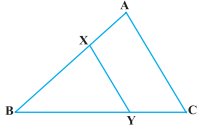
In the given figure, the line segment $XY$ is parallel to side $AC$ of $\triangle$ABC and it divides the triangle into two parts of equal areas. Find the ratio $\frac{\mathrm{A} \mathrm{X}}{\mathrm{AB}}$.
The sum of four consecutive numbers in A.P. is 32 and the ratio of the product of the first and last terms to the product of two middle terms is 7 : 15. Find the number.
If the point $P(x, 3)$ is equidistant from the point $A(7,-1)$ and $B(6,8)$, then find the value of $x$ and find the distance $A P$.
A carton of $24$ bulbs contain 6 defective bulbs. One bulbs is drawn at random. What is the probability that the bulb is not defective? If the bulb selected is defective and it is not replaced and a second bulb is selected at random from the rest, what is the probability that the second bulb is defective?
The line segment joining the points (3, -4) and (1, 2) is trisected at the points P and Q. If the coordinates of P and Q are (p, -2) and $\Big(\frac{5}{3},\text{q}\Big)$ respectively. Find the values of p and q.
Find the sum of two middel most term of the $\text{AP}-\frac{4}{3},-1,\frac{-2}{3},\ ....4\frac{1}{3}.$
Find the value of k for which the system has (i) a unique solution, and (ii) no solution:
$kx + 2y = 5$
$3x + y = 1$