Questions · Page 1 of 2

3 Marks Question

Take a timed test

50 questions · self-marked practice — reveal the answer and mark yourself.

Question 13 Marks
Find the value of k for which the following system of equations has a unique solution:
$kx + 2y = 5$
$3x + y = 1$
Answer
The given system of equation is
$kx + 2y - 5 = 0$
$3x + y - 1 = 0$
The given system of equation is of the form
$a_1x + b_1y + c_1 = 0$
$a_2x + b_2y + c_2 = 0$
Where, $a_1= k, b_1 = 2, c_1 = -5$
And, $a_2 = 3, b_2 = 1, c_2 = -1$
For a unique solution, we must have
$\frac{\text{a}_1}{\text{a}_2}\neq\frac{\text{b}_1}{\text{b}_2}$
$\therefore\frac{\text{k}}{3}\neq\frac{2}{1}$
$\Rightarrow\text{k}\neq6$
So, the given system of equations will have a unique for all real value of k othere then 6.
View full question & answer
Question 23 Marks
Find the value of k for which the following system of equations has no solution:
$2x + ky = 11$
$5x - 7y = 5$
Answer
Given,
$2x + ky = 11$
$5x - 7y = 5$
To find: To determine for what value of k the system of equation has no solution
We know that the system of equations
$a_1x + b_1y = c_1$
$a_2x + b_2y = c_2$​​​​​​​
For no solutions,
$\frac{\text{a}_1}{\text{a}_2}=\frac{\text{b}_1}{\text{b}_2}\neq\frac{\text{c}_1}{\text{c}_2}$
Here,
$\frac{2}{5}=\frac{\text{k}}{-7}\neq\frac{11}{5}$
$\frac{2}{5}=\frac{\text{k}}{-7}$
$\text{k}=\frac{-14}{5}$
Hence for $\text{k}=\frac{-14}{5}$ the system of equations has no solution.
View full question & answer
Question 33 Marks
Ten years ago, a father was twelve times as old as his son and ten years hence, he will be twice as old as his son will be then. Find their present ages.
Answer
Let the present age of father be x years and the present age of son be y years.
Then years ago Father's age = (x - 10) years
Son's age = (y - 10) years
Using the given information we get
x - 10 = 12(y - 10)
⇒ x - 10 = 12y - 120
⇒ x - 12y = -120 + 10
⇒ x - 12y = -110 .....(i)
Ten years hence, Father's age = (x + 10) years
Son's age = (y + 10) years
Using the given information we get
x + 10 = 2(y + 10)
⇒ x + 10 = 2y + 20
⇒ x - 2y = 20 - 10
⇒ x - 2y = 10 ......(ii)
Subtracting equation (i) from equation (ii) we get
-2y + 12y = 10 + 110
⇒ 10y = 120
$\Rightarrow\text{y}=\frac{120}{10}$
⇒ y = 12
Putting y = 12 in equation (ii) we get
x - 2 × 12 = 10
⇒ x - 24 = 10
⇒ x = 10 + 24
⇒ x = 34
Hence, present age of father's is 34 years and present age of son is 12 years.
View full question & answer
Question 43 Marks
Meena went to a bank to withdraw Rs. 2000. She asked the cashier to give her Rs. 50 and Rs. 100 notes only. Meena got 25 notes in all. Find how many notes Rs. 50 and Rs 100 she received.
Answer
Let the number of Rs. 50 notes and Rs. 100 notes be x and y respectively.
According to the question,
x + y = 25 ....(i)
50x + 100y = 2000 ....(ii)
Multiplying equation (i) by 50, we obtain,
50x + 50y = 1250
Subtracting equation (iii) from equation (ii) we obtain,
50y = 750
y = 15
Substituting the value of y in equation (i) we obtain,
x = 10
Hence, meena received 10 notes of Rs. 50 and 15 notes of Rs. 100
Concept insight: This problem talks about two types of notes, Rs. 50 notes and Rs. 100 notes. And the number of both these notes with meena is not known. So, we denote the number of Rs. 50 notes and Rs. 100 notes by variables x and y respectively. Now two liner equatoion can be formed by the given condition which can be solved by eliminatiing one of the variables.
View full question & answer
Question 53 Marks
The cost of 4 pens and 4 pencil boxes is ₹ 100. Three times the cost of a pen is ₹ 15 more than the cost of a pencil box. Form the pair of linear equations for the above situation. Find the cost of a pen and pencil box.
Answer
Let the cost of a pen be ₹ x and the cost of a pencil box be ₹ y.
Then, by given condition.
4x + 4y = 100
⇒ x + y = 25 .....(i)
and 3x = y + 15
⇒ 3x - y = 15 .....(ii)
On adding eq. (i) and (ii) we get
4x = 40
⇒ x = 10
By substituting x = 10, in eq. (i) we get
y = 25 - 10
⇒ y = 15
Hence, the cost of a pen and a pencil box are ₹ 10 and ₹ 15, respectively.
View full question & answer
Question 63 Marks
The numerator of a fraction is 4 less than the denominator. If the numerator is decreased by 2 and denominator is increased by 1, then the denominator is eight times the numerator. Find the fraction.
Answer
Let numerator and denominator be x and y respectively.
Fraction $=\frac{\text{x}}{\text{y}}$
According to question,
x = y - 4 ....(i)
and 8(x - 2) = (y + 1)
⇒ 8x - 16 = y + 1
⇒ 8x - y - 17 = 0 .....(ii)
Putting x = (y - 4) in (2), we get
⇒ 8(y - 4) - y - 17 = 0
⇒ 8y - 32 - y - 17 = 0
⇒ 7y - 49 = 0
⇒ 7y = 49
$\Rightarrow\text{y}=\frac{49}{7}$
⇒ y = 7
Putting y = 7 in (i) we get
⇒ x = 7 - 4
⇒ x = 3
Thus, the fraction $=\frac{3}{7}$
View full question & answer
Question 73 Marks
Find the value of k for which each of the following system of equations have infinitely many solutions:
$2x + 3y = 2$
$(k + 2)x + (2k + 1)y = 2(k - 1)$
Answer
The given equations are
$2x + 3y = 2 .....(i)$
$(k + 2)x + (2k + 1)y = 2(k - 1) .....(ii)$
The given equations are of the form
$a_1x + b_1y + c_1 = 0$
$a_2x + b_2y + c_2 = 0$
Where, $a_1 = 2, b_1 = 3, c_1 = -2$
and, $a_2 = (k + 2), b_2 = (2k + 1)$, and $c_2 = -2(k - 1)$
For infinitely many solutions
$\frac{\text{a}_1}{\text{a}_2}=\frac{\text{b}_1}{\text{b}_2}=\frac{\text{c}_1}{\text{c}_2}$
$\Rightarrow\frac{2}{(\text{k}+2)}=\frac{3}{(2\text{k}+1)}=\frac{-2}{-2(\text{k}-1)}$
$\Rightarrow\frac{2}{(\text{k}+2)}=\frac{3}{(2\text{k}+1)}$
$\Rightarrow 2(2k + 1) = 3(k + 2)$
$\Rightarrow 4k + 2 = 3k + 6$
$\Rightarrow 4k - 3k = 6 - 2$
$\Rightarrow k = 4$
$\Rightarrow k = 4$
Thus, the given system of equations will have infinitely many solutions, if $k = 4$
View full question & answer
Question 83 Marks
Six years hence a man's age will be three times the age of his son and three years ago he was nine times as old as his son. Find their present ages.
Answer
Let the present age of a man and his son be x and y years respectively.
6 years leave (later)
Age of man = (x + 6) years
Age of his son = (y + 6) years
3 years ago
Age of man = (x - 3) years
Age of his son = (y - 3) years
According to question
(x + 6) = 3(y + 6)
⇒ x + 6 = 3y + 18
⇒ x - 3y - 12 = 0 .....(i)
and, (x - 3) = 9(y - 3)
⇒ x - 3 = 9y - 27
⇒ x - 9y + 24 = 0 .....(ii)
Subtracting (ii) from (i) we get
⇒ 6y - 36 = 0
⇒ 6y = 36
$\Rightarrow\text{y}=\frac{36}{6}$
⇒ y = 6 years
Putting y = 6 in (i) we get
⇒ x - 3 × 6 - 12 = 0
⇒ x - 18 - 12 = 0
⇒ x - 30 = 0
⇒ x = 30 years
Thus, present ages of man and his son are 30 years and 6 years respectively.
View full question & answer
Question 93 Marks
Find the values of a and b for which the following system of equations has infinitely many solutions:
$2x + 3y - 7 = 0$
$(a - 1)x + (a + 1)y = (3a - 1)$
Answer
The given equations are
$2x + 3y - 7 = 0 .....(i)$
$(a - 1)x + (a + 1)y = (3a - 1) .....(ii)$
The given equations are of the form
$a_1x + b_1y + c_1 = 0$
$a_2x + b_2y + c_2 = 0$
Where, $a_1 = 2, b_1 = 3, c_1 = -7$
And, $a_2 = (a - 1), b_2 = (a + 1) and c_2 = -(3a - 1)$
For infinite many solutions
$\frac{\text{a}_1}{\text{a}_2}=\frac{\text{b}_1}{\text{b}_2}=\frac{\text{c}_1}{\text{c}_2}$
$\Rightarrow\frac{2}{(\text{a}-1)}=\frac{3}{(\text{a}+1)}=\frac{-7}{-(3\text{a}-1)}$
$\Rightarrow\frac{2}{(\text{a}-1)}=\frac{3}{(\text{a}+1)}$
$\Rightarrow 2a + 2 = 3a - 3$
$\Rightarrow 3a - 2a = 2 + 3$
$\Rightarrow a = 5$
Thus, $a = 5$
View full question & answer
Question 103 Marks
Find the value of k for which the following system of equations has no solution:
$x + 2y = 0$
$2x + ky = 5$
Answer
The given system of equations may be written as,
$x + 2y = 0$
$2x + ky = 5$
The given system of equations is of the form
$a_1x + b_1y + c_1 = 0$
$a_2x + b_2y + c_2 = 0$
Where, $a_1 = 1, b_1 = 2, c_1 = 0$
and, $a_2 = 2, b_2 = k, c_2 = -5$
For a solutions, we must have
$\frac{\text{a}_1}{\text{a}_2}=\frac{\text{b}_1}{\text{b}_2}\neq\frac{\text{c}_1}{\text{c}_2}$
We have,
$\frac{\text{a}_1}{\text{a}_2}=\frac{1}{2}$
$\frac{\text{b}_1}{\text{b}_2}=\frac{2}{\text{k}}$
and, $\frac{\text{c}_1}{\text{c}_2}=\frac{0}{-5}$
Now, $\frac{\text{a}_1}{\text{a}_2}=\frac{\text{b}_1}{\text{b}_2}$
$\Rightarrow\frac{1}{2}=\frac{2}{\text{k}}$
$\Rightarrow\text{k}=4$
Hence, the given system of equations has no solutions, when k = 4
View full question & answer
Question 113 Marks
The sum of a numerator and denominator of a fraction is 18. If the denominator is increased by 2, the fraction reduces to $\frac{1}{3}.$ Find the fraction.
Answer
Let the fraction be $\frac{\text{x}}{\text{y}}$
Then, according to the given conditions we have
x + y = 18 .... (i)
And, $\frac{\text{x}}{\text{y}+2}=\frac{1}{3}$
⇒ 3x = y + 2
⇒ 3x - y = 2 .....(ii)
Adding equation (i) and equation (ii) we get
x + 3x = 18 + 2
⇒ 4x = 20
$\text{x}=\frac{20}{4}=5$
Putting x = 5 in equation (i) we get
5 + y = 18
⇒ y = 18 - 5
⇒ y = 13
Hence, the fraction is $\frac{5}{13}$
View full question & answer
Question 123 Marks
The sum of digits of a two number is 15. The number obtained by reversing the order of digits of the given number exceeds the given number by 9. Find the given number.
Answer
Let the digits at unit tens place be x and y respectively number
= 10y + x
Sum of digits of number is 15
x + y = 15 .....(i)
When digits are reversed then number will be 10x + y
According to equation
10x + y = 10y + x + 9
9x - 9y = 9
x - y = 1 .....(ii)
Adding (i) and (ii) we get
⇒ 2x = 16
$\Rightarrow\text{x}=\frac{16}{2}$
⇒ x = 8
Putting x = 8 in (i) we get
⇒ 8 + y = 15
⇒ y = 7
Thus, the number will be (7 × 10 + 8) = 78
View full question & answer
Question 133 Marks
The difference between two numbers is 26 and one number is three times the other. Find them.
Answer
Let x and y be two numbers
According to question
x - y = 26 ....(i)
and x = 3y .......(ii)
Putting x = 3y in (i) we get
⇒ 3y - y = 26
⇒ 2y = 26
⇒ y = 13
Putting y = 13 in (ii) we get
⇒ x = 3 × 13
⇒ x = 39
Thus number will be 39, 13.
View full question & answer
Question 143 Marks
For what value of k the following system of equations will be inconsistent?
$4x + 6y = 11$
$2x + ky = 7$
Answer
The given equations are,
$4x + 6y = 11 ......(i)$
$2x + ky = 7 .......(ii)$
The given equations are, of the form,
$a_1x + b_1y + c_1 = 0$
$a_2x + b_2y + c_2 = 0$
Where, $a_1 = 4, b_1 = 6, c_1 = -11,$
$a_2 = 2, b_2 = k$ and $c_2 = -7$
For inconsistent solution,
$\frac{\text{a}_1}{\text{a}_2}=\frac{\text{b}_1}{\text{b}_2}\neq\frac{\text{c}_1}{\text{c}_2}$
$\Rightarrow\frac{4}{2}=\frac{6}{\text{k}}\neq\frac{-11}{-7}$
$\Rightarrow\text{k}=\frac{6\times2}{4}$
$\Rightarrow\text{k}=\frac{12}{4}=3$
Thus, the given system of equations will be inconsistent for k = 3
View full question & answer
Question 153 Marks
The larger of two supplementary angles exceeds the smaller by 18 degrees. Find them.
Answer
We know that the sum of supplementary angles will be 180°
Let the longer supplementary angles will be 'y'
Then, x + y = 180° ....(i)
If larger of supplementary angles exceeds the smaller by 18 degree, According to the given condition. We have,
x = y + 18° ....(ii)
Substitute x = y + 18° in equation (i) we get
x + y = 180°
y + 18° + y = 180°
2y + 18° = 180°
2y = 180° - 18°
2y = 162°
$\text{y}=\frac{162^\circ}{2}$
y = 81°
Put y = 81° equation (ii) we get
x = y + 18°
x = 81° + 18°
x = 99°
Hence, the larger supplementary angle is 99°, The smaller supplementary angle is 81°
View full question & answer
Question 163 Marks
A person rowing at the rate of 5km/ h in still water, takes thrice as much time in going 40km upstream as in going 40km downstream. Find the speed of the stream.
Answer
Let the speed of the stream be v km/ h.
Given that, a person rowing in still water = 5km/ h.
The speed of a person rowing in downstream = (5 + v) km/ h.
and the speed of a person Has rowing in upstream = (5 - v) km/ h.
Now, the person taken time to cover 40km downstream,
$\text{t}_1=\frac{40}{5+\text{v}}$
$\Big[\because\text{Speed}=\frac{\text{Distance}}{\text{Time}}\Big]$
and the person has taken time to cover 40km upstream,
$\text{t}_2=\frac{40}{5-\text{v}}\text{h.}$
By condition, $\text{t}_2=\text{t}_1\times3$
$\Rightarrow\frac{40}{5-\text{v}}=\frac{40}{5+\text{v}}\times3$
$\Rightarrow\frac{1}{5-\text{v}}=\frac{3}{5+\text{v}}$
$\Rightarrow5+\text{v}=15-3\text{v}$
$\Rightarrow4\text{v}=10$
$\therefore\text{v}=\frac{10}{4}=2.5\text{km/ h.}$
Hence, the speed of the stream is 2.5km/ h.
View full question & answer
Question 173 Marks
If the numerator of a fraction is multiplied by 2 and the denominator is reduced by 5 the fraction becomes $\frac{6}{5}.$ And, if the denominator is doubled and the numerator is increased by 8, the fraction becomes $\frac{2}{5}.$ Find the fraction.
Answer
Let the fraction be $\frac{\text{x}}{\text{y}}$
Then, according to the given conditions, we have
$\frac{2\text{x}}{\text{y}-5}=\frac{6}{5}$
⇒ 5 × 2x = 6(y - 5)
⇒ 10x = 6y - 30
⇒ 10x - 6y = -30
⇒ 2(5x - 3y) = -30
⇒ 5x - 3y = -15 ....(i)
and, $\frac{\text{x}+8}{2\text{y}}=\frac{2}{5}$
⇒ 5(x + 8) = 2 × 2y
⇒ 5x + 40 = 4y
⇒ 5x - 4y = -40 .....(ii)
Subtracting equation (ii) by equation (i) we get
-3y + 4y = -15 + 40
⇒ y = 25
Putting y = 25 in equation (i) we get
5x - 3 × 25 = -15
⇒ 5x - 75 = -15
⇒ 5x = -15 + 75
⇒ 5x = 60
$\Rightarrow\text{x}=\frac{60}{5}=12$
Hence, the fraction is $\frac{12}{25}$
View full question & answer
Question 183 Marks
Solve the following systems of equations:
$\frac{2}{\text{x}}+\frac{3}{\text{y}}=13,$
$\frac{5}{\text{x}}-\frac{4}{\text{y}}=-2.$
Answer
Let us write the given pair of equation as
$2\Big(\frac{1}{\text{x}}\Big)+3\Big(\frac{1}{\text{y}}\Big)=13\ .....(\text{i})$
$5\Big(\frac{1}{\text{x}}\Big)-4\Big(\frac{1}{\text{y}}\Big)=-2\ .....(\text{ii})$
These equation are not in the from ax + by + c = 0. However, if we substitute
$\frac{1}{\text{x}}=\text{p}$ and $\frac{1}{\text{y}}=\text{q}$ in equationss (i) and (ii) we get
$2\text{p}+3\text{q}=13$
$5\text{p}-4\text{q}=-2$
So, we have expressed the equations as a pair of linear equations. Now, you can use any method to solve these equations, and get p = 2, q = 3.
you know that $\text{p}=\frac{1}{\text{x}}$ and $\text{q}=\frac{1}{\text{y}}.$
Substitute the values of p and q to get
$\frac{1}{\text{x}}=2$ i.e., $\text{x}=\frac{1}{2}$ and $\frac{1}{\text{y}}=3$ i.e., $\text{y}=\frac{1}{3}.$
View full question & answer
Question 193 Marks
The sum of the numerator and denominator of a fraction is 4 more than twice the numerator. If the numerator and denominator are increased by 3, they are in the ratio 2 : 3. Determine the fraction.
Answer
Let the fraction be $\frac{\text{x}}{\text{y}}$
Then, according to the given conditions, we have
x + y = 2x +4
⇒ x + y - 2x = 4
⇒ -x + y = 4 ....(i)
And, $\frac{\text{x}+3}{\text{y}+3}=\frac{2}{3}$
⇒ 3(x + 3) = 2(y + 3)
⇒ 3x + 9 = 2y + 6
⇒ 3x - 2y = 6 - 9
⇒ 3x - 2y = -3 .....(ii)
Multiplying equation (i) by 3 we get
-3x + 3y = 12 .....(iii)
Adding equation (ii) and equation (iii) we get
-2y + 3y = -3 + 12
⇒ y = 9
Putting y = 9 in equation (i) we get
-x + 9 = 4
⇒ -x = 4 - 9
⇒ -x = -5
⇒ x = 5
Hence, the fraction is $\frac{5}{9}$
View full question & answer
Question 203 Marks
Solve the following system of equations by the method of cross-multiplication:
2x - y = 6,
x - y = 2.
Answer
Given,
2x - y = 6
x - y = 2
To find: The solution of the systems of equation by the method of cross-multiplication:
Here we have the pair of simultaneous equation,
2x - y - 6 = 0
x - y - 2 = 0
By cross-multiplication method we get,
$\Rightarrow\frac{\text{x}}{\big((-1)\times(-2)\big)-\big((-1)\times(-6)\big)}=\frac{-\text{y}}{(2)(-2)-(1)(-6)}\\=\frac{\text{1}}{\big((2)\times(-1)\big)-\big((1)\times(-1)\big)}$
$\Rightarrow\frac{\text{x}}{2-6}=\frac{-\text{y}}{-4+6}=\frac{1}{-2+1}$
$\Rightarrow\frac{\text{x}}{-4}=\frac{-\text{y}}{2}=\frac{1}{-1}$
$\Rightarrow\text{x}=\frac{-4}{-1}=4$
$\Rightarrow\text{y}=\frac{-2}{-1}=2$
Hence we get the value of x = 4 and y = 2.
View full question & answer
Question 213 Marks
Father's age is three times the sum of age of his two children. After 5 years his age will be twice the sum of ages of two children. Find the age of father.
Answer
Let the present age of father be x years and the sum of the present age of two chidren be y years. Then,
x = 3y ......(i)
Five years hence, father's age = (x + 5) years
Sum of children's age = (y + 5 + 5)
= (y + 10) years
Using the given inform ation we get
x + 5 = 2(y + 10)
⇒ x + 5 = 2y + 20
⇒ x - 2y = 20 - 5
⇒ x - 2y = 15 .....(ii)
Substituting x = 3y in equation (ii) we get
3y - 2y = 15
⇒ y = 15
Putting y = 15 in equation (i) we get
x = 3 × 15 = 45
Hence, present age of father is 45 years.
View full question & answer
Question 223 Marks
The age of the father is twice the sum of the ages of his two children. After 20 years, his age will be equal to the sum of the ages of his children. Find the age of the father.
Answer
Let the present age (in year) of father and his two children be x, y and z year, respectively.
Now by given condition x = 2(y + z) .......(i)
and after 20 years,
(x + 20) = (y + 20) + (z + 20)
⇒ y + z + 40 = x + 20
⇒ y + z = x - 20
On putting the value of (y + z) in eq. (i) and we get the present age of father
⇒ x = 2(x - 20)
⇒ x = 2x - 40
⇒ x = 40
Hence, the father’s age is 40 years.
View full question & answer
Question 233 Marks
If we add 1 to the numerator and subtract 1 from the denominator, a fraction becomes 1. It also becomes $\frac{1}{2}$ if we only add 1 to the denominator. What is the fraction.
Answer
Let numerator and denominator be x and y respectively.
fraction $=\frac{\text{x}}{\text{y}}$
According to question,
$\frac{\text{x}+1}{\text{y}-1}=1$
2x - x - 1 - 2 = 0
x - 3 = 0
x = 3
⇒ 2x = y + 1
⇒ 2x - y - 1 = 0 ....(ii)
Subtracting (i) from (ii) we get
⇒ 3 - y + 2 = 0
⇒ y = 5
Thus, fraction $=\frac{3}{5}$
View full question & answer
Question 243 Marks
Find the values of a and b for which the following system of equations has infinitely many solutions:
$(2a - 1)x - 3y = 5$
$3x + (b - 2)y = 3$
Answer
Given
$(2a - 1)x - 3y = 5$
$3x + (b - 2)y = 3$
To find: To determine for what value of k the system of equation has infinitely many solutions,
We know that the system of equations,
$a_1x + b_1y = c_1$
$a_2x + b_2y = c_2$
For infinitely many solution
$\frac{\text{a}_1}{\text{a}_2}=\frac{\text{b}_1}{\text{b}_2}=\frac{\text{c}_1}{\text{c}_2}$
Here,
$\frac{2\text{a}-1}{3}=\frac{3}{-(\text{b}-2)}=\frac{5}{3}$
Coniser
$\frac{3}{-(\text{b}-2)}=\frac{5}{3}$
$-5\text{b}+10=9$
$-5\text{b}=-1$
$\text{b}=\frac{1}{5}$
Again consider
$\frac{2\text{a}-1}{3}=\frac{5}{3}$
$2\text{a}-1=5$
$2\text{a}=6$
$\text{a}=3$
Hence for a = 3 and $\text{b}=\frac{1}{5}$ the system of equation has infinitely many solution.
View full question & answer
Question 253 Marks
Solve the following systems of equations:
$\frac{1}{7\text{x}}+\frac{1}{6\text{y}}=3,$
$\frac{1}{2\text{x}}-\frac{1}{3\text{y}}=5.$
Answer
Let $\frac{1}{\text{x}}=\text{u}$ and $\frac{1}{\text{y}}=\text{v}$
$\frac{\text{u}}{7}+\frac{\text{v}}{6}=3$
$\Rightarrow6\text{u}+7\text{v}=126\ .....(\text{i})$
And $\frac{\text{u}}{2}-\frac{\text{v}}{3}=5$
$\Rightarrow3\text{u}-2\text{v}=30\ .....(\text{ii})$
multiplying (ii) by 2 we get,
$\Rightarrow6\text{u}-4\text{v}=60\ .....(\text{iii})$
Subtracting (iii) from (i) we get
$\Rightarrow11\text{v}=66$
$\Rightarrow\text{v}=6$
Putting v = 6 in (iii) we get
$\Rightarrow6\text{u}-4\times6=60$
$\Rightarrow6\text{u}=84$
$\Rightarrow\text{u}=\frac{84}{6}=14$
$\therefore\frac{1}{\text{x}}=\text{u}$
$\Rightarrow\text{x}=\frac{1}{\text{u}}$
$\Rightarrow\text{x}=\frac{1}{14}$
and $\frac{1}{\text{y}}=\text{v}$
$\Rightarrow\text{y}=\frac{1}{\text{v}}$
$\Rightarrow\text{y}=\frac{1}{6}$
Thus, $\text{x}=\frac{1}{14}$ and $\text{y}=\frac{1}{6}$
View full question & answer
Question 263 Marks
Find the value of k for which each of the following system of equations have infinitely many solutions:
$2x + 3y = 7$
$(k + 1)x + (2k - 1)y = 4k + 1$
Answer
The given equations are
$2x + 3y = 7 ....(i)$
$(k + 1)x + (2k - 1)y = 4k + 1 ....(ii)$
The given equations are of the form
$a_1x + b_1y + c_1 = 0$
$a_2x + b_2y + c_2 = 0$
Where, $a_1 = 2, b_1 = 3, c_1 = -7$
and, $a_2 = (k + 1), b_2 = (2k - 1)$ and $c_2 = -(4k + 1)$
For infinitely many solutions
$\frac{\text{a}_1}{\text{a}_2}=\frac{\text{b}_1}{\text{b}_2}=\frac{\text{c}_1}{\text{c}_2}$
$\Rightarrow\frac{2}{(\text{k}+1)}=\frac{3}{(2\text{k}-1)}=\frac{-7}{-(4\text{k}+1)}$
$\Rightarrow\frac{2}{(\text{k}+1)}=\frac{3}{(2\text{k}-1)}$
$\Rightarrow 2(2k - 1) = 3(k + 1)$
$\Rightarrow 4k - 2 = 3k + 3$
$\Rightarrow 4k - 3k = 3 + 2$
$\Rightarrow k = 5$
Thus, the given system of equations has infinitely many solutions, if $k =, 5$
View full question & answer
Question 273 Marks
A father is three times as old as his son. After twelve years, his age will be twice as that of his son then. Find their present ages.
Answer
Let the present ages of a father and his son be x years and y years respectively.
Father is three times as old as his son
x = 3y ....(i)
After 12 years,
Age of father = (x + 12) years
Age of son = (y + 12) years
According to question
(x + 12) = 2(y + 12)
⇒ x + 12 = 2y + 24
⇒ 3y - 2y = 24 - 12
⇒ y = 12
Putting y = 12 in (i) we get
⇒ x = 3 × 12
⇒ x = 36
Thus, present ages of father and his son are 36 years and 12 years respectively.
View full question & answer
Question 283 Marks
Solve the following system of equations by the method of cross-multiplication:
3x + 2y + 25 = 0,
2x + y + 10 = 0.
Answer
The given system of equation is
3x + 2y + 25 = 0 ....(i)
2x + y + 10 = 0 ....(ii)
By cross-multiplication, we get
$\Rightarrow\frac{\text{x}}{2\times10-25\times1}=\frac{\text{y}}{25\times2-3\times10}\\=\frac{1}{3\times1-2\times2}$
$\Rightarrow\frac{\text{x}}{20-25}=\frac{\text{y}}{50-30}=\frac{1}{3-4}$
$\Rightarrow\frac{\text{x}}{-5}=\frac{\text{y}}{20}=\frac{1}{-1}$
$\text{x}=\frac{-5}{-1}=5$ and $\text{y}=\frac{20}{-1}=-20$
Thus, x = 5 and y = -20.
View full question & answer
Question 293 Marks
A fraction becomes $\frac{1}{3}$ if 1 is subtracted from both its numerator and denominator. It 1 is added to both the numerator and denominator, it becomes $\frac{1}{2}.$ Find the fraction.
Answer
Let the numerator and denominator of the fraction be x and y respectively. Then the fraction is $\frac{\text{x}}{\text{y}}$
If 1 is subtracted from both numerator and the denominator, the fraction becomes $\frac{1}{3}$
Thus, we have
$\frac{\text{x}-1}{\text{y}-1}=\frac{1}{3}$
⇒ 3(x - 1) = y - 1
⇒ 3x - 3 = y - 1
⇒ 3x - y - 2 = 0
If 1 is added to both numerator and the denominator, the fraction becomes $\frac{1}{2}$
Thus, we have
$\frac{\text{x}+1}{\text{y}+1}=\frac{1}{2}$
⇒ 2(x + 1) = y + 1
⇒ 2x + 2 = y + 1
⇒ 2x - y + 1 = 0
So, we have two equations
3x - y - 2 = 0
2x - y + 1 = 0
Here x and y are unknowns. We have to solve the above equations for x and y.
By using cross-multiplication, we have
$ \Rightarrow\frac{\text{x}}{(-1)\times1-(-1)\times(-2)}=\frac{-\text{y}}{3\times1-2\times(-2)}\\=\frac{1}{3\times(-1)-2\times(-1)}$
$\Rightarrow\frac{\text{x}}{-1-2}=\frac{-\text{y}}{3+4}=\frac{1}{-3+2}$
$\Rightarrow\frac{\text{x}}{-3}=\frac{-\text{y}}{7}=\frac{1}{-1}$
$\Rightarrow\frac{\text{x}}{3}=\frac{\text{y}}{7}=1$
$\Rightarrow\text{x}=3,\ \text{y}=7$
Hence, the fraction is $\frac{3}{7}$
View full question & answer
Question 303 Marks
Find the value of k for which each of the following system of equations have infinitely many solutions:
$8x + 5y = 9$
$kx + 10y = 18$
Answer
Given
$8x + 5y = 9$
$kx + 10y = 18$
To find: To determine for what value of k the system of equation has infinitely many solutions
We know that the system of equations
$a_1x + b_1y = c_1$
$a_2x + b_2y = c_2$_
For infinitely many solution,
$\frac{\text{a}_1}{\text{a}_2}=\frac{\text{b}_1}{\text{b}_2}=\frac{\text{c}_1}{\text{c}_2}$
Here,
$\frac{8}{\text{k}}=\frac{5}{10}=\frac{9}{18}$
$\frac{8}{\text{k}}=\frac{5}{10}$
$\text{k}=\frac{8\times10}{5}$
$\text{k}=8\times2$
$\text{k}=16$
Hence, the given system of equations will have infinitely many solutions if k = 16
View full question & answer
Question 313 Marks
Find the value of k for which the following system of equations has no solution:
kx + 2y = 3
12x + ky = 6
Answer
kx + 2y = 3
12x + ky = 6
For no solution,
$\frac{\text{a}_1}{\text{a}_2}=\frac{\text{b}_1}{\text{b}_2}\neq\frac{\text{c}_1}{\text{c}_2}$
$\Rightarrow\frac{\text{k}}{12}=\frac{2}{\text{k}}\neq\frac{3}{6}$
$\frac{\text{k}}{12}=\frac{3}{\text{k}}$
$\text{k}^2=36$
$\text{k}=\pm6$ i.e.,
$\text{k}=6,-6$
Also,
$\frac{3}{\text{k}}\neq\frac{3}{6}$
$\frac{3\times6}{3}\neq\text{k}$
$\text{k}\neq6$
k = -6 satisfies both the condition
Hence, k = -6
View full question & answer
Question 323 Marks
Half the perimeter of a garden, whose length is 4 more than its width is 36m. Find the dimension of the garden.
Answer
Let the length and breadth of the garden be x m and y m respectively. Then,
x = y + 4 ....(i)
And, $\frac{1}{2}$ [perimeter of a garden] = 36
$=\frac{1}{2}[2(\text{x}+\text{y})]=36$ $\big[\because$ perimeter of rectangle $=2(\text{l}+\text{b})\big]$
⇒ x + y = 36
Substituting x = y + 4 in equation (ii) we get
y + 4 + y = 36
⇒ 2y = 36 - 4
⇒ 2y = 32
$\Rightarrow\text{y}=\frac{32}{2}$
⇒ y = 16
Putting y = 16 in equation (i) we get
⇒ x = 16 + 4
⇒ x = 20
Hence, the length and breadth of the garden are 20m and 16m respectively.
View full question & answer
Question 333 Marks
The sum of two numbers is 8. If their sum is four times their difference, find the numbers.
Answer
Let x and y be the any two numbers
According to question,
x + y = 8 ....(i)
(x + y) = 4(x - y)
8 = 4(x - y) [from (i)]
2 = (x - y)
x - y = 2 .....(ii)
Adding (i) and (ii) we get
⇒ 2x = 10
$\Rightarrow\text{x}=\frac{10}{2}$
⇒ x = 5
Putting x = 5 in (i) we get
⇒ 5 + y = 8
⇒ y = 3
Thus, the numbers are 5 and 3
View full question & answer
Question 343 Marks
Given the linear equation $2x + 3y - 8 = 0$, write another linear equation in two variables such that the geometrical representation of the pair so formed is:
  1. Intersecting lines.
  2. Parallel lines.
  3. Coincident lines.
Answer
We have, $2x + 3y - 8 = 0$
Let another equation of line is:
$4x + 9y - 4 = 0$
Here, $a_1 = 2, b_1 = 3, c_1 = -8$
$a_2= 4, b_2 = 9, c_2 = -4$
Now, $\frac{\text{a}_1}{\text{a}_2}=\frac{2}{4}=\frac{1}{2}$
$\frac{\text{b}_1}{\text{b}_2}=\frac{3}{9}=\frac{1}{3}$
And $\frac{\text{c}_1}{\text{c}_2}=\frac{-8}{-4}=\frac{2}{1}$
$\therefore\frac{\text{a}_1}{\text{a}_2}\neq\frac{\text{b}_1}{\text{b}_2}$
$\therefore$ 2x + 3y - 8 = 0 and 4x + 9y - 4 = 0 intersect each other at one point.
Hence, required equation of line is 4x + 9y - 4 = 0
We have, $2x + 3y - 8 = 0$
Let another equation of line is:
$4x + 6y - 4 = 0$
Here, $a_1 = 2, b_1 = 3, c_1 = -8$
$a_2= 4, b_2 = 9, c_2 = -4$
Now, $\frac{\text{a}_1}{\text{a}_2}=\frac{2}{4}=\frac{1}{2}$
$\frac{\text{b}_1}{\text{b}_2}=\frac{3}{6}=\frac{1}{2}$
And $\frac{\text{c}_1}{\text{c}_2}=\frac{-8}{-4}=\frac{2}{1}$
$\therefore\frac{\text{a}_1}{\text{a}_2}=\frac{\text{b}_1}{\text{b}_2}\neq\frac{\text{c}_1}{\text{c}_2}$
$\therefore$ Lines are parallel to each other.
Hence, required equation of line is $4x + 6y - 4 = 0.$
Let another equation of line is:
$4x + 6y - 16 = 0$
Now, $\frac{\text{a}_1}{\text{a}_2}=\frac{2}{4}=\frac{1}{2}$
$\frac{\text{b}_1}{\text{b}_2}=\frac{3}{6}=\frac{1}{2}$
and $\frac{\text{c}_1}{\text{c}_2}=\frac{-8}{-16}=\frac{1}{2}$
$\therefore\frac{\text{a}_1}{\text{a}_2}=\frac{\text{b}_1}{\text{b}_2}=\frac{\text{c}_1}{\text{c}_2}$
$\therefore$ Lines are coincident to each other.
View full question & answer
Question 353 Marks
Two numbers are in the ratio 5 : 6. If 8 is subtracted from each of the numbers, the ratio becomes 4 : 5. Find the numbers.
Answer
Let the two numbers be x and y.
Then, by the first condition, ratio of these two numbers = 5 : 6
x : y = 5 : 6
$\Rightarrow\frac{\text{x}}{\text{y}}=\frac{5}{6}$
$\Rightarrow\text{y}=\frac{6\text{x}}{5}\ ....(\text{i})$
And by the second condition, then, 8 is subtracted form each of the numbers, then ratio become 4 : 5
$\frac{\text{x}-8}{\text{y}-8}=\frac{4}{5}$
⇒ 5x - 40 = 4y - 32
⇒ 5x - 4y = 8 .....(ii)
Now, put the value of y in eq. (ii) we get
$5\text{x}-4\Big(\frac{6\text{x}}{5}\Big)=8$
⇒ 25x - 24x = 40
⇒ x = 40
Put the value of x in eq. (i) we get
$\text{y}=\frac{6}{5}\times40$
⇒ y = 6 × 8
⇒ y = 48
Hence, the required numbers are 40 and 48.
View full question & answer
Question 363 Marks
Reena has pend and pencils which together are 40 in number. If she has 5 more pencils and 5 less pens, the number of pencils would become 4 times the number of pens. Find the original number of pens and pencils.
Answer
Let the number of pens be x and that of pencils be y. Then,
x + y = 40 .....(i)
and, (y + 5) = 4(x - 5)
⇒ y + 5 = 4x - 20
⇒ 5 + 20 = 4x - y
⇒ 4x - y = 25 ......(ii)
Adding equation (i) and equation (ii) we get
x + 4x = 40 + 25
⇒ 5x = 65
$\Rightarrow\text{x}=\frac{65}{50}=13$
Putting x = 13 in equation (i) we get
13 + y = 40
⇒ y = 40 - 13 = 27
Hence, Reena has 13 pens and 27 pencils.
View full question & answer
Question 373 Marks
A lending library has a fixed charge for the first three days and additional charge for each day thereafter. Saritha paid Rs. 27 for a book kept for seven days, while Susy paid Rs. 21 for the book she kept for five days. Find the fixed charge and the charge for each extra day.
Answer
Let fixed charge be Rs. x and additional charge be Rs. y respectively.
According to question
x + 4y = 27 .....(i)
x + 2y = 21 ........(ii)
Subtracting (ii) from (i) we get
⇒ 2y = 6
$\Rightarrow\text{y}=\frac{6}{2}=3$
Putting y = 3 in eq. (i) we get
⇒ x + 3 × 4 = 27
⇒ x + 12 = 27
⇒ x = 27 - 12
⇒ x = 15
Thus, fixed charge = Rs. 15 and charge for each extra day = Rs. 3
View full question & answer
Question 383 Marks
Find the values of k for which the system will have (i) a unique solution, and (ii) no solution. Is there a value of k for which the system has infinitely many solutions?
$2x + ky = 1$
$3x - 5y = 7$
Answer
The given equations are,
$2x + ky = 1 ....(i)$
$3x - 5y = 7 ......(ii)$
The given equations are of the form,
$a_1x + b_1y + c_1 = 0$
$a_2x + b_2y + c_2 = 0$
Where, $a_1 = 2, b_1 = k, c_1 = -1$
And, $a_2 = 3, b_2 = -5$, and $c_2 = -7$
For unique solution,
$\frac{\text{a}_1}{\text{a}_2}\neq\frac{\text{b}_1}{\text{b}_2}=\frac{\text{c}_1}{\text{c}_2}$
$\Rightarrow\frac{2}{3}\neq\frac{\text{k}}{-5}$
$\Rightarrow\text{k}\neq\frac{-10}{3}$
Thus, the given system of equations has unique solution if $\text{k}\neq\frac{-10}{3}$
For no solution,
$\frac{\text{a}_1}{\text{a}_2}=\frac{\text{b}_1}{\text{b}_2}=\frac{\text{c}_1}{\text{c}_1}$
$\Rightarrow\frac{2}{3}=\frac{\text{k}}{-5}=\frac{-1}{-7}$
$\Rightarrow\frac{2}{3}=\frac{\text{k}}{-5}$ and $\frac{\text{k}}{-5}=\frac{1}{7}$
$\Rightarrow\text{k}=\frac{-10}{3}$ and $\text{k}=\frac{-5}{7}$
View full question & answer
Question 393 Marks
Find the value of k for which each of the following system of equations have infinitely many solutions:
$2x + 3y - 5 = 0$
$6x + ky - 15 = 0$
Answer
The given equation are
$2x + 3y - 5 = 0 .....(i)$
$6x + ky - 15 = 0 ........(ii)$
The given equation are of the form
$a_1x + b_1y + c_1 = 0$
$a_2x + b_2y + c_2 = 0$
Where,$ a_1 = 2, b_1 = 3, c_1 = -5$
$a_2 = 6, b_2 = k$ and$ c_2 = -15$
For infinitely many solutions
$\frac{\text{a}_1}{\text{a}_2}=\frac{\text{b}_1}{\text{b}_2}=\frac{\text{c}_1}{\text{c}_2}$
$\Rightarrow\frac{2}{6}=\frac{3}{\text{k}}=\frac{-5}{-15}$
$\Rightarrow\frac{2}{6}=\frac{3}{\text{k}}$
$\Rightarrow\text{k}=\frac{3\times6}{2}$
$\Rightarrow\text{k}=9$
Thus, the given system of equations has infinitely many solutions if k = 9.
View full question & answer
Question 403 Marks
Obtain the condition for the following system of linear equations to have a unique solution:
$ax + by = c$
$lx + my = n$
Answer
Given,
$ax + by = c$
$lx + my = n$
To find: To determine the condition for the system of equation to have a unique equation,
We know that the system of equations,
$a_1x + b_1y = c_1$
$a_2x + b_2y = c_2$
For unique solution
$\frac{\text{a}_1}{\text{a}_2}\neq\frac{\text{b}_1}{\text{b}_2}$
Here,
$\Rightarrow\frac{\text{a}}{\text{l}}\neq\frac{\text{b}}{\text{m}}$
$\Rightarrow\text{am}\neq\text{bl}$
Hence for $\text{am}\neq\text{bl}$ the system of equations have unique solution.
View full question & answer
Question 413 Marks
A father is three times as old as his son. In 12 years time, he will be twice as old as his son. Find the present ages of father and the son.
Answer
Let the present ages of a father and his son be x and y years respectively.
After 12 years
Age of father = (x + 12) years
Age of his son = (y + 12) years
According to question
x = 3y ....(i)
And (x + 12) = 2(y + 12)
⇒ x + 12 = 2y + 24
⇒ 3y + 12 = 2y + 24
⇒ 3y - 2y = 24 - 12
⇒ y = 12 years
Putting y = 12 in (i) we get
⇒ x = 3 × 12
⇒ x = 36 years
Thus, present age of father = 36 years.
and present age of his son = 12 years.
View full question & answer
Question 423 Marks
The sum of the numerator and denominator of a fraction is 12. If the denominator is increased by 3, the fraction becomes $\frac{1}{2}.$ Find the fraction.
Answer
Let the fraction be $\frac{\text{x}}{\text{y}}$
Then, according to the given conditions, we have
x + y = 12 .....(i)
and $\frac{\text{x}}{\text{y}+3}=\frac{1}{2}$
⇒ 2x = y + 3
⇒ 2x - y = 3 .....(ii)
Adding equation (i) and equation (ii) we get
x + 2x = 12 + 3
⇒ 3x = 15
$\Rightarrow\text{x}=\frac{15}{3}$
⇒ x = 5
Putting x = 5 in equation (i) we get
5 + y = 12
⇒ y = 12 - 5
⇒ y = 7
Hence, the fraction is $\frac{5}{7}$
View full question & answer
Question 433 Marks
Solve the following systems of equations:
${\text{x}}+2{\text{y}}=\frac{3}{2},$
$2\text{x}+\text{y}=\frac{3}{2}.$
Answer
The given system of equations is,
${\text{x}}+2{\text{y}}=\frac{3}{2}\ .....(\text{i})$
$2\text{x}+\text{y}=\frac{3}{2}\ .......(\text{ii})$
Let us eliminate y from the given equations. The co-efficients of y in the given equations are 2 and 1 respectively. The L.C.M of 2 and 1 is. so, we make the co-efficients of y equal to 2 in the equations.
Multiplying (i) by 1 and (ii) by 2, we get
${\text{x}}+2{\text{y}}=\frac{3}{2}\ .....(\text{iii})$
$4\text{x}+2\text{y}=3\ .....(\text{iv})$
Subtracting (iii) from (iv), we get
$4\text{x}-\text{x}+2\text{y}-2\text{y}=3-\frac{3}{2}$
$\Rightarrow3\text{x}=\frac{6-3}{2}$
$\Rightarrow3\text{x}=\frac{3}{2}$
$\Rightarrow\text{x}=\frac{3}{2\times3}$
$\Rightarrow\text{x}=\frac{1}{2}$
Putting $\text{x}=\frac{1}{2},$ in equation (iv), we get
$4\times\frac{1}{2}+2\text{y}=3$
$\Rightarrow2+2\text{y}=3$
$\Rightarrow2\text{y}=3-2$
$\Rightarrow\text{y}=\frac{1}{2}$
Hence, solution of the given of equation is $\text{x}=\frac{1}{2},\text{y}=\frac{1}{2}.$
View full question & answer
Question 443 Marks
Which value(s) of $\lambda,$ do the pair of linear equations $\lambda\text{x}+\text{y}=\lambda^2$ and $\text{x}+\lambda\text{y}=1$ have:
No solution?
Answer
The given pair of linear equations is
$\lambda\text{x}+\text{y}=\lambda^2$ and $\text{x}+\lambda\text{y}=1$
Here,
$\text{a}_1=\lambda,\text{b}_1=1,\text{c}_1=-\lambda^2$
$\text{a}_2=1,\text{b}_2=\lambda,\text{c}_2=-1$
For no solution,
$\frac{\text{a}_1}{\text{a}_1}=\frac{\text{b}_1}{\text{b}_2}\neq\frac{\text{c}_1}{\text{c}_2}$
$\Rightarrow\frac{\lambda}{1}=\frac{1}{\lambda}\neq\frac{-\lambda^2}{-1}$
$\Rightarrow\lambda^2-1=0$
$\Rightarrow(\lambda-1)(\lambda+1)=0$
$\Rightarrow\lambda=1,-1$
Here, we take only $\lambda=-1$ because at $\lambda=1$ the system of linear equations has infinitely many solutions.
View full question & answer
Question 453 Marks
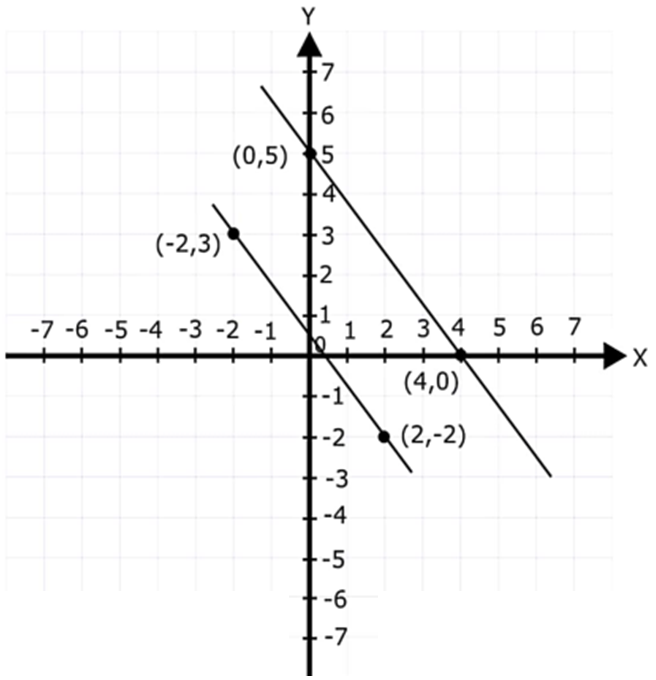
Gloria is walking along the path joining (-2, 3) and (2, -2), while Suresh is walking along the path joining (0, 5) and (4, 0). Represent this situation graphically.
Answer
Given, Gloria is walking along the path joining (-2, 3) and (2, -2), while suresh is walking along the path joining (0, 5) and (4, 0).
View full question & answer
Question 463 Marks
For what value of $\alpha,$ the system of equations will have no solution
$\alpha\text{x}+3\text{y}=\alpha-3$
$12\text{x}+\alpha\text{y}=\alpha$
 
Answer
The given system of equations may be written as,
$\alpha\text{x}+3\text{y}-(\alpha-3)=0$
$12\text{x}+\alpha\text{y}-\alpha=0$
The given system of equations is of the form
$a_1x + b_1y + c_1 = 0$
$a_2x + b_2y + c_2 = 0$
Where, $\text{a}_1=\alpha,\text{b}_1=3,\text{c}_1=-(\alpha-3)$
and, $\text{a}_2=12,\text{b}_2=\alpha,\text{c}_2=-\alpha$
For no solution, we must have
$\frac{\text{a}_1}{\text{a}_2}=\frac{\text{b}_1}{\text{b}_2}\neq\frac{\text{c}_1}{\text{c}_2}$
$\Rightarrow\frac{\alpha}{12}=\frac{3}{\alpha}\neq\frac{-(\alpha-3)}{-\alpha}$
Now,
$\frac{3}{\alpha}\neq\frac{-(\alpha-3)}{-\alpha}$
$\Rightarrow\frac{3}{\alpha}\neq\frac{\alpha-3}{\alpha}$
$\Rightarrow3\neq\alpha-3$
$\Rightarrow3+3\neq\alpha$
$\Rightarrow6\neq\alpha$
$\Rightarrow\alpha\neq6$
and $\frac{\alpha}{12}=\frac{3}{\alpha}$
$\Rightarrow\alpha^2=36$
$\Rightarrow\alpha=\pm6$
$\Rightarrow\alpha=-6$ $\big[\therefore\alpha\neq6\big]$
Hence, the given system of equations will have no solution, if $\alpha=-6$
View full question & answer
Question 473 Marks
Prove that there is a value of $(\text{c}\neq0)$ for which the system has infinitely many solutions. Find this value.
$6x + 3y = c - 3$
$12x + cy = c$
Answer
The given system of equations may be written as,
$6x + 3y - (c - 3) = 0$
$12x + cy - c = 0$
This is of the form
$a_1x + b_1y + c_1 = 0$
$a_2x + b_2y + c_2 = 0$
Where, $a_1 = 6, b_1 = 3, c_1 = -(c - 3)$
And, $a_2 = 12, b_2 = c, c_2 = -c$
For infinitely many solutions, we must have
$\frac{\text{a}_1}{\text{a}_2}=\frac{\text{b}_1}{\text{b}_2}=\frac{\text{c}_1}{\text{c}_2}$
$\Rightarrow\frac{6}{12}=\frac{3}{\text{c}}=\frac{-(\text{c}-3)}{-\text{c}}$
$\Rightarrow\frac{6}{12}=\frac{3}{\text{c}}$ and $$$\frac{3}{\text{c}}=\frac{\text{c}-3}{\text{c}}$
$\Rightarrow6\text{c}=12\times3$ and $3=(\text{c}-3)$
$\Rightarrow\text{c}=\frac{36}{6}$ and $\text{c}-3=3$
$\Rightarrow\text{c}=6$ and $\text{c}=6$
Now,
$\frac{\text{a}_1}{\text{a}_2}=\frac{6}{12}=\frac{1}{2}$
$\frac{\text{b}_1}{\text{b}_2}=\frac{3}{6}=\frac{1}{2}$
$\frac{\text{c}_1}{\text{c}_2}=\frac{-(6-3)}{-6}=\frac{1}{2}$
$\therefore\frac{\text{a}_1}{\text{a}_2}=\frac{\text{b}_1}{\text{b}_2}=\frac{\text{c}_1}{\text{c}_1}$
Clearly, for this value of c, we have $\frac{\text{a}_1}{\text{a}_2}=\frac{\text{b}_1}{\text{b}_2}=\frac{\text{c}_1}{\text{c}_2}$
Hence, the given system of equations has infinitely many solutions, if $c = 6.$
View full question & answer
Question 483 Marks
Find the value of k for which each of the following system of equations have infinitely many solutions:
$kx - 2y + 6 = 0$
$4x - 3y + 9 = 0$
Answer
The given system of equations is
$kx - 2y + 6 = 0$
$4x - 3y + 9 = 0$
The system of equations is of the form
$a_1x + b_1y + c_1 = 0$
$a_2x + b_2y + c_2 = 0$
Where, $a_1 = k, b_1 = -2, c_1 = 6$
and, $a_2 = 4, b_2 = -3, c_2 = 9$
For infinitely many solution, we must have
$\frac{\text{a}_1}{\text{a}_2}=\frac{\text{b}_1}{\text{b}_2}=\frac{\text{c}_1}{\text{c}_2}$
$\Rightarrow\frac{\text{k}}{4}=\frac{-2}{-3}=\frac{6}{9}$
Now,
$\frac{\text{k}}{4}=\frac{6}{9}$
$\Rightarrow\frac{\text{k}}{4}=\frac{2}{3}$
$\Rightarrow\text{k}=\frac{2\times4}{3}$
$\Rightarrow\text{k}=\frac{8}{3}$
Hence, the given system of equations will have infinitely many solutions if $\text{k}=\frac{8}{3}$
View full question & answer
Question 493 Marks
Ten years later, A will be twice as old as B and five years ago, A was three times as old as B. What are the present ages of A and B?
Answer
Let the age of A and B be x and y years respectively. Then,
Ten years later, the age of A will be (x + 10) years and, the age of B will be (y + 10) years.
$\therefore$ x + 10 = 2(y + 10)
⇒ x + 10 = 2y + 20
⇒ x - 2y = 20 - 10
⇒ x - 2y = 10 .....(i)
Five years ago A's age = (x - 5) years
B's ago = (y - 5) years
using the given inform ation we get
x - 5 = 3(y - 5)
⇒ x - 5 = 3y - 15
⇒ x - 3y = - 10 ....(ii)
Subtracting equation (ii) from equation (i) we get
-2y + 3y = 10 + 10
⇒ y = 20
Putting y = 20 in equation (i) we get
x - 2 × 20 = 10
⇒ x = 10 + 40
⇒ x = 50
Hence A's age = 50 years
B's age = 20 years
View full question & answer
Question 503 Marks
Find the value of k for which the following system of equations has no solution:
$kx - 5y = 2$
$6x + 2y = 7$
Answer
Given
$kx - 5y = 2$
$6x + 2y = 7$
$$To find: To determine for what value of k the system of equation has no solution
We know that the system of equations
$a_1x + b_1y = c_1$
$a_2x + b_2y = c_2$_
Where, $a_1 = k, b_1 = -5, c_1 = -2$
and,$ a_2 = 6, b_2 = 2, c_2 = -7$
For solutions,
$\frac{\text{a}_1}{\text{a}_2}=\frac{\text{b}_1}{\text{b}_2}\neq\frac{\text{c}_1}{\text{c}_2}$
Here,
$\frac{\text{k}}{6}=\frac{-5}{2}\neq\frac{2}{7}$
$\frac{\text{k}}{6}=\frac{-5}{2}$
$2k = -30$
$k = -15$
Hence for k = -15 the system of equation have infinitely many solutions.
View full question & answer
3 Marks Question - Maths STD 10 Questions - Vidyadip