Question
For what value of $k,$ the function given below is continuous at $x=0$ ? $f(x)=\left\{\begin{array}{cc}\frac{\sqrt{4+x}-2}{x} & , x \neq 0 \\ k & , x=0\end{array}\right.$

Answer

As, $f(x)=\left\{\begin{array}{cc}\frac{\sqrt{4+x-2}}{x}, & x \neq 0 \\ k, & x=0\end{array}\right.$ is continuous at $x=0$
$ \Rightarrow \ce{LHL=RHL}=f(0)  $ or $ \lim _{x \rightarrow 0} f(x)=f(0)$
$ \Rightarrow \lim _{x \rightarrow 0} \frac{\sqrt{4+x}-2}{x} \times \frac{\sqrt{4+x}+2}{\sqrt{4+x}+2}=k$
$ \Rightarrow \lim _{x \rightarrow 0} \frac{4+x-4}{x(\sqrt{4+x}+2)}=k $
$\Rightarrow k=\lim _{x \rightarrow 0} \frac{1}{(\sqrt{4+x}+2)}$
$ \therefore k=\frac{1}{4}$

Need a full question paper?

Generate a complete, print-ready paper with questions like this in minutes — across 16+ boards, with answer keys.
Start Generating Free

Similar questions

The area bounded by the curve $y = x^4 - 2x^3 + x^2 + 3$ with x-axis and ordinates corresponding to the minima of $y$ is:
Area enclosed by the circle $x^2 + y^2 = a^2$ is equal to:
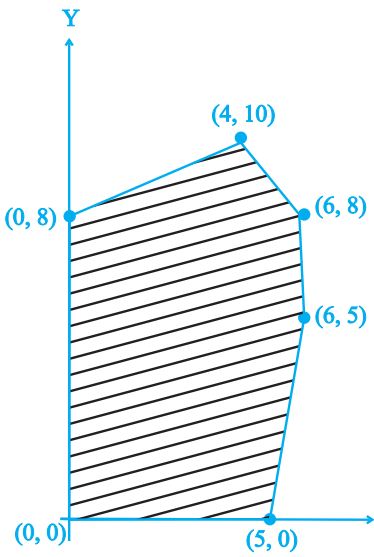
Choose the correct answer from the given four options. The feasible solution for a LPP is shown in. Let Z = 3x - 4y be the objective function.
Maximum of Z occurs at:
  1. (5, 0)
  2. (6, 5)
  3. (6, 8)
  4. (4, 10)
Which of the following transformation reduce the differential quation  into the form $\frac{\text{du}}{\text{dx}}+\text{P}(\text{x})\text{u}=\text{Q}(\text{x})$ into the from $\frac{\text{dz}}{\text{dx}}+\frac{\text{z}}{\text{x}}\log\text{z}=\frac{\text{z}}{\text{x}^{2}}(\log\text{z})^{2}$
  1. $\text{u}=\log\text{x}$
  2. $\text{u}=\text{e}^{\text{z}}$
  3. $\text{u}=(\log\text{z})^{-1}$
  4. $\text{u}=(\log\text{z})^{2}$ 
$l = m = n = 1$ represents the direction cosines of:
 The solution of the differential equation $\frac{\text{dy}}{\text{dx}}+\frac{2\text{y}}{\text{x}}=0$ with y(1) = 1 is given by.
  1. $\text{y}=\frac{1}{\text{x}^{2}}$
  2. $\text{x}=\frac{1}{\text{y}^{2}}$
  3. $\text{x}=\frac{1}{\text{y}}$
  4. $\text{y}=\frac{1}{\text{x}}$ 
Choose the correct answer from the given four options.The curve for which the slope of the tangent at any point is equal to the ratio of the abcissa to the ordinate of the point is:
  1. An ellipse.
  2. parabola.
  3. circle.
  4. rectangular hyperbola.
Choose the correct answer from the given four options.
The vector having initial and terminal points as (2, 5, 0) and (–3, 7, 4), respectively is:
  1. $-\hat{\text{i}}+12\hat{\text{j}}+4\hat{\text{k}}$
  2. $-5\hat{\text{i}}+2\hat{\text{j}}-4\hat{\text{k}}$
  3. $-5\hat{\text{i}}+12\hat{\text{j}}+4\hat{\text{k}}$
  4. $\hat{\text{i}}+\hat{\text{j}}+\hat{\text{k}}$
Associated to a random experiment two events A and B are such that $\text{P(B)}=\frac{3}{5},\text{P}(\text{A}|\text{B})=\frac{1}{2}$ and $\text{P}(\text{A}\cup\text{B})=\frac{4}{5}$. The value pf P(A) is
  1. $\frac{3}{10}$
  2. $\frac{1}{2}$
  3. $\frac{1}{10}$
  4. $\frac{3}{5}$
The region represented by the inequalities $x \geq 6, y \geq 2,2 x+y \leq 10, x \geq 0, y \geq 0$ is