Question
Choose the correct answer from the given four options. The feasible solution for a LPP is shown in. Let Z = 3x - 4y be the objective function.
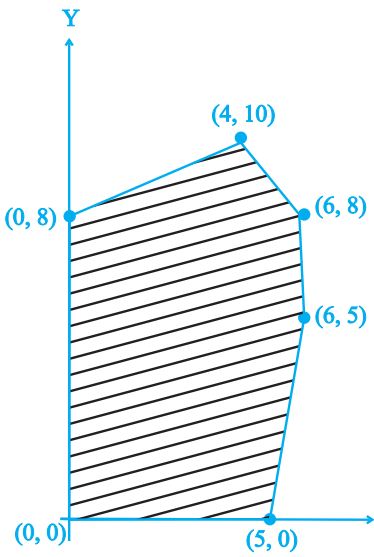
Maximum of Z occurs at:
  1. (5, 0)
  2. (6, 5)
  3. (6, 8)
  4. (4, 10)

Answer

  1. (5, 0)
Solution:
Corner points
Corresponding value of Z = 3x - 4y
(0, 0)
(5, 0)
(6, 5)
(6, 8)
(4, 10)
(0, 8)
0
15 (Maxmimum)
-2
-14
-28
-32
Hence, maximum of Z occurs at (5, 0) and its maximum value is 27.

Need a full question paper?

Generate a complete, print-ready paper with questions like this in minutes — across 16+ boards, with answer keys.

Start Generating Free

Similar questions

Let $A$ be a $3 \times 3$ matrix such that $|\operatorname{adj} A|=64$. Then $|A|$ is equal to:
Choose the correct answer from the given four options.If $\vec{\text{a}},\vec{\text{b}},\vec{\text{c}}$ are three vectors such that $\vec{\text{a}}+\vec{\text{b}}+\vec{\text{c}}=\vec{0}$ and $|\vec{\text{a}}|=2,|\vec{\text{b}}|=3$ and $|\vec{\text{c}}|=5,$ then the value of $\vec{\text{a}}\cdot\vec{\text{b}}+\vec{\text{b}}\cdot\vec{\text{c}}+\vec{\text{c}}\cdot\vec{\text{a}}$ is:
  1. 0.
  2. 1.
  3. -19.
  4. 38.
If $A$ and $B$ are symmetric matrices of the same order, then
Let $\text{U}=\sin^{-1}\Big(\frac{2\text{x}}{1+\text{x}^2}\Big)$ and $\text{V}=\tan^{-1}\Big(\frac{2\text{x}}{1-\text{x}^2}\Big),$ then $\frac{\text{dU}}{\text{dV}}=$
  1. $\frac{1}{2}$
  2. $\text{x}$
  3. $\frac{1-\text{x}^2}{\text{x}^2-4}$
  4. $1$
Let R be a relation on the set N given by R = {(a, b): a = b - 2, b > 6}. Then,
  1. (2, 4) ∈ R
  2. (3, 8) ∈ R
  3. (6, 8) ∈ R
  4. (8, 7) ∈ R
If $\text{x}+\text{y}\leq2,$ $\text{x}\leq0,$ $\text{y}\leq0$ the point at which maximum value of 3x + 2y attained will be.
If the function $\text{f(x)}=\frac{2\text{x}-\sin^{-1}\text{x}}{2\text{x}+\tan^{-1}\text{x}}$ is continuous at each point of its domain, then the value of f(0) is:
  1. $2$
  2. $\frac{1}{3}$
  3. $-\frac{1}{3}$
  4. $\frac{2}{3}$
Which of the following is correct:
  1. Determinant is a square matrix
  2. Determinant is a number associated to a matrix
  3. Determinant is a number associated to a square matrix
  4. None of these
If $w$ is a non $-$ real cube root of unity and $n$ is not a multiple of $3,$ then $\begin{vmatrix}1&\omega^{\text{n}}&\omega^{2\text{n}}\\\omega^{2\text{n}}&1&\omega^{\text{n}}\\\omega^{\text{n}}&\omega^{2\text{n}}&1\end{vmatrix}$ is equal to:
Which of the following is the integrating factor of $( x \log x ) \frac{d y}{d x}+ y =2 \log x ?$