MCQ
For which element would $XH_3$ be a stable species
- A$C$
- B$Si$
- ✓$P$
- D$S$
Generate a complete, print-ready paper with questions like this in minutes — across 16+ boards, with answer keys.
$\mathrm{x}=$ . . . . . . . . . (Nearest integer)
Given : $\left(\mathrm{K}_{\mathrm{r}}\right)_{\text {water }}=1.86 \mathrm{~K} \mathrm{~kg} \mathrm{~mol}^{-1}$.
density of acetic acid is $1.2 \mathrm{~g} \mathrm{~mol}^{-1}$
molar mass of water $=18 \mathrm{~g} \mathrm{~mol}^{-1}$.
molar mass of acetic acid $=60 \mathrm{~g} \mathrm{~mol}^{-1}$.
density of water $=1 \mathrm{~g} \mathrm{~cm}^{-3}$
Acetic acid dissociates as
$\mathrm{CH}_3 \mathrm{COOH} \rightleftharpoons \mathrm{CH}_3 \mathrm{COO}^{\oplus}+\mathrm{H}^{\oplus}$
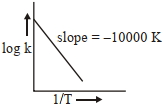
The temperature at which the rate constant of the reaction is $10^{-4} s ^{-1}$ is .............. $K$.
(Rounded-off to the nearest integer)
[Given: The rate constant of the reaction is $10^{-5} s ^{-1}$ at $500 K$.]