Force acting upon a charged particle kept between the plates of a charged condenser is $F$. If one plate of the condenser is removed, then the force acting on the same particle will become
Medium
Download our app for free and get started
(b) Initially $F = qE$ and $E = \frac{\sigma }{{{\varepsilon _0}}}$
$F = \frac{{q\sigma }}{{{\varepsilon _0}}}$
If one plate is removed, then $E$ becomes $\frac{\sigma }{{2{\varepsilon _0}}}$
So $F' = \frac{{q\sigma }}{{2{\varepsilon _0}}} = \frac{F}{2}$

Download our appand get started for free
Experience the future of education. Simply download our apps or reach out to us for more information. Let's shape the future of learning together!No signup needed.*
Similar Questions
- 1During charging a capacitor variation of potential $V$ of the capacitor with time $t$ is shown asView Solution
- 2The distance between the plates of a charged parallel plate capacitor is $5\ cm$ and electric field inside the plates is $200\ Vcm^{-1}$. An uncharged metal bar of width $2\ cm$ is fully immersed into the capacitor. The length of the metal bar is same as that of plate of capacitor. The voltage across capacitor after the immersion of the bar is......$V$View Solution
- 3Two point dipoles of dipole moment ${\vec P_1}$ and ${\vec P_2}$ are at a distance $x$ from each other and ${\vec P_1}$ || ${\vec P_2}$. The force between the dipoles isView Solution
- 4If the electric potential at any point $(x, y, z) \,m$ in space is given by $V =3 x ^{2}$ volt. The electric field at the point $(1,0,3) \,m$ will be ............View Solution
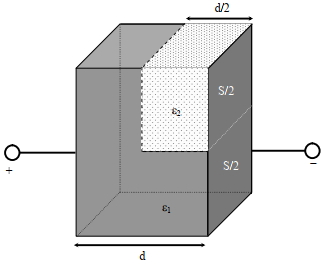
- 5A parallel plate capacitor having plates of area $S$ and plate separation $d$, has capacitance $C _1$ in air. When two dielectrics of different relative permittivities $\left(\varepsilon_1=2\right.$ and $\left.\varepsilon_2=4\right)$ are introduced between the two plates as shown in the figure, the capacitance becomes $C _2$. The ratio $\frac{ C _2}{ C _1}$ isView Solution
- 6Equipotential surfaces associated with an electric field which is increasing in magnitude along the $x$-direction areView Solution
- 7The two metallic plates of radius $r$ are placed at a distance $d$ apart and its capacity is $C$. If a plate of radius $r/2$ and thickness $d$ of dielectric constant $6$ is placed between the plates of the condenser, then its capacity will beView Solution
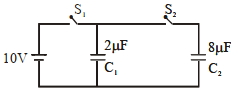
- 8A $2\, \mu F$ capacitor $C _{1}$ is first charged to a potential difference of $10\, V$ using a battery.Then the battery is removed and the capacitor is connected to an uncharged capacitor $C _{2}$ of $8\, \mu F$. The charge in $C _{2}$ on equilibrium condition is $\ldots\,\mu C$. (Round off to the Nearest Integer)View Solution
- 9View SolutionState which of the following is correct
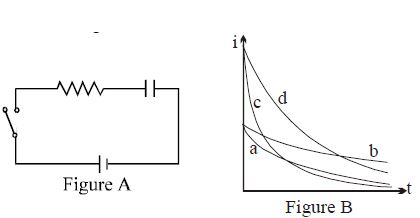
- 10After the switch shown in figure $A$ is closed, there is current $i$ through resistance $R$. Figure $B$ indicates current variation curves $a, b, c$ and $d$ for four sets of values of $R$ and capacitance $C$:View Solution
$(i)$ $R_0$ and $C_0$, $(ii)$ $2R_0$ and $C_0$,
$(iii)$ $R_0$ and $2C_0$, $(iv)$ $2R_0$ and $2C_0$.
Which set goes with which curve?