The two metallic plates of radius $r$ are placed at a distance $d$ apart and its capacity is $C$. If a plate of radius $r/2$ and thickness $d$ of dielectric constant $6$ is placed between the plates of the condenser, then its capacity will be
Diffcult
Download our app for free and get started
(d) Area of the given metallic plate $A = \pi r^2$
Area of the dielectric plate $A' = \pi \,{\left( {\frac{r}{2}} \right)^2} = \frac{A}{4}$
Uncovered area of the metallic plates
$ = A - \frac{A}{4} = \frac{{3A}}{4}$
The given situation is equivalent to a parallel combination of two capacitor. One capacitor $(C')$ is filled with a dielectric medium $(K = 6)$ having area $\frac{A}{4}$ while the other capacitor $(C'')$ is air filled having area $\frac{{3A}}{4}$
Hence
$ = \frac{{{\varepsilon _0}A}}{d}\left( {\frac{K}{4} + \frac{3}{4}} \right)$$ = \frac{{{\varepsilon _0}A}}{d}\,\left( {\frac{6}{4} + \frac{3}{4}} \right) = \frac{9}{4}\,C$
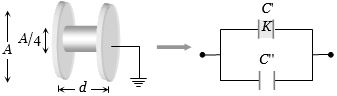
Area of the dielectric plate $A' = \pi \,{\left( {\frac{r}{2}} \right)^2} = \frac{A}{4}$
Uncovered area of the metallic plates
$ = A - \frac{A}{4} = \frac{{3A}}{4}$
The given situation is equivalent to a parallel combination of two capacitor. One capacitor $(C')$ is filled with a dielectric medium $(K = 6)$ having area $\frac{A}{4}$ while the other capacitor $(C'')$ is air filled having area $\frac{{3A}}{4}$
Hence
$ = \frac{{{\varepsilon _0}A}}{d}\left( {\frac{K}{4} + \frac{3}{4}} \right)$$ = \frac{{{\varepsilon _0}A}}{d}\,\left( {\frac{6}{4} + \frac{3}{4}} \right) = \frac{9}{4}\,C$

Download our appand get started for free
Experience the future of education. Simply download our apps or reach out to us for more information. Let's shape the future of learning together!No signup needed.*
Similar Questions
- 1If ${q}_{{f}}$ is the free charge on the capacitor plates and ${q}_{{b}}$ is the bound charge on the dielectric slab of dielectric constant $k$ placed between the capacitor plates, then bound charge $q_{b}$ can be expressed asView Solution
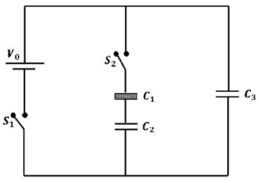
- 2Three identical capacitors $\mathrm{C}_1, \mathrm{C}_2$ and $\mathrm{C}_3$ have a capacitance of $1.0 \mu \mathrm{F}$ each and they are uncharged initially. They are connected in a circuit as shown in the figure and $\mathrm{C}_1$ is then filled completely with a dielectric material of relative permittivity $\varepsilon_{\mathrm{r}}$. The cell electromotive force (emf) $V_0=8 \mathrm{~V}$. First the switch $S_1$ is closed while the switch $S_2$ is kept open. When the capacitor $C_3$ is fully charged, $S_1$ is opened and $S_2$ is closed simultaneously. When all the capacitors reach equilibrium, the charge on $\mathrm{C}_3$ is found to be $5 \mu \mathrm{C}$. The value of $\varepsilon_{\mathrm{r}}=$. . . .View Solution
(image)
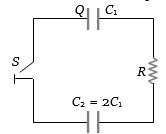
- 3Two capacitors $C_1$ and $C_2 = 2C_1$ are connected in a circuit with a switch between them as shown in the figure. Initially the switch is open and $C_1$ holds charge $Q$. The switch is closed. At steady state, the charge on each capacitor will beView Solution
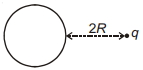
- 4A positive point charge $q$ is placed at a distance $2 R$ from the surface of a metallic shell of radius $R$. The electric field at centre of shell due to induced charge has magnitudeView Solution
- 5A capacitor of capacitance $6\,\mu \,F$ is charged upto $100$ $volt$. The energy stored in the capacitor is........$Joule$View Solution
- 6In an hydrogen atom, the electron revolves around the nucleus in an orbit of radius $0.53 \times {10^{ - 10}}\,m$. Then the electrical potential produced by the nucleus at the position of the electron is......$V$View Solution
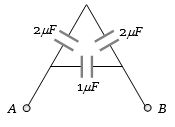
- 7What is the effective capacitance between $A$ and $B$ in the following figure........$\mu \,F$View Solution
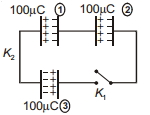
- 8Three identical charged capacitors each of capacitance $5 \,\mu F$ are connected as shown in figure. Potential difference across capacitor $(3)$, long time after the switches $K_1$ and $K_2$ are is closed, is ............ $V$View Solution
- 9The electric potential at any point as a function of distance $(x)$ in meter is given by $V = 5x^2 + 10x -9 \,(volt)$ Value of electric field at $x = 1$ is......$Vm^{-1}$View Solution
- 10A fully charged capacitor has a capacitance $‘C’$. It is discharged through a small coil of resistance wire embedded in a thermally insulated block of specific heat capacity $‘s’$ and mass $‘m’$. If the temperature of the block is raised by ‘$\Delta T$’, the potential difference $‘V’$ across the capacitance isView Solution