Question
Force between the two parallel wires carrying currents has been used to define:

Answer

Ampere is defined as the constant current that will produce an attractive force of $2\times 10^{−7}$ newton per metre of length between two straight, parallel conductors $($carrying the constant current$)$ of infinite length and negligible circular cross section placed one metre apart in a vacuum. This is the Ampere's Force Law.

Need a full question paper?

Generate a complete, print-ready paper with questions like this in minutes — across 16+ boards, with answer keys.
Start Generating Free

Similar questions

Two identical cells send the same current in $2 \Omega$ resistance, whether connected in series or in parallel. The internal resistance of the cell should be
Assertion :   If a point charge q is placed in front of an infinite grounded conducting plane surface, the point charge will experience a force.
Reason     : This force is due to the induced charge on the conducting surface which is at zero potential.(a) If both assertion and reason are true and the reason is the correct explanation of the assertion.(b) If both assertion and reason are true but reason is not the correct explanation of the assertion.(c) If assertion is true but reason is false.(d) If the assertion and reason both are false.


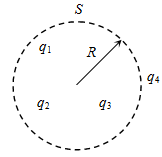
$q_1, q_2, q_3$ and $q_4$ are point charges located at points as shown in the figure and $S$ is a spherical Gaussian surface of radius $R$. Which of the following is true according to the Gauss’s law
Consider an optical communication system operating at $\lambda \sim 800 \mathrm{~nm}$. Suppose, only $1 \%$ of the optical source frequency is the available channel bandwidth for optical communication. How many channels can be accommodated for transmitting audio signals requiring a bandwidth of $8 \ \text{kHz}$
The universal property among all substances is
If a convex lens of focal  length 80 cm and a concave lens of focal length 50 cm are combined together, what will be their resulting power(a) + 6.5D(b) – 6.5 D(c) + 7.5 D(d) – 0.75 D
       
A $PN-$ junction has a thickness of the order of
At temperature 0K, the germanium behaves as a/ an:
Drift velocity $v _{ d }$ varies with the intensity of electric field as per the relation
A lens (focal length 50 cm) forms the image of a distant object which subtends an angle of 1 milliradian at the lens. What is the size of the image(a) 5 mm (b) 1 mm(c) 0.5 mm(d) 0.1 mm