MCQ
Force between two charges at rest is $........$?
  • electrostatic force.
  • B
    elector magnetic force.
  • C
    real force.
  • D
    dynamic force.

Answer

Correct option: A.
electrostatic force.

Force between two charges at rest is electrostatic force of coulomb's law.

Need a full question paper?

Generate a complete, print-ready paper with questions like this in minutes — across 16+ boards, with answer keys.

Start Generating Free

Similar questions

An inductor of reactance $1 \Omega$ and a resistor of $2 \Omega$ are connected in series to the terminals of a $6 V (rms) a.c.$ source. The power dissipated in the circuit is:
The electric field at a distance $\frac{3R}{2}$ from the centre of a charged conducting spherical shell of radius $R$ is $E.$ The electric field at a distance $\frac{R}{2}$ from the centre of the sphere is 
Work done in moving a positive charge on an equipotential surface is
A total charge $Q$ is broken in two parts ${Q_1}$ and ${Q_2}$ and they are placed at a distance $R$ from each other. The maximum force of repulsion between them will occur, when
A glass convex lens $\left(\mu_{ g }=1.5\right)$ has a focal length of 8 cm when placed in air. What would be the focal length of the lens when it is immersed in water $\left(\mu_{ w }=1.33\right)$
The relative permittivity of distilled water is $81 .$ The velocity of light in it will be $....\,\times 10^{7}\,{m} / {s}$

$\left(\right.$ Given $\left.\mu_{r}=1\right)$

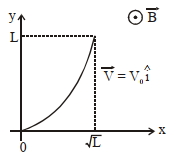
A conducting wire of parabolic shape, initially $y=x^2$, is moving with velocity $\overrightarrow{ V }= V _0 \hat{ i }$ in a nonuniform magnetic field $\vec{B}=B_0\left(1+\left(\frac{y}{L}\right)^\beta\right) \hat{k}$, as shown in figure. If $V_0, B_0, L$ and $\beta$ are positive constants and $\Delta \phi$ is the potential difference developed between the ends of the wire, then the correct statement(s) is/are:

$(1)$ $|\Delta \phi|$ remains the same if the parabolic wire is replaced by a straight wire, $y=x$ initially, of length $\sqrt{2} L$

$(2)$ $|\Delta \phi|$ is proportional to the length of the wire projected on the $y$-axis.

$(3)$ $|\Delta \phi|=\frac{1}{2} B _0 V _0 L$ for $\beta=0$

$(4)$ $|\Delta \phi|=\frac{4}{3} B_0 V_0 L$ for $\beta=2$
In an ac circuit, potential differenc is $V =10 \cos \omega t$ and current flowing through is $I =2 \sin \omega t$ then magnitude of power dissipated is :
A particle of charge $Q$ and mass $M$ moves in a circular path of radius $R$ in a uniform magnetic field of magnitude $B$. The same particle now moves with the same speed in a circular path of same radius $R$ in the space between the cylindrical electrodes of the cylindrical capacitor. The radius of the inner electrode is $R/2$ while that of the outer electrode is $ 3R/2.$ Then the potential difference between the capacitor electrodes must be
According to Bohr's theory, the expressions for the kinetic and potential energy of an electron revolving in an orbit is given respectively by