MCQ
Work done in moving a positive charge on an equipotential surface is
  • A
    Finite, positive but not zero
  • B
    Finite, negative but not zero
  • Zero
  • D
    Infinite

Answer

Correct option: C.
Zero
c
(c) Work done $ = (\Delta V)\,Q$
For an equipotential surface.

Need a full question paper?

Generate a complete, print-ready paper with questions like this in minutes — across 16+ boards, with answer keys.
Start Generating Free

Similar questions

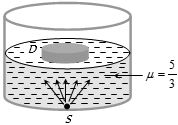
A point source of light $S$ is placed at the bottom of a vessel containing a liquid of refractive index $5/3$. A person is viewing the source from above the surface. There is an opaque disc $D$ of radius $1\, cm$ floating on the surface of the liquid. The centre of the disc lies vertically above the source $S$. The liquid from the vessel is gradually drained out through a tap. The maximum height of the liquid for which the source cannot be seen at all from above is......$cm$
In Bohr's model, if the atomic radius of the first orbit is $r_0$, then the radius of the fourth orbit is
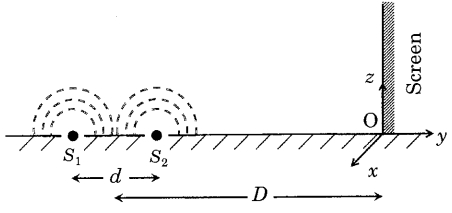
While conducting the Young's double slit experiment, a student replaced the two slits with a large opaque plate in the $x-y$ plane containing two small holes that act as two coherent point sources $\left(S_1, S_2\right)$ emitting light of wavelength $600 \mathrm{~nm}$. The student mistakenly placed the screen parallel to the $x-z$ plane (for $z>0$ ) at a distance $D=3 \mathrm{~m}$ from the mid-point of $S_1 S_2$, as shown schematically in the figure. The distance between the sources $d=0.6003 \mathrm{~mm}$. The origin $\mathrm{O}$ is at the intersection of the screen and the line joining $S_1 S_2$. Which of the following is(are) true of the intensity pattern on the screen?

($A$) Straight bright and dark bands parallel to the $x$-axis

($B$) The region very close to the point $O$ will be dark

($C$) Hyperbolic bright and dark bands with foci symmetrically placed about $\mathrm{O}$ in the $x$-direction

($D$) Semi circular bright and dark bands centered at point $\mathrm{O}$
The fine powder of a coloured glass is seen as
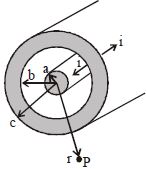
A coaxial cable having radii $a, b$ and $c$ carries equal and opposite currents of magnitude $i$ the inner and outer conductors. What is the magnitude of the magnetic induction at point $P$ outside of the cable at a distance $r$ from the axis?
A long vertical wire in which a current is flowing produces a neutral point with the earth's magnetic field at a distance of $5\, cm$ from the wire. If the horizontal component of the earth's magnetic induction is $0.18\, gauss$, then the curent in the wire is......$A$
When $5\ V$ potential difference is applied across a wire of length $0.1\ m$, the drift speed of electrons is $2.5 \times 10^{-4}$ $ms^{-1}$ . If the electron density in the wire is $8 \times 10^{28}$ $m^{-3}$ the resistivity of the material is close to
In a hypothetical fission reaction

${ }_{92} \mathrm{X}^{236} \rightarrow{ }_{56} \mathrm{Y}^{141}+{ }_{36} \mathrm{Z}^{92}+3 \mathrm{R}$

The identity of emitted particles $(R)$ is :

Three capacitors $2,\, 3$ and $6\  \mu F$ are joined in series with each other. What is the minimum effective capacitance......$\mu \,F$
The refractive index of flint glass for blue $F$ line is $1.6333$ and red $C$ line is $1.6161.$ If the refractive index for yellow $D$ line is $1.622,$ the dispersive power of the glass is