MCQ
forceA particle moves with constant speed $v$ along a circular path of radius $r$ and completes the circle in time $T$. The acceleration of the particle is
  • $2\,\pi \,v/T$
  • B
    $2\,\pi \,r/T$
  • C
    $2\,\pi \,{r^2}/T$
  • D
    $2\,\pi \,{v^2}/T$

Answer

Correct option: A.
$2\,\pi \,v/T$
a
(a)Acceleration$ = {\omega ^2}r = \frac{{{v^2}}}{r} = \omega v = \frac{{2\pi }}{T}v$

Need a full question paper?

Generate a complete, print-ready paper with questions like this in minutes — across 16+ boards, with answer keys.

Start Generating Free

Similar questions

A body under the action of several forces will have zero acceleration
According to kinetic theory of gases,

$A$. The motion of the gas molecules freezes at $0^{\circ} C$

$B$. The mean free path of gas molecules decreases if the density of molecules is increased.

$C$. The mean free path of gas molecules increases if temperature is increased keeping pressure constant.

$D$. Average kinetic energy per molecule per degree of freedom is $\frac{3}{2} k_{B} T$ (for monoatomic gases)

Choose the most appropriate answer from the options given below
Suppose universal gravitational constant starts to decrease, then:
If the ratio of cross-sections of a tube of unequal radius at two places is 1 : 2, then for an incompressible fluid the ratio of the mass of the fluid entering and exiting the tube will be :
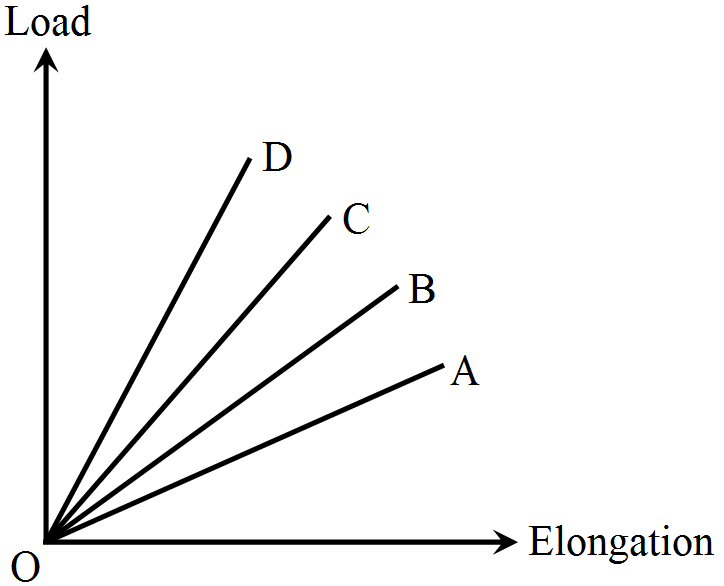
The load versus elongation graph for four wires of the same material is shown in the fig. The thinnest wire is represented by the line.
A physical quantity which has a direction
A simple pendulum performs simple harmonic motion about $X = 0$ with an amplitude $A$ and time period $T$. The speed of the pendulum at $X = \frac{A}{2}$ will be
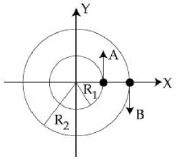
Two particles $A, B$ are moving on two concentric circles of radii $R_1$ and $R_2$ with equal angular speed $\omega $. At $t = 0,$ their positions and direction of motion are shown in the figure

The relative velocity $\overrightarrow {{V_A}}  - \overrightarrow {{V_B}} $ at $t = \frac{\pi }{{2\omega }}$ is given by
A body of mass $m$ is projected at an angle of ${45^o}$ with the horizontal. If air resistance is negligible, then total change in momentum when it strikes the ground is
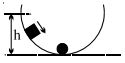
$A$ block of mass $m$ starts from rest and slides down $a$ frictionless semi-circular track from $a$ height $h$ as shown. When it reaches the lowest point of the track, it collides with a stationary piece of putty also having mass $m$. If the block and the putty stick together and continue to slide, the maximum height that the block-putty system could reach is: