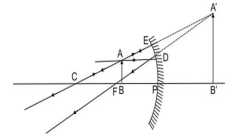
Question
Form the image in case an object is moved from infinity to the concave mirror.
Answer

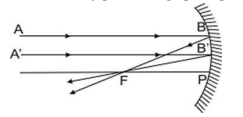
i. Object at Infinity. Two cases arise :
a. When mirror is in parallel plane to the object. In such a case, rays from infinity come parallel to principal axis. After
reflection they pass through principal focus F (Rule 1). Image is extremely small, it is real, inverted and at principal focus.
Image
Object at infinity, real extremely diminished image is formed at principal focus.
b. When mirror is inclined so that the rays strike the mirror obliquely. The ray AB passing through F after reflection goes
parallel to principal axis towards BA' (Rule 2). Another ray DE through C striking the mirror at E is reflected back. The
two form an image at A' Image is real, inverted, extremely diminished and at F.
Image
Object at infinity, image at F. It is real, inverted, very much diminished.
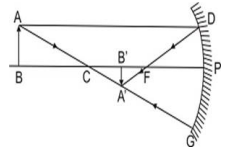
c. Object beyond C. A ray AD from A parallel to principal axis after reflection passes through F (Rule 1), Another ray from
A through C, ray AG is reflected back along the same path (Rule 3), forming real, diminished, inverted image of AB is
formed at A'B', between F and C.
Image
Object beyond C, a real, inverted diminished image between F and C, inverted at C and is of same size as that of object.
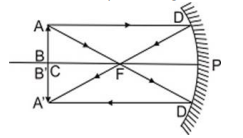
d. Object at C i.e. at 2f. A ray AD from A parallel to principal axis after reflection from mirror passes through F (Rule 1).
Another ray AD' from A through F, goes parallel to principal axis i.e. towards D'A' (rule 2) forming real, inverted image of
AB at C i.e. at 2f. The image is of the same size as the object.
Image
Object at C, Image is also at C. It is real.
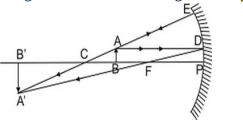
Object between F and C (f and 2f) A ray AD from object going parallel to principal axis is reflected towards F (Rule 1).
Another ray AE through C is reflected back (Rule 3) forming image of A at A'. Similarly image of B is formed at B'.
Image is real, inverted, enlarged and beyond C (2f) i.e. as shown in fig.
Image
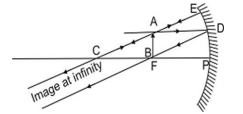
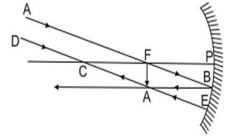
f. Object at F. A ray AD parallel to principal axis passes through F. Another ray AE strikes the mirror normally at E is
reflected back as it passes through C (Rule 3). They form image of object AB at infinity. The image is very much enlarged
and is real and inverted.
Image
Object at E. Real, inverted, extremely enlarged image is formed at infinity.
g. Object between F and P. A ray AD from A goes parallel to principal axis after reflection passes through F (rule 1). Another
ray AE striking the mirror normally through C is reflected back (rule 3). They form virtual image of the object behind the
mirror. The image is erect and enlarged.
Image

Object between F and P. An erect, enlarged, virtual image is formed behind the mirror.

Images Formed by a Concave mirror
Position of ObjectPosition of ImageSize of the ImageNature of Image
At infinityAt focus FHighly diminishedReal and inverted
At CAt CSame sizeReal and inverted
At FAt infinityHighly EnlargedReal and inverted
Beyond CBetween F and CDiminishedReal and inverted
Between F and CBeyond CEnlargedReal and inverted
Between P and FBehind the mirrorEnlargedVirtual and erect


Need a full question paper?

Generate a complete, print-ready paper with questions like this in minutes — across 16+ boards, with answer keys.
Start Generating Free

Similar questions

Following are the two examples of plant movement. One is drooping of leaves in touch-me-not plant and second is
attaching of pea plant to a support with the help of tendrils.
i. What is the stimulus which is common for movement in both the cases?
ii. What is the difference in movement in both the plants? Explain
iii. Give appropriate scientific terms for the movements described in both cases.
What is an electric motor? With the help of a labelled diagram, describe the working of a simple electric motor.
A filamentous alga X is found in ponds, lakes and slow-moving streams. The filament of this alga simply breaks into two (or more) pieces on maturing and each piece then grows to become a complete new alga.
  1. Name an alga which X is likely to be.
  2. What is the colour of X?
  3. What is the method of forming new algae by the breaking of parent alga known as?
  4. An Amoeba also breaks up to form two daughter Amoebae. What is the difference in the splitting of Amoeba and splitting of this alga as a method of reproduction?
  5. Name one marine animal which reproduces in the same way as alga X.
It is desired to obtain an erect image of an object, using concave mirror of focal length of 12 cm.
  1. What should be the range of distance of an object placed in front of the mirror?
  2. Will the image be smaller or larger than the object. Draw ray diagram to show the formation of image in this case.
  3. Where will the image of this object be, if it is placed 24 cm in front of the mirror? Draw ray diagram for this situation also to justify your answer.
Show the positions of pole, principal focus and the centre of curvature in the above ray diagrams.
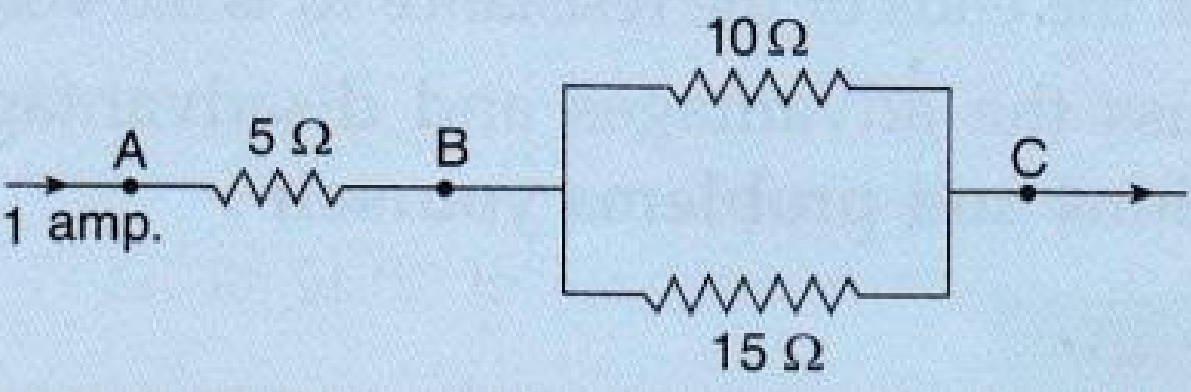
Three resistors are connected as shown in the diagram.

Through the resistor 5 ohm, a current of 1 ampere is flowing,
  1. What is the current through the other two resistors?
  2. What is the p.d. across AB and across AC?
  3. What is the total resistance?
Why did Mendel choose pea plant for his experiments?
Consider the following food chains:
  1. Plants → Mice → Snakes → Hawks
  2. Plants → Mice → Hawks
If energy available at the producer level in both the food chains is 100J, in which case will hawks get more energy as food and by how much? Justify your answer.
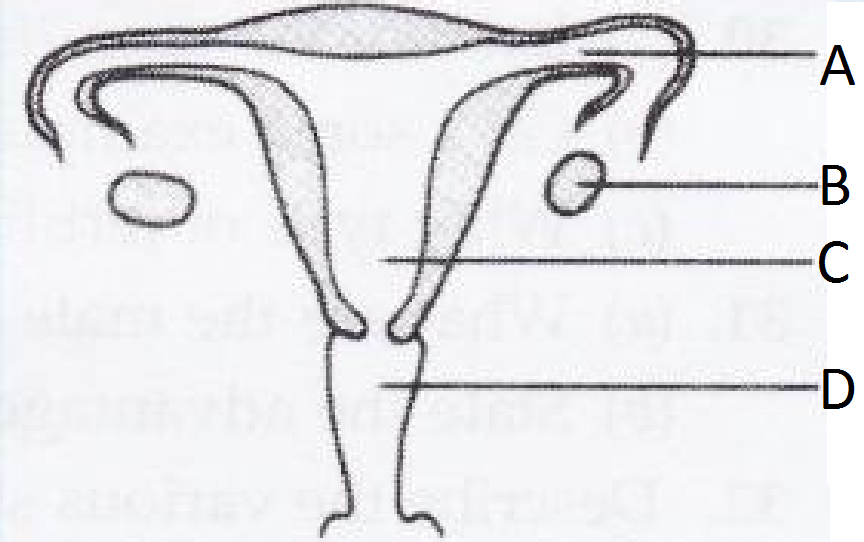
The diagram shows female reproductive system. Name the parts labelled A to D.
  1. In which part do the sperms enter?
  2. Which part releases the egg?
  3. In which part does fertilisation take place?
  4. In which part does the foetus develop?
The pH values of five solutions A, B, C, D and E are given below:
  1. 1
  2. 5
  3. 7
  4. 11
  5. 13
Which solution is:
  1. Weakly alkaline.
  2. Neutral.
  3. Strongly acidic.
  4. Strongly alkaline, and.
  5. Weakly acidic?
Describe the working of an AC generator with the help of a labeled circuit diagram. What changes must be made in the arrangement to convert it to a DC generator?