Questions

[5 marks Questions]

🎯

Test yourself on this topic

6 questions · timed · auto-graded

Question 15 Marks
Draw a ray diagram in each of the following cases to show the formation of image, when the object is placed:
i. between optical center and principal focus of a convex lens.
ii. anywhere in front of a concave lens.
iii. at 2F of a convex lens.
State the signs and values of magnifications in the above mentioned cases (i) and (ii).
Answer
i. When an object is placed between the optical center and principal focus of a convex lens then image formed beyond 2F on the
opposite side.
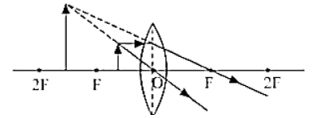
Image
Since the image formed is virtual and erect so sign of magnification will be positive. Moreover, the image formed is magnified
therefore the absolute value of magnification will be greater than one.
ii. When an object is placed anywhere in front of a concave lens.
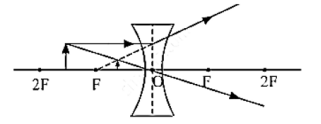
ImageSince the image formed is virtual and erect so sign of magnification will be positive. Moreover, the image formed is
diminished therefore the absolute value of magnification will be less than one.
iii. When an object is placed at 2F of a convex lens then the image is formed at 2F opposite side of the mirror.
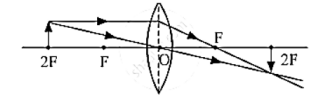
Image
View full question & answer
Question 25 Marks
Form the image in case an object is moved from infinity to the concave mirror.
Answer
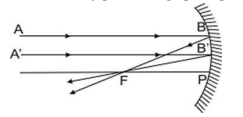
i. Object at Infinity. Two cases arise :
a. When mirror is in parallel plane to the object. In such a case, rays from infinity come parallel to principal axis. After
reflection they pass through principal focus F (Rule 1). Image is extremely small, it is real, inverted and at principal focus.
Image
Object at infinity, real extremely diminished image is formed at principal focus.
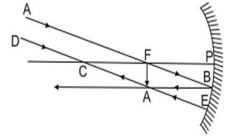
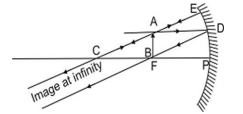
b. When mirror is inclined so that the rays strike the mirror obliquely. The ray AB passing through F after reflection goes
parallel to principal axis towards BA' (Rule 2). Another ray DE through C striking the mirror at E is reflected back. The
two form an image at A' Image is real, inverted, extremely diminished and at F.
Image
Object at infinity, image at F. It is real, inverted, very much diminished.
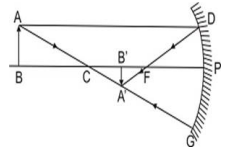
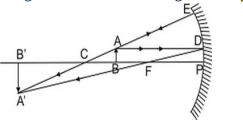
c. Object beyond C. A ray AD from A parallel to principal axis after reflection passes through F (Rule 1), Another ray from
A through C, ray AG is reflected back along the same path (Rule 3), forming real, diminished, inverted image of AB is
formed at A'B', between F and C.
Image
Object beyond C, a real, inverted diminished image between F and C, inverted at C and is of same size as that of object.
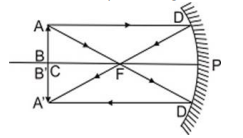
d. Object at C i.e. at 2f. A ray AD from A parallel to principal axis after reflection from mirror passes through F (Rule 1).
Another ray AD' from A through F, goes parallel to principal axis i.e. towards D'A' (rule 2) forming real, inverted image of
AB at C i.e. at 2f. The image is of the same size as the object.
Image
Object at C, Image is also at C. It is real.
Object between F and C (f and 2f) A ray AD from object going parallel to principal axis is reflected towards F (Rule 1).
Another ray AE through C is reflected back (Rule 3) forming image of A at A'. Similarly image of B is formed at B'.
Image is real, inverted, enlarged and beyond C (2f) i.e. as shown in fig.
Image
f. Object at F. A ray AD parallel to principal axis passes through F. Another ray AE strikes the mirror normally at E is
reflected back as it passes through C (Rule 3). They form image of object AB at infinity. The image is very much enlarged
and is real and inverted.
Image
Object at E. Real, inverted, extremely enlarged image is formed at infinity.
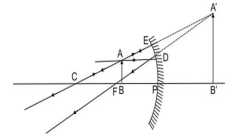
g. Object between F and P. A ray AD from A goes parallel to principal axis after reflection passes through F (rule 1). Another
ray AE striking the mirror normally through C is reflected back (rule 3). They form virtual image of the object behind the
mirror. The image is erect and enlarged.
Image

Object between F and P. An erect, enlarged, virtual image is formed behind the mirror.

Images Formed by a Concave mirror
Position of ObjectPosition of ImageSize of the ImageNature of Image
At infinityAt focus FHighly diminishedReal and inverted
At CAt CSame sizeReal and inverted
At FAt infinityHighly EnlargedReal and inverted
Beyond CBetween F and CDiminishedReal and inverted
Between F and CBeyond CEnlargedReal and inverted
Between P and FBehind the mirrorEnlargedVirtual and erect


View full question & answer
Question 35 Marks
Following are the two examples of plant movement. One is drooping of leaves in touch-me-not plant and second is
attaching of pea plant to a support with the help of tendrils.
i. What is the stimulus which is common for movement in both the cases?
ii. What is the difference in movement in both the plants? Explain
iii. Give appropriate scientific terms for the movements described in both cases.
Answer
i. Touch is the stimulus which is common for movement in both the cases.
ii. Drooping of leaves in touch-me-not plant is an example of growth-independent movement which occurs due to change in
turgour pressure of the cells. But attaching of pea plant to a support with help of tendrils is a growth dependent movement.
The pea plants develop tendrils which are sensitive to touch. When they come in contact with a support they encircle the
support and clings to them. Auxin hormone plays an important role. Auxin synthesized at the tip diffuses to parts away from
the support, so those parts away from support grow faster than those parts in contact. So the tendrils encircle the support.
iii. Drooping of leaves in touch-me-not plant is an example of seismonastic movement whereas attaching of pea plant to a support with the help of tendrils is an example of curvature movement.
View full question & answer
Question 45 Marks
a. What is reproduction? List its two types.
b. How are the modes of reproduction different in unicellular and multicellular organisms?
Answer
a. Reproduction- It is a biological process by which new individual organisms (offspring)are produced from their parents.
Types of reproduction:-
(i) Asexual reproduction
(ii) Sexual reproduction
b.
Unicellular OrganismsMulticellular Organisms
Only one parent is required for reproduction.Two parents are required for reproduction.
It is a fast process of reproduction.Slower than unicellular organisms.
No specialized cells are required for reproduction.Specialized cells are required for reproduction.
View full question & answer
Question 55 Marks
An organic compound A is widely used as a preservative in pickles and has a molecular formula $C _2 H _4 O _2$. This compound reacts with ethanol to form a sweet smelling compound B.
i. Identify the compound A.
ii. Write the chemical equation for its reaction with ethanol to form compound B.
iii. How can we get compound A form B?
iv. Name the process and write corresponding chemical equation.
v. Which gas is produced when compound A reacts with washing soda? Write the chemical equation.
Answer
i. A is ethanoic acid $\left( CH _3 COOH \right)$. Commonly, known as acetic acid. Its 5 % solution in water is used to prepare vinegar, which is used as preservatives for pickles.
ii. $\underset{(A)}{ CH _3 COOH }+\underset{\text { Ethanol }}{ C _2 H _5 OH } \xrightarrow{\text { Conc. } H _2 SO _4} CH _3 COOC _2 H _5+ H _2 O$
iii. Compound A (ethanoic acid) can be obtained from compound B (ethyl ethanoate) by the action of a base.
iv. Saponification.
$CH _3 COOC _2 H _5 \xrightarrow{ NaOH } \underset{\text { Ethanol }}{ C _2 H _5 OH }+ CH _3 COONa$
v. $CO _2$gas is produced. This reaction is same as reaction of acid with metal carbonate.
$CH _3 COOH +\underset{\text { Washing soda }}{ Na _2 CO _3} \rightarrow 2 CH _3 COONa + H _2 O + CO _2 \uparrow$
View full question & answer
Question 65 Marks
A compound C (molecular formula, $C _2 H _4 O _2$) reacts with Na - metal to form a compound R and evolves a gas that burns with a pop sound. Compound C on treatment with an alcohol A in presence of an acid forms a sweetsmelling compound S (molecular formula, $C _3 H _6 O _2$). On the addition of NaOH to C, it also gives R and water. S on treatment with NaOH solution gives back R and A.
Identify C, R, A, S, and write down the reactions involved.
Answer
Compound 'C' is ethanoic acid. It reacts with sodium to form sodium ethanoate. Therefore, compound 'R' is sodium ethanoate or
sodium acetate. We know that hydrogen gas burns with a pop sound. This reaction can be represented as-
$2 CH _3 COOH +2 Na \longrightarrow 2 CH _3 COONa + H _2$
When ethanoic acid reacts with methanol in the presence of an acid, we get (methyl ethanoate) ester which is a sweet-smelling
substance. Hence, compound S is methyl ethanoate and A is methanol. This reaction can be represented as-
$CH _3 COOH + CH _3 OH \xrightarrow{\text { Acid }} CH _3 COOH - CH _3$
When sodium hydroxide is added to ethanoic acid, it gives sodium ethanoate and water as given below-
$CH _3 COOH + NaOH \longrightarrow CH _3 COONa + H _2 O$
When methyl ethanoate is treated with NaOH solution, it gives back methanol and sodium ethanoate as shown below-
$CH _3 COO - CH _3+ NaOH \longrightarrow CH _3 OH + CH _3 COONa$
View full question & answer
[5 marks Questions] - Science STD 10 Questions - Vidyadip