MCQ
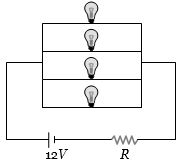
Four identical electrical lamps are labelled $1.5\,V$, $0.5\,A$ which describes the condition necessary for them to operate at normal brightness. A $12\,V$ battery of negligible internal resistance is connected to lamps as shown, then
  • A
    The value of $R$ for normal brightness of each lamp is $(3/4)$ $\Omega$
  • The value of $R$ for normal brightness of each lamp is $(21/4)$ $\Omega$
  • C
    Total power dissipated in circuit when all lamps are normally bright is $24\,W$
  • D
    Power dissipated in $R$ is $21\,W$ when all lamps are normally bright
Answer

Correct option: B.
The value of $R$ for normal brightness of each lamp is $(21/4)$ $\Omega$
b
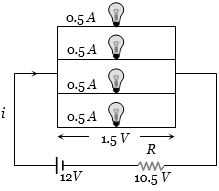
For normal brightness of each bulb see following circuit. Current through each bulb $=$ $0.5\, A$

So main current $i = 2\,A$

Also, voltage across the combination $ = 1.5\,V$

So voltage across the resistance $ = 10.5\,V$

Hence for resistance $V = i\,R$ $ \Rightarrow $  $10.5 = 2 \times R$ $ \Rightarrow $ $R = \frac{{21}}{4}\,\Omega $

Need a full question paper?

Generate a complete, print-ready paper with questions like this in minutes — across 16+ boards, with answer keys.

Start Generating Free

Similar questions

Kinetic energy with the electrons are emitted from the metal surface due to photoelectric effect is:
A ray of monochromatic light is incident on one refracting face of a prism of angle $75^o $. It passes through the prism and is incident on the other face at the critical angle. If the refractive index of the material of the prism is $\sqrt 2 $, the angle of incidence on the first face of the prism is.......$^o$
A beam of well collimated cathode rays travelling with a speed of $5 \times {10^6}\,m{s^{ - 1}}$ enter a region of mutually perpendicular electric and magnetic fields and emerge undeviated from this region. If $| B |=0.02\; T$, the magnitude of the electric field is
In a transformer, the number of turns in primary and secondary are $500$ and $2000$ respectively. If current in primary is $48\, A$, the current in the secondary is........$A$
In the circuit shown in the figure, the total charge in $750\, \mu C$ and the voltage across capacitor $C _{2}$ is $20\, V$. Then the charge on capacitor $C _{2}$ is$....\mu C$
Assume that the nuclear binding energy per nucleon $(B/A)$ versus mass number $(A)$ is as shown in the figure. Use this plot to choose the correct choice $(s)$ given below

$(A)$ Fusion of two nuclei with mass numbers lying in the range of $1 < A < 50$ will release energy

$(B)$ Fusion of two nuclei with mass numbers lying in the range of $51 < A < 100$ will release energy

$(C)$ Fission of a nucleus lying in the mass range of $100 < A < 200$ will release energy when broken into two equal fragments

$(D)$ Fission of a nucleus lying in the mass range of $200 < A < 260$ will release energy when broken into two equal fragments

It is not convenient to use a spherical Gaussian surface to find the electric field due to an electric dipole using Gauss’s theorem because
Consider a galvanometer shunted with $5\, \Omega$ resistance and $2\, \%$ of current passes through it.

What is the resistance of the given galvanometer? (In $\Omega$)

Substance on the choroid is
$A$ fish is near the centre of a spherical water filled $( \mu = 4/3)$ fish bowl. $A$ child stands in air at a distance $2R$ ($R$ is the radius of curvature of the sphere) from the centre of the bowl. At what distance from the centre would the child nose appear to the fish situated at the centre :