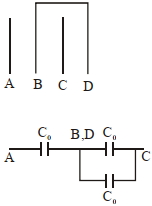
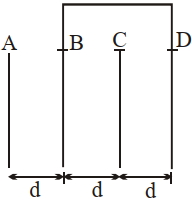
Four identical rectangular plates with length, $l=2\, cm$ and breadth, $b =\frac{3}{2}\, cm$ are arranged as shown in figure. The equivalent capacitance between $A$ and $C$ is $\frac{ x \varepsilon_{0}}{ d } .$ The value of $x$ is (Round off to the Nearest Integer)
JEE MAIN 2021, Medium
Download our app for free and get started
$C _{ eq }=\frac{2 C _{0}}{3}=\frac{2}{3} \frac{ \epsilon _{0} A }{ d }$
$C _{ eq }=\frac{2 \epsilon_{0}}{3 d } \times\left(2 \times \frac{3}{2}\right)=2\left(\because A =1 b =2 \times \frac{3}{2}\right)$981-s594
Download our app
and get started for free
Experience the future of education. Simply download our apps or reach out to us for more information. Let's shape the future of learning together!No signup needed.*
A parallel plate capacitor having crosssectional area $A$ and separation $d$ has air in between the plates. Now an insulating slab of same area but thickness $d/2$ is inserted between the plates as shown in figure having dielectric constant $K (=4) .$ The ratio of new capacitance to its original capacitance will be,
An infinite non-conducting sheet has a surface charge density $\sigma = 0.10\, \mu C/m^2$ on one side. How far apart are equipotential surfaces whose potentials differ by $50\, V$
A charged capacitor is allowed to discharge through a resistor by closing the key at the instant $t =0$. At the instant $t = (ln \,4) $ $\mu s$, the reading of the ammeter falls half the initial value. The resistance of the ammeter is equal to
Three charges $-q, Q$ and $-q$ are placed respectively at equal distances on a straight line. If the potential energy of the system of three charges is zero, then what is the ratio of $Q: q$ ?
What will be the capacity of a parallel-plate capacitor when the half of parallel space between the plates is filled by a material of dielectric constant ${\varepsilon _r}$ ? Assume that the capacity of the capacitor in air is $C$
In the following circuit, the switch $S$ is closed at $t = 0.$ The charge on the capacitor $C_1$ as a function of time will be given by $\left( {{C_{eq}}\, = {\kern 1pt} \,\frac{{{C_1}{C_2}}}{{{C_1} + {C_2}}}} \right).$
Consider the configuration of a system of four charges each of value $+q$ . The work done by external agent in changing the configuration of the system from figure $(1)$ to figure $(2)$ is