MCQ
Four light waves are represented by
  • A
    (i) $y=a \sin \omega t$
  • B
    (ii) $y=a_2 \sin (\omega t+\phi)$
  • (iii) $y=a_1 \sin 2 \omega t$
  • D
    (iv) $y=a_2 \sin 2(\omega t+\phi)$

Answer

Correct option: C.
(iii) $y=a_1 \sin 2 \omega t$
(c) Fringe width $\beta \propto \lambda$. Therefore, $\lambda$ and hence $\beta$ decreases 1.5 times when immersed in liquid. The distance between central maxima and 10 maxima is $3 cm$ in vacuum. When immersed in liquid it will reduce to $2 cm$. Position of central maxima will not change while $10^*$ maxima will be obtained at $y=4 cm$.

Need a full question paper?

Generate a complete, print-ready paper with questions like this in minutes — across 16+ boards, with answer keys.

Start Generating Free

Similar questions

A glass flask of volume one litre at $0^{\circ} \mathrm{C}$ is filled, level full of mercury at this temperature. The flask and mercury are now heated to $100^{\circ} \mathrm{C}$. How much mercury will spill out, if coefficient of volume expansion of mercury is $1.82 \times 10^{-4} /{ }^{\circ} \mathrm{C}$ and linear expansion of glass is $0.1 \times 10^{-4} /{ }^{\circ} \mathrm{C}$ respectively
When the amount of work done is $333 \mathrm{cal}$ and change in internal energy is $167 \mathrm{cal}$, then the heat supplied is
A body of mass $5 \mathrm{~kg}$ is moving with a momentum of $10 \mathrm{~kg}-\mathrm{m} / \mathrm{s}$. A force of $0.2 \mathrm{~N}$ acts on it in the direction of motion of the body for 10 seconds. The increase in its kinetic energy is
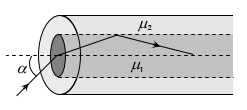
An optical fibre consists of core of $\mu$ surrounded by a cladding of $\mu$. $<\mu$. A beam of light enters from air at an angle $\alpha$ with axis of fibre. The highest $\alpha$ for which ray can be travelled through fibre isImage
A particle of mass $\mathrm{m}$ moving with horizontal speed $6 \mathrm{~m} / \mathrm{sec}$ as shown in figure. If $m \ll M$ then for one dimensional elastic collision, the speed of lighter particle after collision will be

Image

A particle $P$ is sliding down a frictionless hemispherical bowl. It passes the point $A$ at $t=0$. At this instant of time, the horizontal component of its velocity is $v$. A bead $Q$ of the same mass as $P$ is ejected from $A$ at $t=0$ along the horizontal string $A B$ $($see figure$)$ with the speed $v$. Friction between the bead and the string may be neglected. Let $t_P$ and $t_Q$ be the respective time taken by $P$ and $Q$ to reach the point $B$. 
When an ideal diatomic gas is heated at constant pressure, the fraction of the heat energy supplied which increases the internal energy of the gas, is
From the adjacent figure, the correct observation is

Image

An imaginary line joining the optical centre of the eye lens and the yellow point is called as
The reason for shining of air bubble in water is