MCQ 11 Mark
Two polaroids are placed in the path of unpolarized beam of intensity $I_0$ such that no light is emitted from the second polaroid. If a third polaroid whose polarization axis makes an angle $\theta$ with the polarization axis of first polaroid, is placed between these polaroids then the intensity of light emerging from the last polaroid will be
- ✓
$\left(\frac{I_0}{8}\right) \sin ^2 2 \theta$
- B
$\left(\frac{I_0}{4}\right) \sin ^2 2 \theta$
- C
$\left(\frac{I_0}{2}\right) \cos ^4 \theta$
- D
$I_0 \cos ^4 \theta$
AnswerCorrect option: A. $\left(\frac{I_0}{8}\right) \sin ^2 2 \theta$
View full question & answer→MCQ 21 Mark
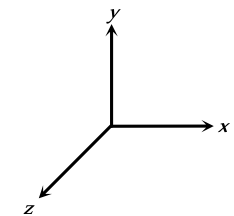
light wave is travelling along y-direction. If the corresponding $\vec{E}$ vector at any time is along the $x$-axis, the direction of $\vec{B}$ vector at that time is along
- A
$y$-axis
- B
$x$-axis
- C
$+z$-axis
- ✓
$-z$ axis
AnswerCorrect option: D. $-z$ axis
Direction of wave propagation is given by $\vec{E} \times \vec{B}$.
View full question & answer→MCQ 31 Mark
Two coherent sources of different intensities send waves which interfere. The ratio of maximum intensity to the minimum intensity is $25.$ The intensities of the sources are in the ratio
- A
$25: 1$
- B
$5: 1$
- ✓
$9: 4$
- D
$25: 16$
AnswerCorrect option: C. $9: 4$
$\frac{I_{\max }}{I_{\min }}=\left(\frac{\sqrt{\frac{I_1}{I_2}}+1}{\sqrt{\frac{I_1}{I_2}}-1}\right)^2 \Rightarrow \frac{I_1}{I_2}=\frac{9}{4}$
View full question & answer→MCQ 41 Mark
Two coherent sources of intensities, $l$ and $l$ produce an interferen pattern. The maximum intensity in the interference pattern will be
AnswerCorrect option: D. $\left(\sqrt{I_1}+\sqrt{I_2}\right)^2$
Resultant intensity $I_R=I_1+I_2+2 \sqrt{I_1 I_2} \cos \phi$
For maximum $I_R, \phi=0^{\circ}$
$\Rightarrow I_R=I_1+I_2+2 \sqrt{I_1 I_2}=\left(\sqrt{I_1}+\sqrt{I_2}\right)^2$
View full question & answer→MCQ 51 Mark
Newton postulated his corpuscular theory on the basis of
- A
- B
- ✓
Rectilinear propagation of light
- D
Dispersion of white light
AnswerCorrect option: C. Rectilinear propagation of light
Newton first law of motion states that every particle travels in a straight line with a constant velocity unless disturbed by anexternal force. So the corpuscles travels in straight lines.
View full question & answer→MCQ 61 Mark
A light has amplitude $A$ and angle between analyser and polariser is $60^{\circ}$. Light is reflected by analyser has amplitude
- A
$A \sqrt{2}$
- B
$A / \sqrt{2}$
- C
$\sqrt{3} A / 2$
- ✓
$A / 2$
AnswerCorrect option: D. $A / 2$
The amplitude will be $A \cos 60^{\circ}=A / 2$
View full question & answer→MCQ 71 Mark
The angle of polarisation for any medium is $60,$ what will be critical angle for this
AnswerCorrect option: D. $\sin ^{-1} \frac{1}{\sqrt{3}}$
By using $\mu=\tan \theta_p \Rightarrow \mu=\tan 60=\sqrt{3}$, also $C=\sin ^{-1}\left(\frac{1}{\mu}\right) \Rightarrow C=\sin ^{-1}\left(\frac{1}{\sqrt{3}}\right)$
View full question & answer→MCQ 81 Mark
In which one of the following regions of the electromagnetic spectrum will the vibrational motion of molecules give rise to absorption
AnswerMolecular spectra due to vibrational motion lie in the microwave region of EM-spectrum. Due to Kirchhoff's law in spectroscopy the same will be absorbed.
View full question & answer→MCQ 91 Mark
Which of the following phenomena can explain quantum nature of light
AnswerPhotoelectric effect explain the quantum nature of light while interference, diffraction and polarization explain the wave nature of light.
View full question & answer→MCQ 101 Mark
The transverse nature of light is shown by [CPMT 1972, 74, 78;
MCQ 111 Mark
Intensity of light depends upon
MCQ 121 Mark
The phase difference between incident wave and reflected wave is $180^{\circ}$ when light ray
- ✓
Enters into glass from air
- B
Enters into air from glass
- C
Enters into glass from diamond
- D
Enters into water from glass
AnswerCorrect option: A. Enters into glass from air
When light reflect from denser surface phase change of $\pi$ occurs.
View full question & answer→MCQ 131 Mark
- ✓
All particles in it have same phase
- B
All particles have opposite phase of vibrations
- C
Few particles are in same phase, rest are in opposite phase
- D
AnswerCorrect option: A. All particles in it have same phase
Wavefront is the locus of all the particles which vibrates in the same phase.
View full question & answer→MCQ 141 Mark
Wavefront of a wave has direction with wave motion
- A
- ✓
- C
- D
At an angle of $\theta$
AnswerDirection of wave is perpendicular to the wavefront.
View full question & answer→MCQ 151 Mark
A rocket is going towards moon with a speed $v$. The astronaut in the rocket sends signals of frequency $v$ towards the moon and receives them back on reflection from the moon. What will be the frequency of the signal received by the astronaut (Take $k
AnswerCorrect option: A. (a) $\frac{ C }{ C - v } v$
(a)$\Delta \lambda=\lambda \cdot \frac{v}{c} $
$\text { where } v=r \omega=r \times\left(\frac{2 \pi}{T}\right) $
$\therefore \Delta \lambda=\frac{4320 \times 7 \times 10^8 \times 2 \times 3.14}{3 \times 10^8 \times 22 \times 86400}=0.033 A$
View full question & answer→MCQ 161 Mark
A rocket is going away from the earth at a speed of $10 m / s$ if the wavelength of the light wave emitted by it be $5700 \mathring A$, what will be its Doppler's shift
- A
$200 \mathring A$
- ✓
$19 \mathring A$
- C
$20 \mathring A$
- D
$0.2 \mathring A$
AnswerCorrect option: B. $19 \mathring A$
$\frac{\Delta \lambda}{\lambda}=\frac{v}{c} \Rightarrow \Delta \lambda=\frac{5700 \times 10^6}{3 \times 10^3}=19 \mathring A$
View full question & answer→MCQ 171 Mark
Wave nature of light is verified by
AnswerPhotoelectric effect varifies particle nature of light. Reflection and refraction varifies both particle nature and wave nature of light.
View full question & answer→MCQ 181 Mark
Coherent sources are those sources for which
- A
Phase difference remain constant
- B
Frequency remains constant
- ✓
Both phase difference and frequency remains constant
- D
AnswerCorrect option: C. Both phase difference and frequency remains constant
View full question & answer→MCQ 191 Mark
Two coherent sources have intensity in the ratio of $\frac{100}{1}$. Ratio of (intensity) $\max /$ (intensity) $\min$ is
- A
$\frac{1}{100}$
- B
$\frac{1}{10}$
- C
$\frac{10}{1}$
- ✓
$\frac{3}{2}$
AnswerCorrect option: D. $\frac{3}{2}$
$\frac{I_1}{I_2}=\frac{100}{1}$Now $\frac{I_{\max }}{I_{\min }}=\left(\frac{\sqrt{\frac{I_1}{I_2}}+1}{\sqrt{\frac{I_1}{I_2}}-1}\right)^2=\left(\frac{\sqrt{100}+1}{\sqrt{100}-1}\right)^2=\frac{121}{81} \approx \frac{3}{2}$
View full question & answer→MCQ 201 Mark
Ratio of amplitude of interfering waves is $3: 4$. Now ratio of their intensities will be
- A
$\frac{16}{9}$
- B
$49: 1$
- ✓
$\frac{9}{16}$
- D
AnswerCorrect option: C. $\frac{9}{16}$
$I \propto a^2 \Rightarrow \frac{I_1}{I_2}=\left(\frac{a_1}{a_2}\right)^2=\left(\frac{3}{4}\right)^2=\frac{9}{16}$
View full question & answer→MCQ 211 Mark
Ray diverging from a point source from a wave front that is
MCQ 221 Mark
If the distance between a point source and screen is doubled, then intensity of light on the screen will become
MCQ 231 Mark
If the shift of wavelength of light emitted by a star is towards violet, then this shows that star is
- A
- ✓
- C
- D
Information is incomplete
AnswerShifting towards ultraviolet region shows that Apparent wavelength decreased. Therefore the source is moving towards the earth.
View full question & answer→MCQ 241 Mark
In Young's double slit experiment, the intensity on the screen at a point where path difference is $\lambda$ is $K$. What will be the intensity at the point where path difference is $\lambda / 4$
- A
(a) $\frac{K}{4}$
- B
(b) $\frac{K}{2}$
- C
(c) $K$
- ✓
Answer(d) If shift is equivalent to $n$ fringes then
$n=\frac{(\mu-1) t}{\lambda} \Rightarrow n \propto t \Rightarrow \frac{t_2}{t_1}=\frac{n_2}{n_1}$
$ \Rightarrow t_2=\frac{n_2}{n_1} \times t $
$t_2=\frac{20}{30} \times 4.8=3.2 mm .$
View full question & answer→MCQ 251 Mark
In a two slit experiment with monochromatic light fringes are obtained on a screen placed at some distance from the sits. If the screen is moved by $5 \times 10^{-2} m$ towards the slits, the change in fringe width is $3 \times 10^{-5} m$. If separation between the slits is $10^{-3} m$, the wavelength of light used is
- ✓
(a) $6000 \AA$
- B
(b) $5000 \AA$
- C
(c) $3000 \AA$
- D
(d) $4500 \AA$
AnswerCorrect option: A. (a) $6000 \AA$
(a) $P$ is the position of 11 bright fringe from $Q$. From central position $O, P$ will be the position of $10^*$ bright fringe.Path difference between the waves reaching at $P=S B=10 \lambda=$ $10 \times 6000 \times 10^{-}=6 \times 10^{-} m$.
View full question & answer→MCQ 261 Mark
The $6563 \mathring A$ line emitted by hydrogen atom in a star is found to be red shifted by $5 \mathring A$. The speed with which the star is receding from the earth is
- A
$17.29 \times 10 m / s$
- B
$4.29 \times 10^9 m / s$
- C
$3.39 \times 10 m^6 / s$
- ✓
$2.29 \times 10^5 m / s$
AnswerCorrect option: D. $2.29 \times 10^5 m / s$
$\frac{\Delta \lambda}{\lambda}=\frac{v}{c} \Rightarrow v=\frac{\Delta \lambda}{\lambda} \cdot c=\frac{5}{6563} \times\left(3 \times 10^8\right)=2.29 \times 10^5 m / sec$
View full question & answer→MCQ 271 Mark
In an apparatus, the electric field was found to oscillate with an amplitude of $18 V / m$. The magnitude of the oscillating magnetic field will be
- A
$4 \times 10^{-6} T$
- ✓
$6 \times 10^{-8} T$
- C
$9 \times 10^{-9} T$
- D
$11 \times 10^{-11} T$
AnswerCorrect option: B. $6 \times 10^{-8} T$
$c=\frac{E}{B} \Rightarrow B=\frac{E}{c}=\frac{18}{3 \times 10^8}=6 \times 10^{-8} T$.
View full question & answer→MCQ 281 Mark
In an electromagnetic wave, the electric and magnetising fields are $100 \ Vm ^{-1}$ and $0.265\ Am ^{-1}$. The maximum energy flow is
- ✓
$26.5 W / m ^2$
- B
$36.5 W / m ^2$
- C
$46.7 W / m ^2$
- D
$765 W / m ^2$
AnswerCorrect option: A. $26.5 W / m ^2$
Here $E_0=100 V / m , B_0=0.265 A / m$.
$\therefore$ Maximum rate of energy flow $S=E_0 \times B_0$
$=100 \times .265=26.5 \frac{ W }{ m ^2}$
View full question & answer→MCQ 291 Mark
The $k$ line of singly ionised calcium has a wavelength of $393.3\ nm$ as measured on earth. In the spectrum of one of the observed galaxies, this spectral line is located at $401.8\ nm$. The speed with which the galaxy is moving away from us, will be
- ✓
$6480 \ km / s$
- B
$3240 \ km / s$
- C
$4240 \ km / \sec$
- D
AnswerCorrect option: A. $6480 \ km / s$
$6480 \ km / s$
View full question & answer→MCQ 301 Mark
Which one of the following have minimum wavelength
- A
- ✓
- C
$X$-rays
- D
$\gamma$ - rays
View full question & answer→MCQ 311 Mark
Which of the following electromagnetic waves have minimum frequency
MCQ 321 Mark
The electromagnetic waves do not transport
AnswerEM waves transport energy, momentum and information but not charge. EM waves are uncharged
View full question & answer→MCQ 331 Mark
The idea of secondary wavelets for the propagation of a wave was first given by
AnswerThe idea of secondary wavelets is given by Huygen.
View full question & answer→MCQ 341 Mark
Frequency of a wave is $6 \times 10^{15}\ Hz$. The wave is
View full question & answer→MCQ 351 Mark
The velocity of light emitted by a source $S$ observed by an observer $O$, who is at rest with respect to $S$ is $c$. If the observer moves towards $S$ with velocity $v$, the velocity of light as observed will be
View full question & answer→MCQ 361 Mark
Which of the following statement is wrong
- ✓
Infrared photon has more energy than the photon of visible light
- B
Photographic plates are sensitive to ultraviolet rays
- C
Photographic plates can be made sensitive to infrared rays
- D
Infrared rays are invisible but can cast shadows like visible light rays
AnswerCorrect option: A. Infrared photon has more energy than the photon of visible light
View full question & answer→MCQ 371 Mark
The wavelength of light observed on the earth, from a moving star is found to decrease by $0.05 \%$. Relative to the earth the star is
- A
Moving away with a velocity of $1.5 \times 10^5 m / s$
- ✓
Coming closer with a velocity of $1.5 \times 10^5 m / s$
- C
Moving away with a velocity of $1.5 \times 10^4 m / s$
- D
Coming closer with a velocity of $1.5 \times 10^4 m / s$
AnswerCorrect option: B. Coming closer with a velocity of $1.5 \times 10^5 m / s$
$\frac{\Delta \lambda}{\lambda}=\frac{v}{c} \Rightarrow \frac{0.05}{100}=\frac{v}{3 \times 10^8} \Rightarrow v=1.5 \times 10 m / s$(Since wavelength is decreasing, so star coming closer)
View full question & answer→MCQ 381 Mark
In the spectrum of light of a luminous heavenly body the wavelength of a spectral line is measured to be $4747 \mathring A$ while actual wavelength of the line is $4700 \mathring A$. The relative velocity of the heavenly body with respect to earth will be (velocity of light is $3 \times 10^8 m / s$ )
- A
$3 \times 10^5 m / s$ moving towards the earth
- B
$3 \times 10^5 m / s$ moving away from the earth
- C
$3 \times 10^6 m / s$ moving towards the earth
- ✓
$3 \times 10^6 m / s$ moving away from the earth
AnswerCorrect option: D. $3 \times 10^6 m / s$ moving away from the earth
(d)
$\Delta \lambda=\frac{v_s}{c} \lambda \Rightarrow v_s=\frac{\Delta \lambda . c}{\lambda}=\frac{47 \times 3 \times 10^8}{4700}$ $=3 \times 10^6 m / s$ away from earth
View full question & answer→MCQ 391 Mark
As a result of interference of two coherent sources of light, energy is
- A
- ✓
Redistributed and the distribution does not vary with time
- C
- D
Redistributed and the distribution changes with time
AnswerCorrect option: B. Redistributed and the distribution does not vary with time
In interference energy is redistribution.
View full question & answer→MCQ 401 Mark
Two waves are represented by the equations $y_1=a \sin \omega t$ and $y_2=a \cos \omega t$. The first wave
- A
Leads the second by $\pi$
- B
Lags the second by $\pi$
- C
Leads the second by $\frac{\pi}{2}$
- ✓
Lags the second by $\frac{\pi}{2}$
AnswerCorrect option: D. Lags the second by $\frac{\pi}{2}$
$y_1=a \sin \omega t, y_2=a \cos \omega t=a \sin \left(\omega t+\frac{\pi}{2}\right)$
View full question & answer→MCQ 411 Mark
The range of wavelength of the visible light is
- A
$10 \mathring A$ to $100 \mathring A$
- ✓
$4,000 \mathring A$ to $8,000 \mathring A$
- C
$8,000 \mathring A$ to $10,000 \mathring A$
- D
$10,000 \mathring A$ to $15,000 \mathring A$
AnswerCorrect option: B. $4,000 \mathring A$ to $8,000 \mathring A$
Wavelength of visible spectrum is $3900 \mathring A-7800 \mathring A$.
View full question & answer→MCQ 421 Mark
The two waves represented by $y_1=a \sin (\omega t)$ and $y_2=b \cos (\omega t)$ have a phase difference of
- A
$0$
- ✓
$\frac{\pi}{2}$
- C
$\pi$
- D
$\frac{\pi}{4}$
AnswerCorrect option: B. $\frac{\pi}{2}$
$y_1=a \sin \omega t$, and $y_2=b \cos \omega t=b \sin \left(\omega t+\frac{\pi}{2}\right)$
So phase difference $\phi=\pi / 2$
View full question & answer→MCQ 431 Mark
If two waves represented by $y_1=4 \sin \omega t$ and $y_2=3 \sin \left(\omega t+\frac{\pi}{3}\right)$ interfere at a point, the amplitude of the resulting wave will be about
Answer$\phi=\pi / 3, a_1=4, a_2=3$
So, $A=\sqrt{a_1^2+a_2^2+2 a_1 \cdot a_2 \cos \phi} \Rightarrow A \approx 6$
View full question & answer→MCQ 441 Mark
A star is moving towards the earth with a speed of $4.5 \times 10^6 m / s$. If the true wavelength of a certain line in the spectrum received from the star is $5890 \mathring A$, its apparent wavelength will be about $\left[c=3 \times 10^8 m / s \right]$
- A
$5890 \mathring A$
- B
$5978 \mathring A$
- ✓
$5802 \mathring A$
- D
$5896 \mathring A$
AnswerCorrect option: C. $5802 \mathring A$
$\lambda^{\prime}=\lambda\left(1-\frac{v}{c}\right)=5890\left(1-\frac{4.5 \times 10^6}{3 \times 10^8}\right) \approx 5802 \mathring A$
View full question & answer→MCQ 451 Mark
A star is going away from the earth. An observer on the earth will see the wavelength of light coming from the star
- A
- ✓
- C
Neither decreased nor increased
- D
Decreased or increased depending upon the velocity of the star
View full question & answer→MCQ 461 Mark
If the amplitude ratio of two sources producing interference is $3: 5$, the ratio of intensities at maxima and minima is
- A
$25: 16$
- B
$5: 3$
- ✓
$16: 1$
- D
$25: 9$
AnswerCorrect option: C. $16: 1$
$\frac{a_1}{a_2}=\frac{3}{5} $
$\therefore \frac{I_{\max }}{I_{\min }}=\frac{\left(a_1+a_2\right)^2}{\left(a_1-a_2\right)^2}=\frac{(3+5)^2}{(3-5)^2}=\frac{16}{1}$
View full question & answer→MCQ 471 Mark
If $L$ is the coherence length and $c$ the velocity of light, the coherent time is
- A
$c L$
- ✓
$\frac{L}{c}$
- C
$\frac{c}{L}$
- D
$\frac{1}{L c}$
AnswerCorrect option: B. $\frac{L}{c}$
Coherent time $=\frac{\text { Coherence length }}{\text { Velocity of light }}=\frac{L}{c}$
View full question & answer→MCQ 481 Mark
Which of the following statements indicates that light waves are transverse
- A
light waves can travel in vacuum
- B
Light waves show interference
- ✓
light waves can be polarized
- D
light waves can be diffracted
AnswerCorrect option: C. light waves can be polarized
Transverse waves can be polarised.
View full question & answer→MCQ 491 Mark
Wave which cannot travel in vacuum is
AnswerInfrasonic waves are mechanical waves.
View full question & answer→MCQ 501 Mark
The sun is rotating about its own axis. The spectral lines emitted from the two ends of its equator, for an observer on the earth, will show
- A
- B
- ✓
Shift towards red end by one line and towards violet end by other
- D
AnswerCorrect option: C. Shift towards red end by one line and towards violet end by other
View full question & answer→