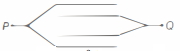
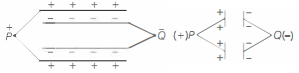
Four metallic plates each of surface area (of one side) $A$, are placed at a distance $d$ apart from each other. The two outer plates are connected to a point $P$ and the two inner plates are connected to another point as shown in figure below. Then, the capacitance of the system is
KVPY 2009, Medium


Download our appand get started for free
Experience the future of education. Simply download our apps or reach out to us for more information. Let's shape the future of learning together!No signup needed.*
Similar Questions
- 1Kinetic energy of an electron accelerated in a potential difference of $100\, V$ isView Solution
- 2Choose the $CORRECT$ optionView Solution
- 3The mean free path of electrons in a metal is $4 \times 10^{-8} \;m$. The electric field which can give on an average $2 \;eV$ energy to an electron in the metal will be in units of $V / m$View Solution
- 4Concentric metallic hollow spheres of radii $R$ and $4 R$ hold charges $Q _{1}$ and $Q _{2}$ respectively. Given that surface charge densities of the concentric spheres are equal, the potential difference $V ( R )- V (4 R )$ isView Solution
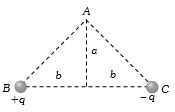
- 5As shown in the figure, charges $ + q$ and $ - q$ are placed at the vertices $B$ and $C$ of an isosceles triangle. The potential at the vertex $A$ isView Solution
- 6Potential atapoint $A$ is $3 $ $ volt$ and atapoint $B$ is $7$ $volt$,an electron is moving towards $A$ from $B.$View Solution
- 7In a region, electric field varies as $E = 2x^2 -4$ where $x$ is the distance in metre from origin along $x-$ axis. A positive charge of $1\,\mu C$ is released with minimum velocity from infinity for crossing the origin, thenView Solution
- 8A capacitor having capacitance $C$ is charged to a voltage $V$. It is then removed and connected in parallel with another identical capacitor which is uncharged. The new charge on each capacitor is nowView Solution
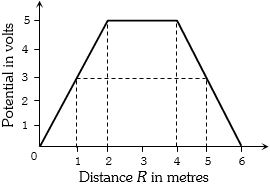
- 9The variation of potential with distance $R$ from a fixed point is as shown below. The electric field at $R = 5\,m$ is......$volt/m$View Solution
- 10In a parallel plate capacitor set up, the plate area of capacitor is $2 \,m ^{2}$ and the plates are separated by $1\, m$. If the space between the plates are filled with a dielectric material of thickness $0.5\, m$ and area $2\, m ^{2}$ (see $fig.$) the capacitance of the set-up will be $.........\, \varepsilon_{0}$View Solution
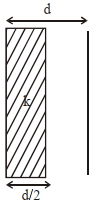
(Dielectric constant of the material $=3.2$ ) and (Round off to the Nearest Integer)