In a parallel plate capacitor set up, the plate area of capacitor is $2 \,m ^{2}$ and the plates are separated by $1\, m$. If the space between the plates are filled with a dielectric material of thickness $0.5\, m$ and area $2\, m ^{2}$ (see $fig.$) the capacitance of the set-up will be $.........\, \varepsilon_{0}$
(Dielectric constant of the material $=3.2$ ) and (Round off to the Nearest Integer)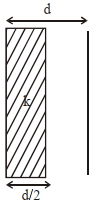
JEE MAIN 2021, Diffcult


Download our appand get started for free
Experience the future of education. Simply download our apps or reach out to us for more information. Let's shape the future of learning together!No signup needed.*
Similar Questions
- 1If ${q}_{{f}}$ is the free charge on the capacitor plates and ${q}_{{b}}$ is the bound charge on the dielectric slab of dielectric constant $k$ placed between the capacitor plates, then bound charge $q_{b}$ can be expressed asView Solution
- 2The equation of an equipotential line in an electric field is $y = 2x$, then the electric field strength vector at $(1, 2)$ may beView Solution
- 3View SolutionConsider the points lying on a straight line joining two fixed opposite charges. Between the charges there is
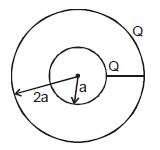
- 4Figure shows a solid metal sphere of radius $‘a’$ surrounded by a concentric thin metal shell of radius $2a$ . Initially both are having charges $Q$ each. When the two are connected by a conducting wire as shown in the figure, then amount of heat produced in this process will beView Solution
- 5A parallel plate capacitor has an electric field of ${10^5}\,V/m$ between the plates. If the charge on the capacitor plate is $1\,\mu \,C$, the force on each capacitor plate is......$N$View Solution
- 6A parallel plate capacitor has capacitance $C$. If it is equally filled with parallel layers of materials of dielectric constants $K_1$ and $K_2$ its capacity becomes $C_1$. The ratio of $C_1$ to $C$ isView Solution
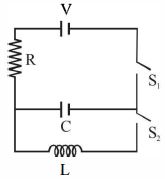
- 7In an $LCR $ circuit as shown below both switches are open initially. Now switch $S_1$ is closed, $S_2$ kept open. ( $q$ is charge on the capacitor and $\tau = RC$ is Capacitive time constant). Which of the following statement is correct?View Solution
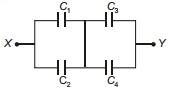
- 8In the circuit shown below $C_1=10 \,\mu F , C_2=C_3=20 \,\mu F$, and $C_4=40 \,\mu F$. If the charge on $C_1$ is $20 \,\mu C$ then potential difference between $X$ and $Y$ is ......... $V$View Solution
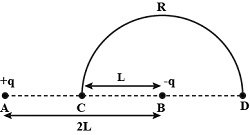
- 9Charges $+q$ and $-q$ are placed at points $A$ and $B$ respectively which are a distance $2\,L$ apart, $C$ is the midpoint between $A$ and $B.$ The work done in moving a charge $+Q$ along the semicircle $CRD$ isView Solution
- 10An electric dipole of moment $\vec p$ is kept in a uniform electric field $\vec E$. Angle between $\vec p$ and $\vec E$ is $30^o$. Calculate work done by field when angle is increased to $60^o.$View Solution