Four point charges $-Q, -q, 2q$ and $2Q$ are placed, one at each comer of the square. The relation between $Q$ and $q$ for which the potential at the centre of the square is zero is
AIPMT 2012, Medium


Download our appand get started for free
Experience the future of education. Simply download our apps or reach out to us for more information. Let's shape the future of learning together!No signup needed.*
Similar Questions
- 1An electron of mass $m$ and charge $e$ is accelerated from rest through a potential difference $V$ in vacuum. Its final velocity will beView Solution
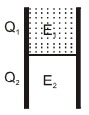
- 2A parallel plate capacitor has a dielectric slab of dielectric constant $K$ between its plates that covers $1 / 3$ of the area of its plates, as shown in the figure. The total capacitance of the capacitor is $C$ while that of the portion with dielectric in between is $C _1$. When the capacitor is charged, the plate area covered by the dielectric gets charge $Q_1$ and the rest of the area gets charge $Q_2$. Choose the correct option/options, igonoring edge effects.View Solution
$(A)$ $\frac{E_1}{E_2}=1$ $(B)$ $\frac{E_1}{E_2}=\frac{1}{K}$ $(C)$ $\frac{Q_1}{Q_2}=\frac{3}{K}$ $(D)$ $\frac{ C }{ C _1}=\frac{2+ K }{ K }$
- 3In a region, electric field varies as $E = 2x^2 -4$ where $x$ is the distance in metre from origin along $x-$ axis. A positive charge of $1\,\mu C$ is released with minimum velocity from infinity for crossing the origin, thenView Solution
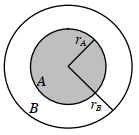
- 4In the figure, the inner (shaded) region $A$ represents a sphere of radius $r_A=1$, within which the electrostatic charge density varies with the radial distance $r$ from the center as $\rho_A=k r$, where $k$ is positive. In the spherical shell $B$ of outer radius $r_B$, the electrostatic charge density varies as $\rho_{\bar{B}}=\frac{2 k}{r}$. Assume that dimensions are taken care of. All physical quantities are in their $SI$ units.View Solution
Which of the following statement($s$) is(are) correct?
- 5A parallel plate capacitor has a plate separation of $0.01\, mm$ and use a dielectric (whose dielectric strength is $19\, KV/mm$) as an insulator. The maximum potential difference that can be applied to the terminals of the capacitor is......$V$View Solution
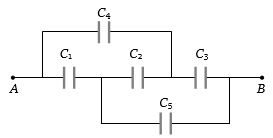
- 6In the given figure the capacitors ${C_1},{C_3},{C_4},{C_5}$ have a capacitance $4\,\mu F$ each if the capacitor $C_2$ has a capacitance $10\,F$, then effective capacitance between $A$ and $B$ will be.....$\mu F$View Solution
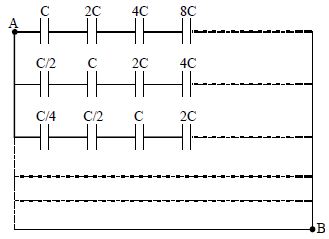
- 7Consider an infinite matrix of capacitors as shown in the figure. The effective capacitance between point $A$ and $B$ will beView Solution
- 8The capacity of a parallel plate condenser is $15\,\mu \,F$, when the distance between its plates is $6 \,cm$. If the distance between the plates is reduced to $2\, cm$, then the capacity of this parallel plate condenser will be......$\mu \,F$View Solution
- 9View SolutionThe energy of a charged capacitor resides in
- 10The area of the plates of a parallel plate capacitor is $A$ and the gap between them is $d$. The gap is filled with a non-homogeneous dielectric whose dielectric constant varies with the distance $‘y’$ from one plate as : $K = \lambda \ sec(\pi y/2d)$, where $\lambda $ is a dimensionless constant. The capacitance of this capacitor isView Solution