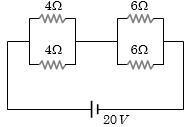
Four resistances are connected in a circuit in the given figure. The electric current flowing through $4\, ohm$ and $6\, ohm$ resistance is respectively
Medium


Download our appand get started for free
Experience the future of education. Simply download our apps or reach out to us for more information. Let's shape the future of learning together!No signup needed.*
Similar Questions
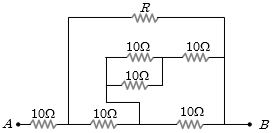
- 1A wire of length ' $r$ ' and resistance $100 \Omega$ is divided into $10$ equal parts. The first $5$ parts are connected in series while the next $5$ parts are connected in parallel. The two combinations are again connected in series. The resistance of this final combination is:View Solution
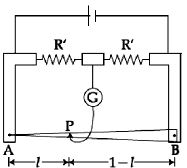
- 2In a meter bridge, the wire of length $1\, m$ has a nonuniform cross-section such that, the variation $\frac{{dR}}{{d\ell }}$ of its resistance $R$ with length $\ell $ is $\frac{{dR}}{{d\ell }} \propto \frac{1}{{\sqrt \ell }}$ Two equal resistances are connected as shown in the figure. The galvanometer has zero deflection when the jockey is at point $P$. What is the length $AP$ ? ................ $m$View Solution
- 3If a wire of resistance $20\,\Omega $ is covered with ice and a voltage of $210\, V$ is applied across the wire, then the rate of melting of ice is .................. $g/s$View Solution
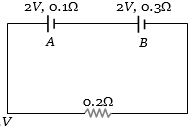
- 4The internal resistances of two cells shown are $0.1\,\Omega $ and $0.3\,\Omega $. If $R = 0.2\,\Omega $, the potential difference across the cellView Solution
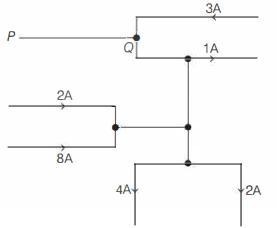
- 5Figure below shows a portion of an electric circuit with the currents in amperes and their directions. The magnitude and direction of the current in the portion $P Q$ isView Solution
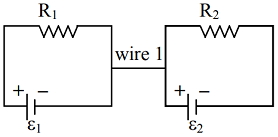
- 6In the circuit, wire $1$ is of negligible resistance. Then,View Solution
- 7The storage battery of a car has an $emf$ of $12\; V$. If the internal resistance of the battery is $0.4\; \Omega,$ what is the maximum current (in $A$) that can be drawn from the battery?View Solution
- 8A thermocouple of negligible resistance produces an $e.m.f.$ of $40\,\mu V{/^o}C$ in the linear range of temperature. A galvanometer of resistance $10\; ohm$ whose sensitivity is $1\;\mu A/div$, is employed with the thermocouple. The smallest value of temperature difference that can be detected by the system will beView Solution
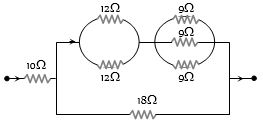
- 9In the following circuit, $18\,\Omega $ resistor develops $2\,J/sec$ due to current flowing through it. The power developed across $10\,\Omega $ resistance is .............. $W$View Solution
- 10For what value of $R$ the net resistance of the circuit will be $18\, ohms$ ............... $\Omega$View Solution