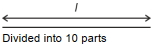
A wire of length ' $r$ ' and resistance $100 \Omega$ is divided into $10$ equal parts. The first $5$ parts are connected in series while the next $5$ parts are connected in parallel. The two combinations are again connected in series. The resistance of this final combination is:
NEET 2024, Medium


Download our appand get started for free
Experience the future of education. Simply download our apps or reach out to us for more information. Let's shape the future of learning together!No signup needed.*
Similar Questions
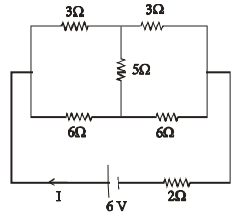
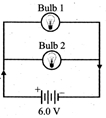
- 1A battery of $6\,V$ is connected to the circuit as shown below. The current I drawn from the battery is:View Solution
- 2A heater coil connected to a supply of a $220\, V$ is dissipating some power ${P_1}.$ The coil is cut into half and the two halves are connected in parallel. The heater now dissipates a power ${P_2}.$ The ratio of power ${P_1}\,\,:\,\,{P_2}$ isView Solution
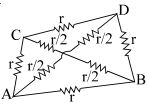
- 3The figure shows a tetrahedron, each side of which has a resistance $r$ If a battery is connected between any two points of the tetrahedron, then identify the correct statement $(s)$.View Solution
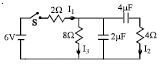
- 4In the circuit shown in the figure, the switch $S$ is initially open and the capacitor is initially uncharged. $ I_1, I_2$ and $I_3$ represent the current in the resistance $2\,\Omega , 4\,\Omega $ and $8\,\Omega$ respectively.View Solution
- 5Infinite number of cells having $emf$ and internal resistance $\left( {E,r} \right)$, $\left( {\frac{E}{n},\frac{r}{n}} \right)$, $\left( {\frac{E}{{{n^2}}},\frac{r}{{{n^2}}}} \right)$, $\left( {\frac{E}{{{n^3}}},\frac{r}{{{n^3}}}} \right)$..... are connected in series in same manner across an external resistance of $\frac{{nr}}{{n + 1}}$ . Current flowing through the external resistor isView Solution
- 6A $6.0\,volt$ battery is connected to two light bulbs as shown in figure. Light bulb $1$ has resistance $3\,ohm$ while light bulb $2$ has resistance $6\,ohm.$ Battery has negligible internal resistance. Which bulb will glow brighter?View Solution
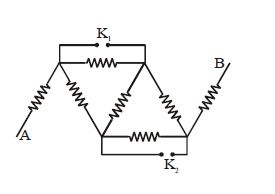
- 7All wires have same resistance and equivalent resistance between $A$ and $B$ is $R$. Now keys are closed, then the equivalent resistance will becomeView Solution
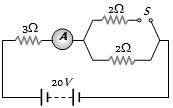
- 8In the circuit shown, the reading of ammeter when switch $S$ is open and when switch $S$ is closed respectively areView Solution
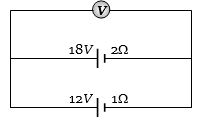
- 9Two batteries, one of emf $18\,volts\;emf$ and internal resistance $2\,\Omega $ and the other of emf $12\, volt$ and internal resistance $1\,\Omega $, are connected as shown. The voltmeter $V$ will record a reading of .............. $volt$View Solution
- 10View SolutionA conductor behaves as a superconductor