Four rods of indentical cross-sectional area and made from the same metal form the sides of a square. The temperature of two diagonally opposite points are $\theta$ and $\sqrt2 \theta$ respectively in the teady state. Assuming that only heat conduction takes place, what will be the temperature difference between other two points ?
Medium


Download our appand get started for free
Experience the future of education. Simply download our apps or reach out to us for more information. Let's shape the future of learning together!No signup needed.*
Similar Questions
- 1Relation between emissivity $e$ and absorptive power $a$ is (for black body)View Solution
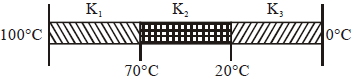
- 2Three rods of identical cross-section and lengths are made of three different materials of thermal conductivity $K _{1}, K _{2},$ and $K _{3}$, respectively. They are joined together at their ends to make a long rod (see figure). One end of the long rod is maintained at $100^{\circ} C$ and the ther at $0^{\circ} C$ (see figure). If the joints of the rod are at $70^{\circ} C$ and $20^{\circ} C$ in steady state and there is no loss of energy from the surface of the rod, the correct relationship between $K _{1}, K _{2}$ and $K _{3}$ isView Solution
- 3View SolutionA piece of blue glass heated to a high temperature and a piece of red glass at room temperature, are taken inside a dimly lit room then
- 4The only possibility of heat flow in a thermos flask is through its cork which is $75 cm^2$ in area and $5 cm$ thick. Its thermal conductivity is $0.0075 cal/cmsec^oC$. The outside temperature is$ 40^oC$ and latent heat of ice is $80 cal g^{-1}$. Time taken by $500 g$ of ice at $0^oC$ in the flask to melt into water at $0^oC$ is ....... $hr$View Solution
- 5Column $I$ gives some devices and Column $II$ gives some process on which the functioning of these devices depend. Match the devices in Column $I$ with the processes in Column $II$ and indicate your answer by darkening appropriate bubbles in the $4 \times 4$ matrix given in the $ORS$.View Solution
Column $I$ Column $II$ $(A)$ Bimetallic strip $(p)$ Radiation from a hot body $(B)$ Steam engine $(q)$ Energy conversion $(C)$ Incandescent lamp $(r)$ Melting $(D)$ Electric fuse $(s)$ Thermal expansion of solids - 6Two spherical black bodies of radii ${r_1}$ and ${r_2}$ and with surface temperature ${T_1}$and ${T_2}$ respectively radiate the same power. Then the ratio of ${r_1}$ and ${r_2}$ will beView Solution
- 7According to Newton’s law of cooling, the rate of cooling of a body is proportional to ${(\Delta \theta )^n}$, where $\Delta \theta $ is the difference of the temperature of the body and the surroundings, and n is equal toView Solution
- 8A solid sphere of radius $R$ and a hollow sphere of inner radius $r$ and outer radius $R$ made of copper are heated to the same temperature and are allowed to cool in the same environment. Then, choose the $CORRECT$ statementView Solution
- 9Surface of the lake is at $2°C$ . Find the temperature of the bottom of the lake..... $^oC$View Solution
- 10A solid cube and a solid sphere of the same material have equal surface area. Both are at the same temperature ${120^o}C$, thenView Solution