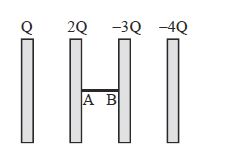
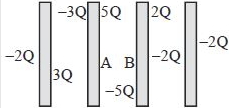
Four very large metal plates are given the charges as shown in figure. The middle two are then connected through a wire. Find the charge that will flow through the wire
Medium


Download our appand get started for free
Experience the future of education. Simply download our apps or reach out to us for more information. Let's shape the future of learning together!No signup needed.*
Similar Questions
- 1View SolutionThe potential to which a conductor is raised, depends on
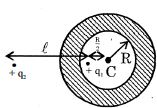
- 2A solid conducting sphere has cavity, as shown in figure. A charge $+ {q_1}$ is situated away from the centre. A charge $+q_2$ is situated outside the sphere then true statement isView Solution
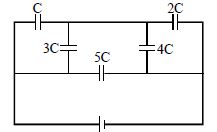
- 3In the given circuit, ratio of charge stored in the capacitors $C, 2C, 3C, 4C, 5C$ isView Solution
- 4A particle of mass $‘m’$ and charge $‘q’$ is accelerated through a potential difference of $V$ volt, its energy will beView Solution
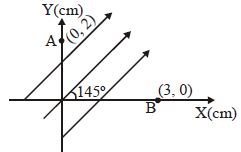
- 5A uniform electric field of $400 \,v/m$ is directed $45^o$ above the $x$ - axis. The potential difference $V_A - V_B$ is -.....$V$View Solution
- 6In a parallel plate capacitor of capacitance $C$, a metal sheet is inserted between the plates, parallel to them. If the thickness of the sheet is half of the separation between the plates. The capacitance will beView Solution
- 7A parallel plate condenser with a dielectric of dielectric constant $K$ between the plates has a capacity $C$ and is charged to a potential $V\ volt$. The dielectric slab is slowly removed from between the plates and then reinserted. The net work done by the system in this process isView Solution
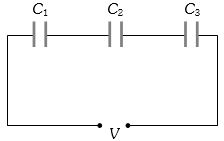
- 8In the figure, three capacitors each of capacitance $6\,pF$ are connected in series. The total capacitance of the combination will beView Solution
- 9An initially uncharged capacitor $C$ is being charged by a battery of emf $E$ through a resistance $R$ upto the instant, when the capacitor is charged to the potential $E / 2$, then the ratio of the work done by the battery to the heat dissipated by the resistor is given byView Solution
- 10A potential difference of $300\, volts$ is applied to a combination of $2.0\,\mu F$ and $8.0\,\mu F$ capacitors connected in series. The charge on the $2.0\,\mu F$ capacitor isView Solution