A particle of mass $‘m’$ and charge $‘q’$ is accelerated through a potential difference of $V$ volt, its energy will be
Easy


Download our appand get started for free
Experience the future of education. Simply download our apps or reach out to us for more information. Let's shape the future of learning together!No signup needed.*
Similar Questions
- 1$125$ identical drops each charged to the same potential of $50\;volts$ are combined to form a single drop. The potential of the new drop will be......$V$View Solution
- 2Two condensers of capacity $0.3\,\mu F$ and $0.6\,\mu F$ respectively are connected in series. The combination is connected across a potential of $6\,volts$. The ratio of energies stored by the condensers will beView Solution
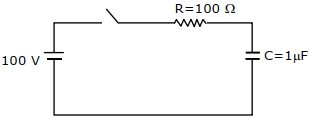
- 3A capacitor of capacitance $C=1\, \mu \,{F}$ is suddenly connected to a battery of $100\, volt$ through a resistance ${R}=100\, \Omega$. The time taken for the capacitor to be charged to get $50 \,{V}$ is $....\,\times \,10^{-4}\,s.$View Solution
[Take $\ln 2=0.69]$
- 4View SolutionTwo capacitors of equal capacity are first connected in parallel and then in series. The ratio of the total capacities in the two cases will be
- 5A small conducting sphere of radius $r$ is lying concentrically inside a bigger hollow conducting sphere of radius $R.$ The bigger and smaller spheres are charged with $Q$ and $q (Q > q)$ and are insulated from each other. The potential difference between the spheres will beView Solution
- 6This questions has statement$-1$ and statement$-2$. Of the four choices given after the statements, choose the one that best describe the two statements.View Solution
An insulating solid sphere of radius $R$ has a uniformly
positive charge density $\rho$. As a result of this uniform charge distribution there is a finite value of electric potential at the centre of the sphere, at the surface of the sphere and also at a point out side the sphere. The electric potential at infinite is zero.Statement$ -1$ : When a charge $q$ is take from the centre of the surface of the sphere its potential energy changes by $\frac{{q\rho }}{{3{\varepsilon _0}}}$
Statement$ -2$ : The electric field at a distance $r(r < R)$ from centre of the sphere is $\frac{{\rho r}}{{3{\varepsilon _0}}}$
- 7The maximum electric field that can be held in air without producing ionisation of air is $10^7\,V/m$. The maximum potential therefore, to which a conducting sphere of radius $0.10\,m$ can be charged in air isView Solution
- 8A parallel plate capacitor is made of two square parallel plates of area $A$ , and separated by a distance $d < < \sqrt A $ . The capacitor is connected to a battery with potential $V$ and allowed to fully charge. The battery is then disconnected. A square metal conducting slab also with area $A$ but thickness $\frac {d}{2}$ is then fully inserted between the plates, so that it is always parallel to the plates. How much work has been done on the metal slab by external agent while it is being inserted?View Solution
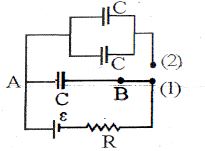
- 9If capacitor connected across $AB$ is charged to $Q$ and then switch is shifted to $2$ . The heat released after thatView Solution
- 10A parallel plate capacitor has plate of length $'l',$ width $'w'$ and separation of plates is $'d'.$ It is connected to a battery of emf $V$. A dielectric slab of the same thickness '$d$' and of dielectric constant $k =4$ is being inserted between the plates of the capacitor. At what length of the slab inside plates, will be energy stored in the capacitor be two times the initial energy stored$?$View Solution