Four wires $AB,\,\,BC,\,\,CD,\,\,DA$ of resistance $4\, \Omega$ each and a fifth wire $BD$ of resistance $8\, \Omega$ are joined to form a rectangle $ABCD$ of which $BD$ is a diagonal. The effective resistance between the points $A$ and $B$ is
Medium


Download our appand get started for free
Experience the future of education. Simply download our apps or reach out to us for more information. Let's shape the future of learning together!No signup needed.*
Similar Questions
- 1A resistance of $2\,\Omega $ is connected across one gap of a meter-bridge and unknown resistance, greater than $2\,\Omega $ , is connected a cross the other gap. When these resistances are interchanged, the balance point shifts by $20\ cm$ , neglecting any end correction, the unknown resistance is ................ $\Omega$View Solution
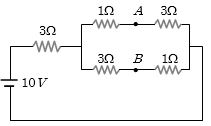
- 2A battery of $e.m.f.$ $10\, V$ is connected to resistance as shown in figure. The potential difference ${V_A} - {V_B}$ between the points $A$ and $B$ is .................... $V$View Solution
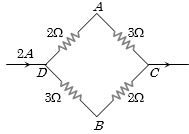
- 3A current of $2\,A$ flows in a system of conductors as shown. The potential difference $({V_A} - {V_B})$ will be ............ $V$View Solution
- 4Two electric bulbs marked $25\ W - 220\ V$ and $100\ W - 220\ V$ are connected in series to a $440\ V$ supply. Which of the bulbs will fuse?View Solution
- 5In order to increase the resistance of a given wire of uniform cross section to four times its value, a fraction of its length is stretched uniformly till the full length of the wire becomes $\frac{3}{2}$ times the original length what is the value of this fraction?View Solution
- 6Two heaters $A$ and $B$ have power rating of $1 \mathrm{~kW}$ and $2 \mathrm{~kW}$, respectively. Those two are first connected in series and then in parallel to a fixed power source. The ratio of power outputs for these two cases is:View Solution
- 7The supply voltage to room is $120\ V$. The resistance of the lead wires is $6\,\Omega$ . A $60\ W$ bulb is already switched on. What is the decrease of voltage across the bulb, when a $240\ W$ heater is switched on in parallel to the bulb? ............. $V$View Solution
- 8View SolutionAccording to Joule's law, if the potential difference across a conductor having a material of specific resistance remains constant, then the heat produced in the conductor is directly proportional to
- 9A wire when connected to $220\,V$ mains supply has power dissipation ${P_1}$. Now the wire is cut into two equal pieces which are connected in parallel to the same supply. Power dissipation in this case is ${P_2}$. Then ${P_2}:{P_1}$ isView Solution
- 10Two resistances ${R_1}$ and ${R_2}$ when connected in series and parallel with $120\, V$ line, power consumed will be $25\, W$ and $100\, W$ respectively. Then the ratio of power consumed by ${R_1}$ to that consumed by ${R_2}$ will beView Solution