A wire when connected to $220\,V$ mains supply has power dissipation ${P_1}$. Now the wire is cut into two equal pieces which are connected in parallel to the same supply. Power dissipation in this case is ${P_2}$. Then ${P_2}:{P_1}$ is
AIEEE 2002, Medium


Download our appand get started for free
Experience the future of education. Simply download our apps or reach out to us for more information. Let's shape the future of learning together!No signup needed.*
Similar Questions
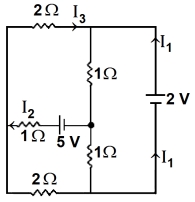
- 1In the following circuit, the magnitude of current $I _{ l }$, is $............A$.View Solution
- 2A wire $100\,cm$ long and $2.0\,mm$ diameter has a resistance of $0.7\, ohm$, the electrical resistivity of the material is ...........$ \times {10^{ - 6}}\,ohm \times m$View Solution
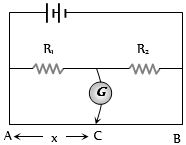
- 3In the shown arrangement of the experiment of the meter bridge if $AC$ corresponding to null deflection of galvanometer is $x$, what would be its value if the radius of the wire $AB$ is doubledView Solution
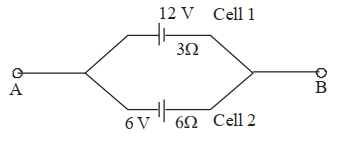
- 4Two cells are connected between points $A$ and $B$ as shown. Cell $1$ has emf of $12\,V$ and internal resistance of $3\,\Omega$. Cell $2$ has emf of $6\,V$ and internal resistance of $6\,\Omega$. An external resistor $R$ of $4\,\Omega$ is connected across $A$ and $B$. The current flowing through $R$ will be $.............A$.View Solution
- 5An insulating pipe of cross-section area $'A'$ contains an electrolyte which has two types of ions $\rightarrow$ their charges being $-e$ and $+2e$. $A$ potential difference applied between the ends of the pipe result in the drifting of the two types of ions, having drift speed $= v$ ($-ve$ ion) and $v/4$ ($+ve$ ion). Both ions have the same number per unit volume $= n$. The current flowing through the pipe isView Solution
- 6Two cells, having the same $e.m.f.$ are connected in series through an external resistance $R.$ Cells have internal resistances $r_1$ and $r_2\,\, (r_1 > r_2)$ respectively. When the circuit is closed, the potential difference across the first cell is zero. The value of $R$ isView Solution
- 7View SolutionOn increasing the temperature of a conductor, its resistance increases because
- 8View SolutionWhich is a wrong statement
- 9An electron revolves $6 × 10^{15}$ times/sec in circular loop. The current in the loop isView Solution
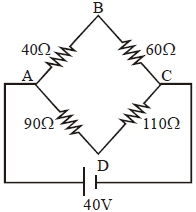
- 10Four resistances $40 \ \Omega, 60\ \Omega, 90\ \Omega$ and $110\ \Omega$ make the arms of a quadrilateral $A,B,C,D$. Across $AC$ is a battery of emf $40\, V$ and internal resistance negligible. The potential difference across $BD$ is $V$ is......View Solution