Question
$\frac{2\text{x}-1}{3}-\frac{6\text{x}-2}{5}=\frac{1}{3}$

Answer

$\frac{2\text{x}-1}{3}-\frac{6\text{x}-2}{5}=\frac{1}{3}$
$=\frac{5(2\text{x}-1)-3(6\text{x}-2)}{15}=\frac{1}{3}$
$=\frac{10\text{x}-5-18\text{x}+6}{15}=\frac{1}{3}$ (L.C.M. of 3, 5 = 15)
$=\frac{-8\text{x}+1}{15}=\frac{1}{3}$
$\Rightarrow(-8\text{x}+1)\times3=1\times15$ (By cross multiplication)
$\Rightarrow$ Dividing by 3
$\frac{(-8\text{x}+1)\times3}{3}=\frac{1\times15}{3}$
$\Rightarrow-8\text{x}+1=5$
Subtracting 1 from both side,
$-8\text{x}+1-1=5-1$
$\Rightarrow-8\text{x}=4$
Dividing by -8,
$\frac{-8\text{x}}{-8}=\frac{4}{-8}$
$\Rightarrow\text{x}=\frac{1}{-2}$
$\therefore\text{x}=\frac{-1}{2}$
Verification:
$\text{L.H.S.}=\frac{2\text{x}-1}{3}-\frac{6\text{x}-2}{5}$
$=\frac{2\Big(\frac{-1}{2}\Big)-1}{3}-\frac{6\Big(\frac{-1}{2}\Big)-2}{5}$
$=\frac{-1-1}{3}-\frac{-3-2}{5}$
$=\frac{-2}{3}-\frac{-5}{5}=\frac{-2}{3}+1$
$=\frac{1}{3}=\text{R.H.S.}$

Need a full question paper?

Generate a complete, print-ready paper with questions like this in minutes — across 16+ boards, with answer keys.
Start Generating Free

Similar questions

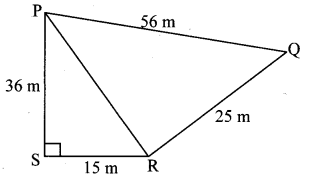
Look at the measures shown in the given figure and find the area of ☐PQRS.
Image
In the following table, data of the transport means used by students in 8th standard for commutation between home and school is given. Draw a subdivided bar diagram to show the data.
(Scale: On Y axis: 1 cm = 500 students)
Means of commutation\TownPaithanYeolaShahapur
Cycle325015001250
Bus and auto750500500
On foot10001000500
A lady went shopping and spent half of what she had on buying hankies and gave a rupee to a beggar waiting outside the shop. She spent half of what was left on a lunch and followed that up with a two rupee tip. She spent half of the remaining amount on a book and three rupees on bus fare. When she reached home, she found that she had exactly one rupee left. How much money did she start with?
Draw a line l. Take a point T outside the line. Through point T draw a line parallel to line l.
Construct a quadrilateral ABCD in which AB = 4cm, AC = 5cm, AD = 5.5cm and $\angle\text{ABC}=\angle\text{ACD}=90^\circ.$
It x and y vary inversely, fill in the following blanks:
x
12
16
...
8
...
y
...
6
4
...
0.25
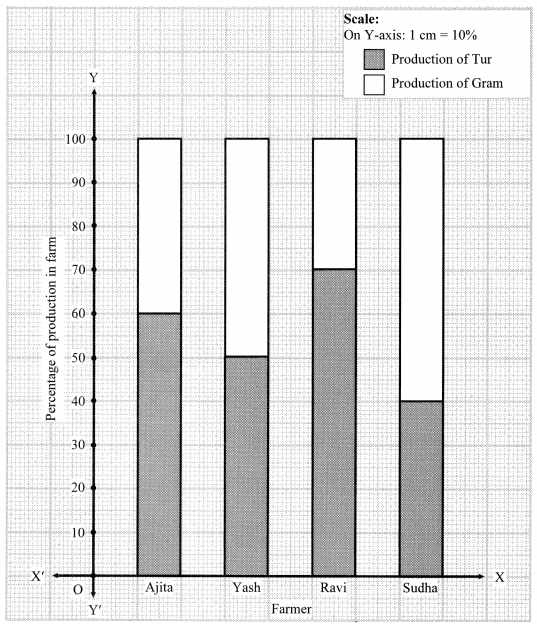
Observe the following graph and answer the questions.
Image
  1. State the type of the bar graph.
  2. How much percent is the Tur production to total production in Ajita’s farm?
  3. Compare the production of Gram in the farms of Yash and Ravi and state whose percentage of production is more and by how much?
  4. Whose percentage production of Tur is the least?
  5. State production percentages of Tur and Gram in Sudha’s farm.
Draw an acute angled ∆PQR. Draw all of its altitudes. Name the point of concurrence as ‘O’.
Construct a frequency table for the following weights (in gm) of 35 mangoes using the equal class intervals, one of them is 40-50 (45 not included):
30, 40, 45, 32, 43, 50, 55, 62, 70, 70, 61, 62, 53, 52, 50, 42, 35, 37, 53, 55, 65, 70, 73, 74, 45, 46, 58, 59, 60, 62, 74, 34, 35, 70, 68.
  1. What is the class mark of the class interval 40-45?
  2. What is the range of the above weights?
  3. How many classes are there?
Construct a quadrilateral ABCD, where AB = 4.2cm, BC = 3.6cm, CD = 4.8cm, $\angle\text{B}=30^\circ$ and $\angle\text{C}=150^\circ.$