Frequency of a sonometer wire is $n.$ Now its tension is increased $4$ times and its length is doubled then new frequency will be
Easy
Download our app for free and get started
(d) $n \propto \frac{1}{l}\sqrt T $
==> $\frac{{n'}}{n} = \sqrt {\frac{{T'}}{T}} \times \frac{l}{{l'}} = \sqrt 4 \times \frac{1}{2} = 1$
==> $n' = n$

Download our appand get started for free
Experience the future of education. Simply download our apps or reach out to us for more information. Let's shape the future of learning together!No signup needed.*
Similar Questions
- 1A $20 \mathrm{~cm}$ long string, having a mass of $1.0 \mathrm{~g}$, is fixed at both the ends. The tension in the string is $0.5 \mathrm{~N}$. The string is set into vibrations using an external vibrator of frequency $100 \mathrm{~Hz}$. Find the separation (in $cm$) between the successive nodes on the string.View Solution
- 2A man is watching two trains, one leaving and the other coming in with equal speeds of $4\, m/sec$. If they sound their whistles, each of frequency $240 Hz$, the number of beats heard by the man (velocity of sound in air $= 320 m/sec$) will be equal toView Solution
- 3An open tube is in resonance with string (frequency of vibration of tube is $n_0$). If tube is dipped in water so that $75\%$ of length of tube is inside water, then the ratio of the frequency of tube to string now will beView Solution
- 4View SolutionAt a certain instant a stationary transverse wave is found to have maximum kinetic energy. The appearance of string at that instant is
- 5A string of length $1\,\,m$ and linear mass density $0.01\,\,kgm^{-1}$ is stretched to a tension of $100\,\,N.$ When both ends of the string are fixed, the three lowest frequencies for standing wave are $f_1, f_2$ and $f_3$. When only one end of the string is fixed, the three lowest frequencies for standing wave are $n_1, n_2$ and $n_3$. ThenView Solution
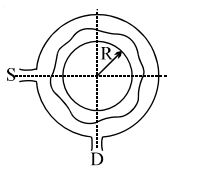
- 6A narrow tube is bent in the form of a circle of radius $R,$ as shown in the figure. Two small holes $S$ and $D$ are made in the tube at the positions right angle to each other. A source placed at $S$ generated a wave of intensity $I_0$ which is equally divided into two parts : One part travels along the longer path, while the other travels along the shorter path. Both the part waves meet at the point $D$ where a detector is placed The maximum value of $\lambda$ to produce a maxima at $D$ is given byView Solution
- 7Two waves having equationsView Solution
${x_1} = a\sin (\omega \,t + {\phi _1})$, ${x_2} = a\sin \,(\omega \,t + {\phi _2})$
If in the resultant wave the frequency and amplitude remain equal to those of superimposing waves. Then phase difference between them is
- 8A wire of length $30\,cm$, stretched between rigid supports, has it's $n^{\text {th}}$ and $(n+1)^{\text {th}}$ harmonics at $400\,Hz$ and $450\; Hz$, respectively. If tension in the string is $2700\,N$, it's linear mass density is.........$kg/m$.View Solution
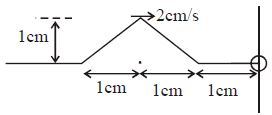
- 9A trianguler pulse moving at $2\ cm/s$ on a rope approches an end at which it is free to slide on vertical pole. What is the particle speed at the free end at $\frac{3}{4}\ sec$ from the instant shown ...... $cm/s$View Solution
- 10Two waves represented by,View Solution
${y_1} = 10\,\sin \,200\pi t$,
${y_2} = 20\,\sin \,\left( {2000\pi t + \frac{\pi }{2}} \right)$
are superimposed at any point at a particular instant. The amplitude of the resultant wave is