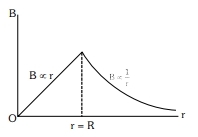
From Ampere's circuital law for a long straight wire of circular cross-section carrying a steady current, the variation of magnetic field in the inside and outside region of the wire is :
NEET 2022, Medium
Download our app for free and get started

Download our appand get started for free
Experience the future of education. Simply download our apps or reach out to us for more information. Let's shape the future of learning together!No signup needed.*
Similar Questions
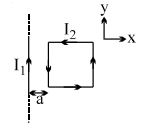
- 1A square loop of side $\lambda $ is placed in the neighbourhood of an infinitely long straight wire carrying a current $I_1.$ The loop carries a current $I_2$ as shown in figureView Solution
- 2View SolutionA metallic ring with a small cut is held horizontally and a magnet is allowed to fall vertically through the ring then the acceleration of the metallic ring is :
- 3A circular coil has moment of inertia $0.8 \,kg m ^{2}$ around any diameter and is carrying current to roduce a magnetic moment of $20\, Am ^{2}$. The coil is kept initially in a vertical position and it can rotate freely around a horizontal diameter. When a uniform magnetic field of $4\, T$ is applied along the vertical, it starts rotating around its horizontal diameter. The angular speed the coil acquires after rotating by $60^{\circ}$ will beView Solution
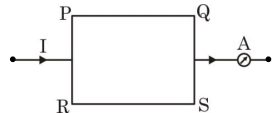
- 4A current carrying rectangular loop PQRS is made of uniform wire. The length $PR = QS =5\,cm$ and $PQ = RS =100\,cm$. If ammeter current reading changes from I to $2 I$, the ratio of magnetic forces per unit length on the wire $P Q$ due to wire RS in the two cases respectively $f_{ PQ }^{ I }: f_{ PQ }^{2 I }$ is :View Solution
- 5Electron moves at right angles to a magnetic field of $1.5 \times 10^{-2}\,tesla$ with speed of $6 \times 10^7\,m/s$. If the specific charge of the electron is $1.7 \times 10^{11}\,C/kg$. The radius of circular path will be......$cm$View Solution
- 6View SolutionA negatively charged particle projected towards east is deflected towards north by a magnetic field. The field may be
- 7A $50\, ohm$ galvanometer gets full scale deflection when a current of $0.01\, A$ passes through the coil. When it is converted to a $10\, A$ ammeter, the shunt resistance is ........... $\Omega $View Solution
- 8An orbital electron in the ground state of hydrogen has magnetic moment $\mu_1$. This orbital electron is excited to $3^{rd}$ excited state by some energy transfer to the hydrogen atom. The new magnetic moment of the electron is $\mu_2$ , thenView Solution
- 9A particle of charge $q$ and mass $m$ moves in a circular orbit of radius $r$ with angular speed $\omega $. The ratio of the magnitude of its magnetic moment to that of its angular momentum depends onView Solution
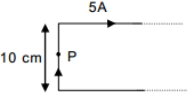
- 10Find force per unit length at $P$.View Solution