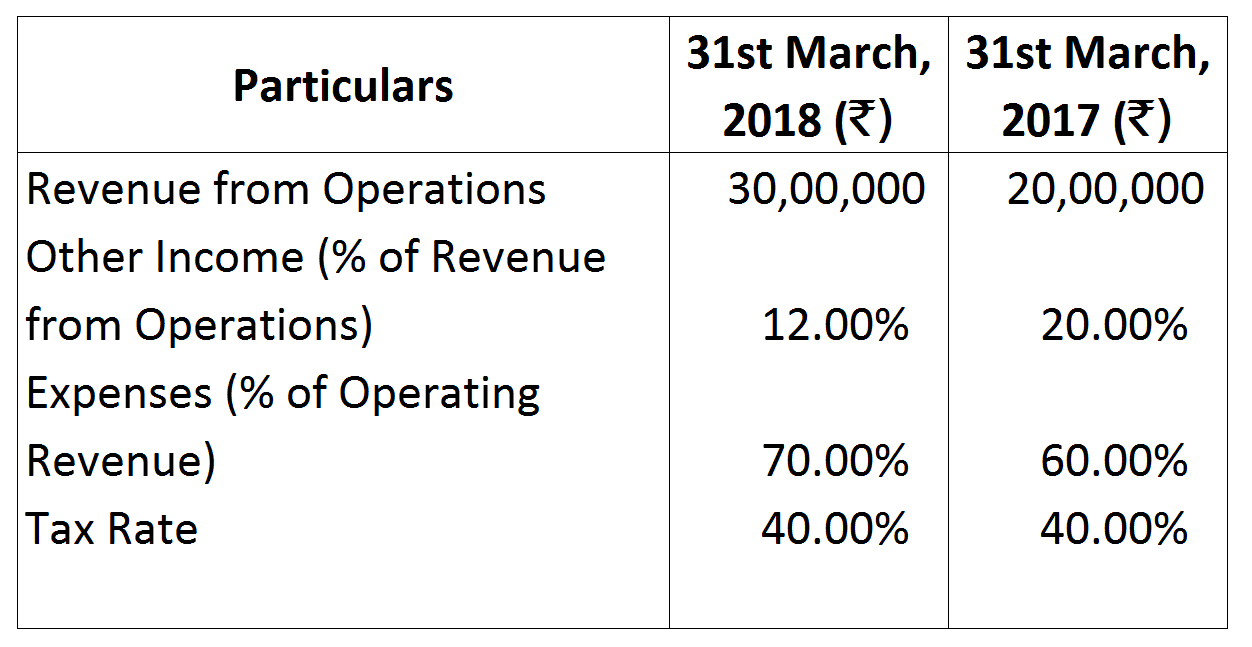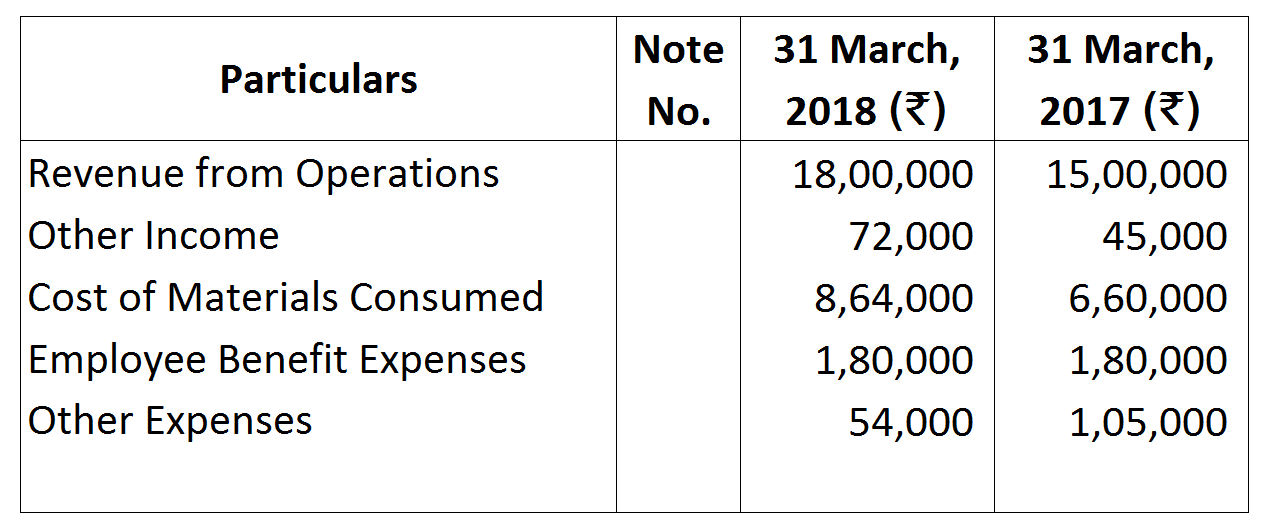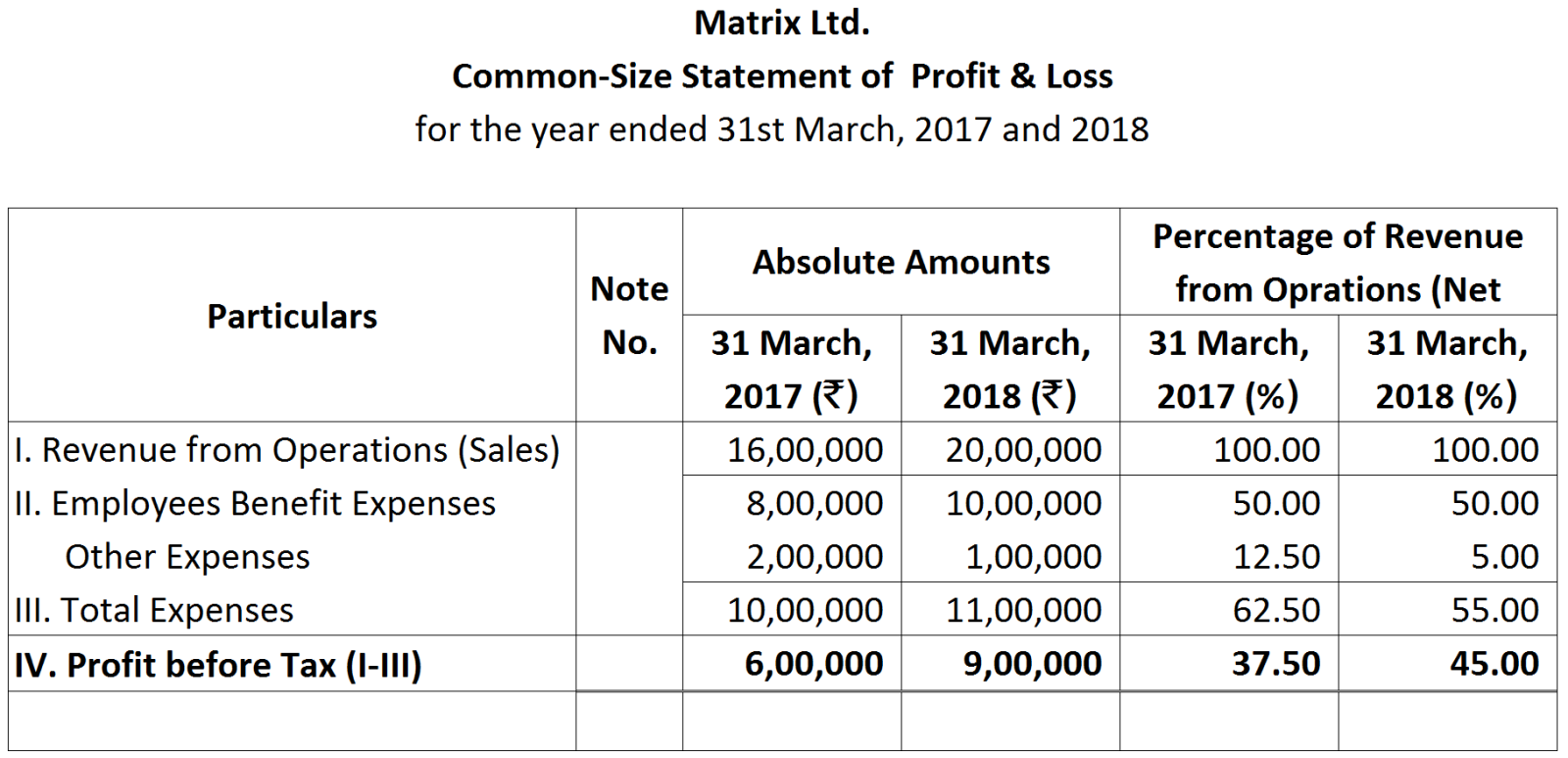
Question

From the above, Compute Operating Ratio.

Answer

Operating Ratio 31st March, 2017 31st March, 2018
$\frac{\text{Operating Cost}}{\text{Revenue from Operation}}\times100$ $=\frac{₹\ 10,00,000}{₹\ 16,00,000}\times100=62.50\%$ $=\frac{₹\ 11,00,000}{₹\ 20,00,000}\times100=55\%$

Need a full question paper?

Generate a complete, print-ready paper with questions like this in minutes — across 16+ boards, with answer keys.
Start Generating Free

Similar questions

X Ltd., made a profit of ₹ 1,00,000 after considering the following items:
  1. Depreciation on Fixed Assets ₹ 20,000.
  2. Writing off preliminary expenses ₹ 10,000.
  3. Loss on sale of furniture ₹ 1,000.
  4. Provision for taxation ₹ 1,60,000.
  5. Transfer to General Reserve ₹ 14,000.
  6. Profit on sale of machinery ₹ 6,000.
The following additional information is available to you:Calculate Cash flow from operating activities.
State giving reasons which of the following transactions would Improve Reduce or Not change the Quick Ratio if Quick Ratio is (i) 1.5 : 1, (ii) 1 : 1 or (iii) 0.8 : 1.
  1. Payment of Outstanding Liabilities
  2. Debentures of ₹ 2,00,000 converted into equity shares.
  3. Purchase of goods on Credit of 2 months.
  4. B/R endorsed to Creditors.
  5. Sale of goods Costing ₹ 50,000 for ₹ 45,000.
  6. B/R drawn on a Debtor.
  7. Paid rent ₹ 3,000 in advance.
  8. Trade receivables included a debtor Sh. Ashok who paid his entire amount due ₹ 9,700.
Give a format of Common Size Statement of Profit & Loss for two years.
A company has an opening credit balance in Surplus, i.e., Balance in Statement of profit and loss of ₹ 1,00,000. During the year, it earned a profit of ₹ 75,000. It decided to transfer ₹ 15,000 to Debentures Redemption Reserve (DRR) and also proposed to pay dividend of ₹ 25,000. How will be the appropriations shown in the financial statemenrs?Hint:
Note: Proposed Dividend ₹ 25,000 is shown as contigent liability in Notes to Accounts.
Raja Ltd. invited applications for issuing 50,000 Equity Shares of ₹ 10 each.
The amount was payable as follow:
On Application - ₹ 3 per share,
On Allotment - ₹ 5 per share
On First and Final call - Balance
Applications for 70,000 shares were received. Allotment was made to all applicants on pro rata basis. Excess money received on application was adjusted towards sums due on allotment. Ramesh, who had applied for 700 shares, did not pay the allotment money and on his failure to pay the allotment money his shares were forfeited. Afterwards, the first and the final call was made. Adhar, who had been allotted 500 shares, did not pay the first and final call. His shares were also forfeited. Out of the forfeited shares 900 shares were reissued at ₹ 8 per share as fully paid-up. The reissued shares included all the shares of Ramesh.
Pass necessary journal entries for the above transactions in the books of the company.
Kaveri Ltd. issued 50,000, 8% Debentures of ₹ 100 each at par on Oct. 1, 2012 redeemable on March, 31, 2016. It was decided to invest 15% of the face value of debentures to be redeemed towards Debenture Redemption Investment on 30th April, 2015. Debentures were redeemed on due date. Record necessary entries for issue and redemption of debentures.
Under what heads the following items on the Assets side of the Balance Sheet of a Company will be presented:
  1. Sundry Debtors.
  2. Loose Tools.
  3. Live Stock.
  4. Goods in Transit.
  5. Prepaid Expenses.
From the following information, prepare comparative statement of profit and loss:
R Ltd. issued 8,000, 13% Debentures of ₹ 100 each at a discount of 5% payable as follows:
On Application ₹ 25
On Allotment ₹ 25
On First and Final Call The balance amount
Public applied for 6,000 debentures. All the moneys were duly received. Expenses on issue of debenture amounted to ₹ 20,000. Directors decided to write off $\frac{1}{5}\text{th}$ of "Expenses on Issue A/c'' and "Discount on Issue of Debentures A/c'' from Statement of P & L each year.
Pass journal entries (for first year only).
Convert the following particulars into Common Size Statement of Profit & Loss and interpret the changes in 2018: